| Author |
 Replies: 14 / Views: 1,712 Replies: 14 / Views: 1,712 |
|
|
Valued Member
United States
79 Posts |
I just got this from my dealer. Their wholesaler is from Spain. It is labeled as "Celtic Saxon" however the Germanic Saxons did not go to Britain until 500AD, and settled more within the British Anglo area than the Scottish/Irish Celtic area. Any thoughts? 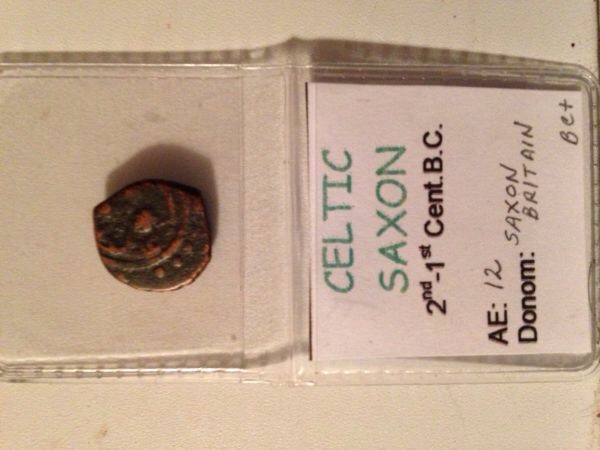 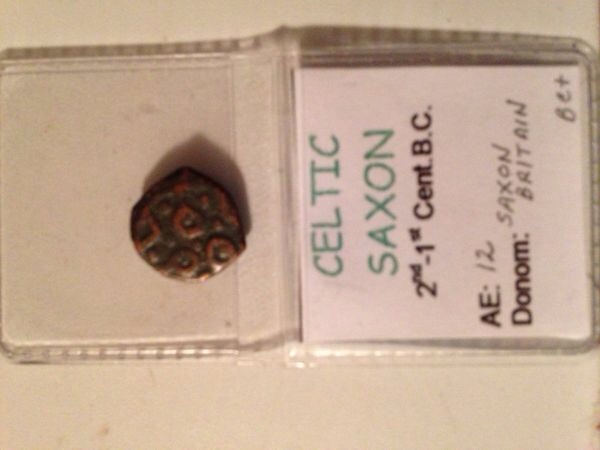 |
|
|
|
Bedrock of the Community
Australia
21792 Posts |
No wonder you have some questions about this piece. The graphics on the coin ARE reminiscent of a Celtic style.
At first or second century BC, it ain't Saxon. They invaded post Roman times. This coin looks to be anepigraphic.
The seller should have included much more information.
Ask the dealer or his supplier to give that information, otherwise they are no better than I, attempting an educated guess.
|
|
Valued Member
 United States
79 Posts |
Exactly, sei. I realized the same thing, that's why I chose to buy it. I once picked what was being sold as a common widows mite but it didn't look quite right to me, and it turned out to be a much more interesting Jewish Revolt Prudah. Mysteries are much funner.
I agree, I think it's Celtic, but the "Saxon" label is not right.
Hopefully I will be able to find some similar match online.
Thanks for your input.
|
|
Moderator
 Australia
16999 Posts |
They are two different periods of English coinage: "Celtic" is pre-Roman, "Saxon" is post-Roman. Frankly, the dealer combining these two terms does not give me any confidence that any of the information on the card is actually true (kind of like the coin from Norman Sicily c. AD 1100 I once bought from a dealer who'd labelled it "Eastern Constantinople AD 500", whatever that was supposed to mean).
There aren't any proper small "bronze" coins in either the Saxon or Celtic series, so if it is indeed British, then it's probably debased silver, rather than bronze.
Don't say "infinitely" when you mean "very"; otherwise, you'll have no word left when you want to talk about something really infinite. - C. S. Lewis
|
|
Valued Member
United States
79 Posts |
Sap,
I agree with you too as well. I am going to try and focus on the pattern/strike, which as mentioned above is very ambiguous to me. Almost strikes me as another ancient Hebrew coin, or possibly a crude old British or Celtic coin. I paid very little for it, so it was worth the mystery for me.
How does that pattern strike you?
|
|
Valued Member
United States
79 Posts |
Maybe Iberian, because of the bronze?
|
|
Pillar of the Community
United States
2480 Posts |
robfromshasta,
I love your attitude and philosophy regarding this coin. I can't help you out with the ID, but it looks like a fun project. Hope it turns out well :)
|
|
Moderator
Australia
16999 Posts |
I have to say, my first instinct looking at the coin, with no preconception of where it might be from, was "India". I suspect that's just because the cross-of-circles pattern reminds me of the little square Ujjain coppers. Don't say "infinitely" when you mean "very"; otherwise, you'll have no word left when you want to talk about something really infinite. - C. S. Lewis
|
|
Pillar of the Community
United Kingdom
946 Posts |
Quote:
I just got this from my dealer. Their wholesaler is from Spain. It is labeled as "Celtic Saxon" however the Germanic Saxons did not go to Britain until 500AD, and settled more within the British Anglo area than the Scottish/Irish Celtic area.
Any thoughts?~robfromshasta An amazing invention, or example of taking liberties. The seller ought to have made an effort to attribute the coin, but maybe such an odd attribution was thought to make it attractive or at least covering as many possibilities of it coming from Britain. The Jutes, Angles, Saxons, Frisians and others from Scandinavia and even Franks, were used as mercenaries during the later era of Roman Britain. The so-called "Saxon Shore" of East Anglia was more likely to have been garrisoned by such mercenaries than to have been garrisoned by Italians against the sea-faring Germans. For example, the "British Emperor" Allectus had a lot of Franks in his army, circa 296 A.D. So there were Angles and Saxons in Roman Britain before 500 A.D. Anyhow, none of this has any relationship to the coin in question.  Edited by Masis
09/28/2013 11:42 am
|
|
Pillar of the Community
United States
5010 Posts |
my first thought was "indian" also...but I don't know...I'm certainly interested.  |
|
Moderator
United States
23731 Posts |
Interesting little coin that I also think might be Indian. Anoob would be the one to know if it is or not.
|
|
Pillar of the Community
United States
2480 Posts |
The dot-within-circle motif is somewhat similar to some coins of the Satavahana Empire (India) but I don't think it's one of them. Wouldn't hurt to browse http://www.coinindia.com though. |
|
Pillar of the Community
United States
5155 Posts |
Well it very well might be something from India, but I don't see a stupa and the Satavahanas had ring link with lines, on almost all of their coins. It could also be from Celtic Germania and the region of Saxony, or Saxon... |
|
Valued Member
United States
79 Posts |
Well, I've spent a good portion of the day online trying to find a close match, but no luck yet. Obviously it cannot be "Celtic Saxon", but it could be Celtic OR Saxon, as well as a very good chance it could be from India and just had found its way into some hoard in Britain.
Most examples of the circles with dots seem to be BC however, so I'm doubting its post-Roman now, though I won't close my mind to that possibility.
|
|
Pillar of the Community
United States
5155 Posts |
but you still have the possibility of Celts from the Saxony region of Germania.
|
| |
Replies: 14 / Views: 1,712 |
|










 Posted 09/28/2013 03:13 am


