I previously posted a bit of history and background on the commemorative half-dollar that marked the 150th anniversary of the Battle of Bennington and the establishment of the Vermont Republic. I won't repeat it here, those interested can read the original here:
http://goccf.com/t/119262.Tonight, I thought I'd share another side of the story, by showcasing the commemorative medal issued by the Vermont Sesqui-Centennial Commission, the same folks who sponsored the half-dollar.
Charles Keck designed the Vermont-Bennington half-dollar; my previous post discusses how he came to be such. The Vermont Commission was pleased with the original models that Keck prepared for the coin, but they were not approved by the Commission on Fine Arts (CFA). Their primary objections were targeted at Keck's model for the coin's reverse.
Read More: Commems CollectionFor the obverse, Keck created a right-facing portrait of Ira Allen â€" often referred to as the "Founder of Vermont." The design, with minor modifications, was eventually approved by the CFA and was used on the half-dollar.
The original model for the coin's reverse depicted Fay's Green Mountain Inn; it was often referred to as Fay's Tavern. The name of the establishment was later changed to the Catamount Tavern. The name change came after a stuffed catamount was mounted on a 25-foot tall signpost at the front of the building. The fierce animal was meant to be a warning to those from the New York colony who were intent on incorporating Vermont under their governance â€" such attempts would be met with fierce opposition. The tavern was an important meeting place in early Vermont, especially for the Green Mountain Boys. Ethan Allen planned the defense of Vermont against the New Yorkers at the tavern, and John Stark made plans regarding the Battle of Bennington within its walls.
Unfortunately for Keck and the Vermont Commission, the CFA was not happy with the use of the tavern building for the reverse â€" it was generally opposed to architectural renderings on coins. The CFA suggested the use of a catamount as the primary reverse design element. This did not sit well with Vermont's Commission, but they relented and Mr. Keck got to work and created three new reverse designs, two of which featured a catamount. The issued coin reflects the accepted catamount design; the other featured a catamount perched on a rock.
The original "Fay's Tavern" design was not abandoned, however, as Keck would bring it back for the reverse of the Commission's commemorative medal. The wreath encircling the tavern features the names of key historical figures from Vermont's colonial past. The medal's obverse features a "Green Mountain Boy" holding a flintlock rifle in the foreground with the "Bennington Flag" in the background; the flag traces its roots to the Battle of Bennington.
As with the half-dollar, the commemorative medal was clearly a dual commemorative for Vermont's Sesquicentennial (obverse) and the Battle of Bennington (reverse).
The medal was struck in bronze by the Medallic Art Company of New York, and is 63mm in diameter.
I believe the medal to be a noteworthy "cousin" to the 1927 commemorative half-dollar. Hope you believe it to be as well!
Vermont/Battle of Bennington Sesquicentennial Medal - Obverse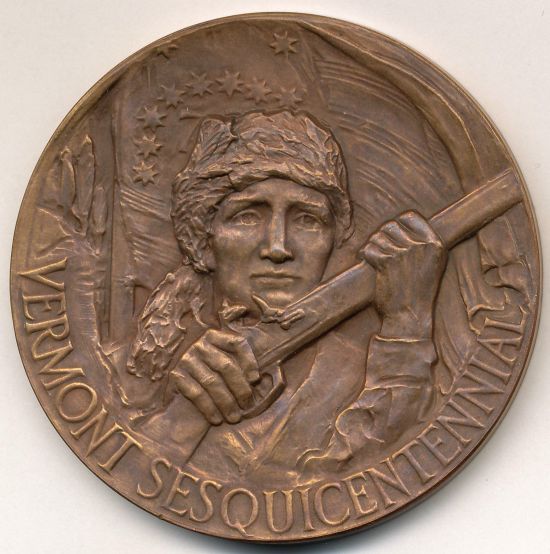 Vermont/Battle of Bennington Sesquicentennial Medal - Reverse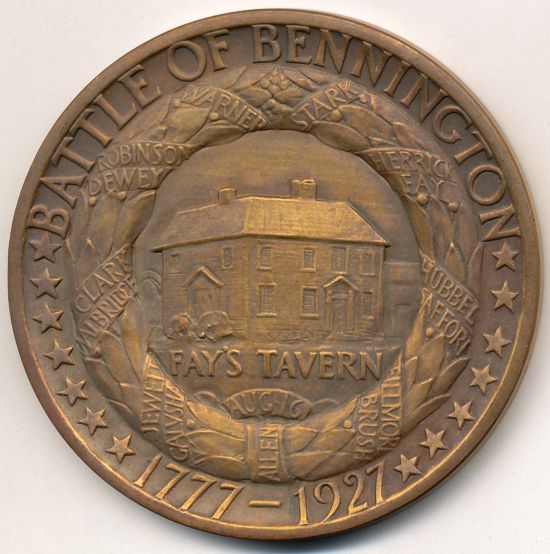







 Posted 01/28/2014 06:37 am





