| Author |
 Replies: 55 / Views: 16,895 Replies: 55 / Views: 16,895 |
|
|
|
Forum Dad
 United States
24232 Posts |
See if any of your local coin shops or "We Buy Gold and Silver" places have an XRF machine. They'll tell you in five seconds.
|
|
Pillar of the Community
United States
1903 Posts |
XRF won't tell you if it is solid silver. XRF only samples the surface and down a few microns. Thick silver plated brass will register as silver on an XRF. XRF is a neat way to detect surface composition or the alloy of a material you trust as being purely of the same material throughout, but to use it to determine the content of an unknown object's core is a task not intended for this device.
|
|
Forum Dad
United States
24232 Posts |
Quote:
XRF won't tell you if it is solid silver. XRF only samples the surface and down a few microns. Nope, they have them now that will even scan them right through slabs. Trust me, played with one for 30 minutes at the FUN show last year. |
|
Pillar of the Community
United States
1903 Posts |
plastic and dense metals are totally different things. Read below from a manufacturer of XRF devices. These don't do any justice to anything but surface analysis of precious metals... Quote:
Question: You mentioned XRF is surface technique? What is the depth of measurement? Can you analyse metal under the paint or anodized layer (aluminum alloy)?
For light plastics or light organic materials, penetration is on the order of mm or cm. For heavier plastics (like PVC), or plastics with metallic additives (like Ti, Zn), or aluminum alloys, penetration is on the order of a few mm. For heavier metal alloys (Ti, Fe, etc) penetration is on the order of 100s of um, and for the heaviest metals (gold, lead, etc) penetration is a few 10s of um.
Testing through a surface layer, whether it be corrosion, contamination, paint, or an anodized surface, depends on what is in the surface layer, how thick it is, and what elements are being tested in the substrate layer. It is always preferable to clean off a surface coating and test bare substrate. Surface coatings can partially or completely shield the substrate elements, and this is especially true for lighter elements like Mg and Al. If the surface coating is thin and the substrate elements are heavier (e.g. Pb, Sn, etc) then testing through the coating may be possible, though a user should validate that this is possible. Again, for best results it is always better to test a clean and uncoated homogeneous sample
|
|
Forum Dad
United States
24232 Posts |
This guy's gun does not do just the surface.... 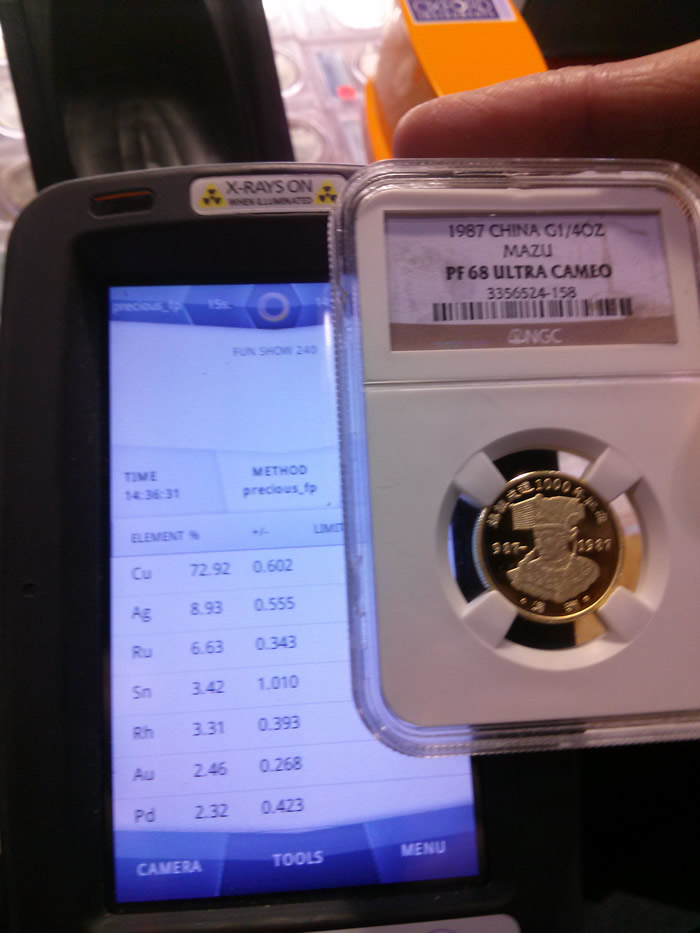 |
|
Moderator
United States
16697 Posts |
Bobby, this half might be a good candidate for FUN :-)
swcoin.ecrater.com
|
|
Pillar of the Community
United States
1903 Posts |
I get that it verifies that the Mazu in a fake slab is a fake coin...but what makes you think it is going past the surface alloy?
|
|
Moderator
United States
16697 Posts |
72.92% Cu  swcoin.ecrater.com
|
|
Valued Member
United States
355 Posts |
|
|
Bedrock of the Community
Australia
21792 Posts |
To examine the guts of a coin *NAA X-Ray or ultrasound is needed.
*Neutron Activation Analysis will give the range of trace elements inside the coin but a small drill sample is required.
Expensive and not suitable for coins.
X-Ray examination is sometimes used to examine unseen aircraft airframes. Don't know how useful it would be for a small object such as a coin.
Same applies for ultrasound or magnetic resonance examination.
Such instruments are used in industrial applications.
It is the above methods that are used for detecting tungsten cores in gold bars.
Edited by sel_69l
12/04/2014 5:27 pm
|
|
Pillar of the Community
United States
3755 Posts |
All that is neat and cool, but it really doesn't matter for this case. The coin in question is clearly plated. Dont need a machine for this one.
|
|
Pillar of the Community
United States
523 Posts |
Plated but the simplest test is to flip it and then a clad do the same. If they sound the same, test over....I think it is plated but you never know but getting graded is a waste...imho.
|
|
Pillar of the Community
United States
5903 Posts |
The best method to find out is what Bobby said. I would call a few buy it now shops and see if they have a XRF scanner that you can have them test it, other then whats been suggested that which you have tried. I think plated coins are fairly detectable with your naked eye, check out other silver Kennedy halves you have and compare, do the tissue test on both and see any difference. And if there is you know what you have. |
|
Pillar of the Community
United States
4707 Posts |
|
|
Valued Member
United States
61 Posts |
I also think it may be plated in chrome, it just doesn't look right on the obverse. I go through about 8k-12k halves per week and unfortunately there are many attempts to make non silver coins look silver, I think the main reason is to frustrate coin roll hunters.
|
| |
Replies: 55 / Views: 16,895 |








 First Page
 Previous Page


 Posted 12/04/2014 2:40 pm


