| Author |
 Replies: 380 / Views: 46,629 Replies: 380 / Views: 46,629 |
|
|
|
Valued Member
 United States
122 Posts |
Thanks for the positive feedback guys. I do like to think of the detecting community as the tip of the spear. That's a great analogy. I will most definitely be posting things in the detecting section of the forum in the future. As for the coins in my videos, I have a pretty extensive collection of coins, with pictures of each one. So when I dig a coin I show it being recovered and then I show close ups of it in the field. When I get home I often use stock images of the corresponding coins in my collection. In essence, the coin that comes out of the ground is often not the coin shown later on in the video. In the cases where I don't have a duplicate coin that looks all nice and shiny, I determine if the actual dug coin needs cleaning. Obviously KEY DATE COINS ARE NOT TO BE TAMPERED WITH but in order to protect the coins from further abrasions and corrosion, a simple rinsing is needed. Cleaning depends on the compound of the coin. Copper gets a nice looooooong soak in olive oil followed by a hot bath in distilled water. Silver typically gets a simple rinsing with distilled water in order to "knock off" any possibly abrasive material. i.e. sand/dirt etc. Nickels are pretty well shot in our ground here. They typically (but not always) come out VERY damaged. Soap and water is about all you can do for them. In the case of this particular coin (01 S Barber) I used warm distilled water to rinse the sand and dirt off. It was then very gently blotted dry (once on the front, once on the back) with a microfiber towel and immediately placed in a holder.
|
|
Valued Member
United States
122 Posts |
Very kind words SuperDave!
|
|
Pillar of the Community
United States
1391 Posts |
Nice to see another metal detectorist from Idaho. You are right about Idaho being harsh on the silver. I find it interesting that you found a 3 cent piece. I've only ever heard of one of them being found before in Idaho.
|
|
Valued Member
United States
122 Posts |
I've only ever found one US 3 cent piece and that came from Phili. However, I did recently find a 3 pence in idaho. Which I think was weird. Even weirder though was a couple years back I dug a 1798 LC out of Boise. The Idaho LC club is pretty stinkin in small. Mine is the oldest Idaho LC we know of by about 40 years. Crazy whats out there still... and the journey those items must have seen to end up where they are today... Just blows my mind. LOVE IT
Edited by DrTones
12/18/2014 1:51 pm
|
|
Pillar of the Community
United States
3486 Posts |
http://www.barbercoins.org/1901SBQ.htmlThis is the online authentication guide for the 1901-S Quarter on the BCCS site. Elbesaar, thanks for pointing out our existence. We DO have a few knowledgeable people in our group! Now, I suspect DrTones little 'problem' would generate a bit of interest among our members. And that scratch/gouge is not SO bad. These quarters are usually worn slick.
|
|
Moderator
 United States
16696 Posts |
My buddy and I detect regularly here in So. Cal but we have very few older areas that are not protected.
There is one park the Rangers gave us permission that dates back to an 1870's ranch.
So far, I found an old military button and my buddy has found a few Wheat Cents and an old six shooter shell casing but not much else..yet.
If you think about it, there are more rarities like yours still waiting to be found :-)
swcoin.ecrater.com
|
|
Moderator
United States
15929 Posts |
Late to the party with my input ... too much work alas.
Outstanding find and a treasured coin in any condition!
Looking forward to learning how this story plays out.
David
|
|
Pillar of the Community
United States
7842 Posts |
I just seen the same coin/finder in another forum who has received some negative things to say about this little "quarter" with side by side comparisons of a known authentic coin that do not look favorably for authenticity.
Edited by oih82w8
12/19/2014 12:01 am
|
|
Pillar of the Community
United States
5854 Posts |
That is one heck of a find if confirmed to be genuine. Definitely get it certified by either PCGS or NGC, preferably PCGS because of resale value.
Using the link provided by matthewvincent, the coin seems to match die pair a. That makes me hopeful that it is indeed genuine. I wonder if anyone else sees the same thing.
If genuine, I would say that it just falls slightly short of EF. Details look mid VF or so.
Edited by D0ubl3Eagle
12/19/2014 12:29 am
|
|
Valued Member
United States
122 Posts |
Die pair "A" for sure. I'm not sure what others are "seeing" but this coin is 100% genuine. Regardless of grade, when it comes back as "authentic" I will smile very largely. 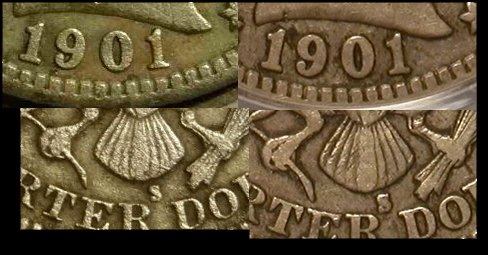 Edited by DrTones
12/19/2014 02:09 am
|
|
Moderator
United States
16696 Posts |
|
|
Moderator
United States
23522 Posts |
So, someone raise the arguments "against" here, and we'll discuss them rationally. I don't like seeing numismatic disinformation being spread, even in other forums, and if those arguments are incorrect we can provide a Google datapoint countering them.
|
|
Valued Member
United States
122 Posts |
I know there's a lot of fakes out there. The reason I'm so confident is because of where this coin was found. There was no reason to counterfeit this particular coin around the turn of the century. It wasn't a key date yet. Location, location location
|
|
Pillar of the Community
United States
7842 Posts |
I may be talking out of my hat here...there are significant differences in the letters displayed in the side by side image above. It is widely known that Chinese fakes are out there which is why I recommended TPG authentication. The two above just don't match up; lettering style (thickness) and the mint mark are very different. With a reported mintage of 72,664 pieces, I am not sure how many die pairs there are for this date/mint combo. Edited by oih82w8
12/19/2014 2:55 pm
|
|
Valued Member
United States
122 Posts |
Yeah I agree. It will will absolutely need authentication either way. I think the differences in the letters is due to the environmental issues. There's a certain degree of naturally occurring elextrolysis that happens to coins in mineralized ground
|
| |
Replies: 380 / Views: 46,629 |







 First Page
 Previous Page


 Posted 12/18/2014 1:17 pm





