| Author |
 Replies: 27 / Views: 3,698 Replies: 27 / Views: 3,698 |
|
|
|
Pillar of the Community
Spain
629 Posts |
Thank you, I have send the image to some friends (and the url of the post)...
Well, I must say that spanish is the ideal language to curse and to swear (we have thousands of insults)...
jejeje.
It was an amazing example of fake.
|
|
Valued Member
United States
61 Posts |
I doubt the coin is fake. Someone taking the trouble to make a make look that convincing isn't going to make the mistake of using ceramic instead of copper. Besides, the weight would be an instant tipoff. What I think happened is that the "crystallized" which is a misnomer but in wide use. If this is the case the tin and lead in the alloy migrated and aligned. Since these are structurally weak metals and pressure on the coin would create stress and the coin would shatter along the fault lines where the tin/lead had concentrated.
Ras
|
|
Pillar of the Community
Spain
629 Posts |
"Ockam´s razor" states that among competing hypotheses that predict equally well, the one with the fewest assumptions should be selected.
Hypothesis 1: The "coin" is fake.
Hypothesis 2: that the "crystallized" which is a misnomer but in wide use. If this is the case the tin and lead in the alloy migrated and aligned. Since these are structurally weak metals and pressure on the coin would create stress and the coin would shatter along the fault lines where the tin/lead had concentrated.
I prefer Hypothesis 1, it´s the simplest explanation.
Good night! (Here, in Spain is so late, that really it´s too soon)
02:49 A.M.
;D
|
|
Valued Member
United States
72 Posts |
Just wondering and I'm probably totally off with thinking this since I don't know too much about ancient coins yet, but could it be a coin that was an ancient counterfeit and the counterfeiter wanted to save money so used a cheaper metal?
|
|
Bedrock of the Community
Australia
21792 Posts |
I do NOT think this is a fake 40 nummi.
It MUST be remembered that all ancient coins have a potential for being very brittle.
It is impossible for the word 'must' to be over emphasized, with perhaps the exception of gold coins.
Ancient bronze and copper coins have the potential fully corrode internally, leaving no clean metal. Have a look inside the fracture lines with a 20x loupe, and examine the extent of the internal corrosion that this coin has most probably sustained.
Ancient silver coins can suffer the twin problems of internal silver crystallization and the formation of horn silver, both of which can very seriously weaken the internal structure of the coin.
Google 'silver crystallisation' and 'horn silver' for more information.
Ancient coins can have the potential to snap apart in your fingers, so handle them carefully.
Even ancient glassware can be extremely fragile. Glass is a supercooled liquid, but glass has the potential to crystallize over the centuries, and ancient glass objects can fall apart in your hands.
Edited by sel_69l
04/02/2015 10:40 pm
|
|
Moderator
 Australia
17005 Posts |
Sorry, guys, but it is a fake, the very commonly encountered Justinian Year XII follis Nicomedia mint tourist fake, with the little die notch outside of the PP on the obverse and the gap in the circle of dots at 2 o'clock on the reverse. We've seen several of them on the forum, most recently here. Don't say "infinitely" when you mean "very"; otherwise, you'll have no word left when you want to talk about something really infinite. - C. S. Lewis
|
|
Pillar of the Community
Spain
629 Posts |
I have been deceived in several occasions.
Is ALWAYS the same process:
1.- I see a coin that I have been looking for or is a very interesting type, or is very cheap.
2.- I perceive that there is "something wrong" concerning that coin.
3.- My own greed starts to work...
4.- I began to give myself lots of reasons to explain why that coin that "don´t look genuine" MUST BE genuine.
5.- I get self convinced
6.- I pay the "coin"
7.- I arrive home...
8.- I look CAREFULLY the coin...
9.- I say myself "Alberto, you are a XXXXX" (I´m sorry but "fool" is not hard enought to translate into english the spanish word that I use in that moments...)
10.- I put the "coin" in my "Fake´s tray"
About my Fake´s tray...
I use it to correct my own attitude, I must explain:
Several times, I Feel that I´m something like the "Master of the Numismatic Universe", then, when I start opening my coin´s trays feeling myself more and more "Master of the numismatic acknoledge" I suddenly see all that fakes...
I recover the awesome attitude in a moment...
Edited by Athalbert
04/03/2015 02:01 am
|
|
Valued Member
United States
249 Posts |
Please post a closeup pic of the EDGE of the coin... the undamaged edge.
I'm 38 years in the jewelry mfg. business and can say that it looks like many fantasy/fakes I've come across in the past made from "white metal" (a tin alloy consisting of 92 pts Sn, and 8 pts. Sb), then plated and antiqued w/ a number of different tecniques.
Just thinking out loud, how do you suppose the exterior of the OP's coin could/does have a fine patina as well as wear commensurate with the coins age, while that "layer" (skin) is but a few microns thick as noted from the pix from the side where broken? Add to that, "how" could, under normal circumstances, such an ancient coin have survived this long only to broken by the post office? Yes they're a rough lot but I get some pretty fragile items through the U.S. mail still intact! lol!
regards, m
Edited by rynegold
04/03/2015 06:59 am
|
|
Bedrock of the Community
Australia
21792 Posts |
@ FR: What is the total weight of all of the pieces?
That may give some clue of what it is (was) composed of.
|
|
Valued Member
United States
249 Posts |
Here's a fairly simple test: if indeed it's "white metal", you can hold it in a pair of tweezers and melt it with a large kitchen match! 600o will do the trick. In our business these items are actually cast in vulcanized rubber molds!https://www.google.com/search?q=%22...%3B220%3B165Edited by rynegold
04/03/2015 07:18 am
|
|
Pillar of the Community
 United States
3495 Posts |
It is without question fake !
Even a dope like me can tell the fractures are fresh and clean and have nothing to do with the passage of time.
It is shattered like a fine piece of China !
(In this case a piece of Turkey !)
Total weight is 16.28 grams which is light but the flan is quite thin so I would not have discounted it on that alone.
I could post all the pics I have of the breakage but they all look pretty much the same. Pure grey material with no appearance of discoloration or previous faults in the material.
No great loss ...... but some disappointment !
|
|
Pillar of the Community
United States
549 Posts |
The year 12 (first year of the facing issue) of Justinian fake with NIK mintmark is well-known and common. I have seen several on ebay in the last two years, each with a radically different "patina" making them look unlike one another, except for the exact same flan shape and underlying details. Here is the one that taught me this lesson: 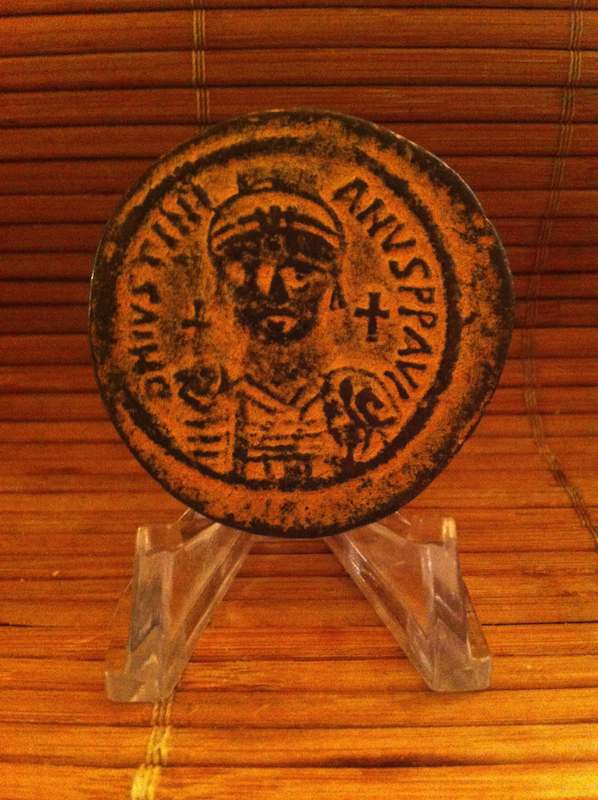 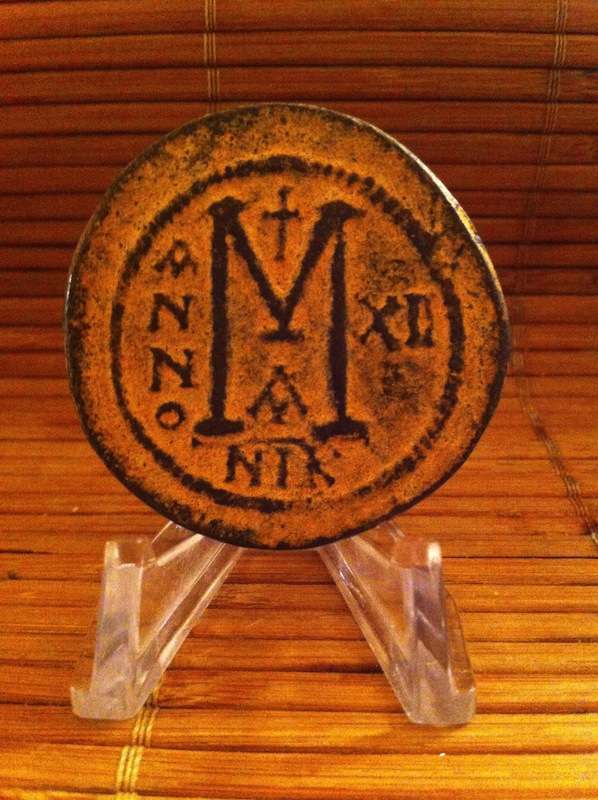 Compare it in shape to the original posting. It the same fake with a different surface. Take a look at the flaws, for example, at 3:00 on the obverse just outside the beading. This is not a coincidence. It's a cast fake from the same mold. If you thought the original broken coin was genuine, take this occasion to learn from the "soft" and "mushy" details which are typical of cast fakes. The applied patina helps obscure this indication on the orange coin I show, but is clear on the original coin of this thread. |
| |
Replies: 27 / Views: 3,698 |








 First Page


 Posted 04/02/2015 8:22 pm


