| Author |
 Replies: 9 / Views: 1,193 Replies: 9 / Views: 1,193 |
|
|
Pillar of the Community
 Spain
2752 Posts |
Hi there  Getting really hot out here now ! Differences in the dies!? Here are 2 Licinius I AE3s that I have. RIC VII #48 Heraclea minted between AD 318-320. Top one is 18mm dia and 2.70gr bottom one is 19mm dia and 3.82gr I bought them to show the differences in the dies from the same workshop, in this case the 2nd. There are differences on both sides of the coins, but I bought them primarily to show the differences in the decoration of the imperial mantles the dots,lines etc.And I've just seen another with a different style which I'll probably buy. Question 1....And you'll probably have to excuse my ignorance here  ...But how many dies were running at any one time just one or multiple? Question 2....Have both the coins got Lambdas on the reverse R/F Or could they be Deltas or even Alphas... ?  RIC states only lambda..So is the difference just artistic licence of the die cutter ? And more importantly, what is the significance of this mark in relation to the mint as I can't seem to find any information about it?  Any information you have will be greatly appreciated.  Thanks in advance ....Saludos Paul 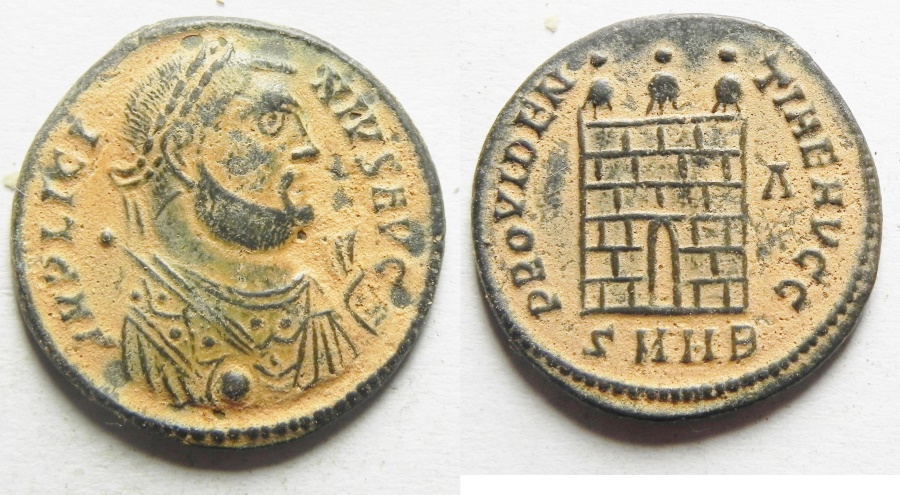 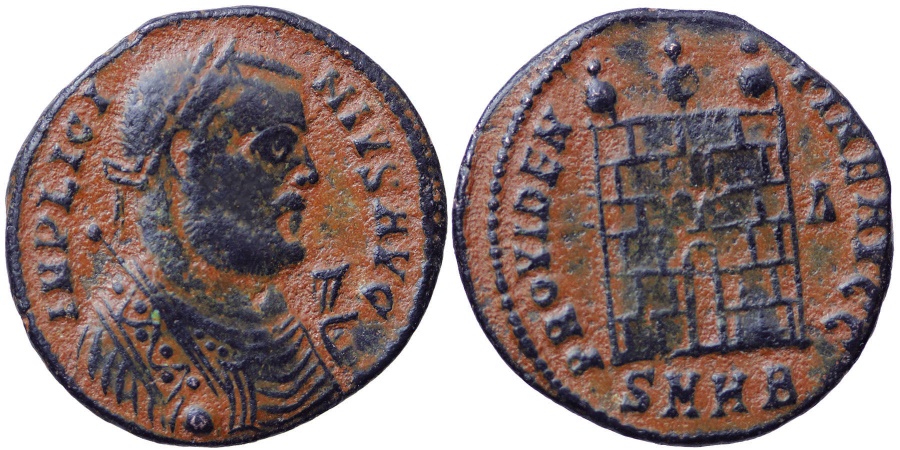 |
|
|
|
Pillar of the Community
Spain
629 Posts |
In ancient times, coin dies were all hand made...
One pair of dies could made about 50.000 coin (others authors think that "only" 30.000), this implies that there are always a lot of different dies in each emission.
|
|
Moderator
 United States
23731 Posts |
Depending on the amount of output needed I'm sure there were more the one person at a workshop striking coins at a time. With each die being hand made they are not going to be exactly the same. This give us the various varieties listed in RIC. The coin coins were produced at the same workshop, but there is noticeable difference especially on the reverse, indicating to me at least the the dies were made by two different persons. I believe both are marked Lambda but the one on the second coin is struck from a worn die and squeezed together.
|
|
Pillar of the Community
Belgium
1194 Posts |
A mint had often more than one officina , as here.the officina is indicated in the exergue or nearto the image . here it is SMHB , sacra mometa herecleae secunda ,the second.the number is indicated by a Roman letter , a . B. C or a Greek letter , alfa beta gamma...therecan be many officinae , depending of the mint, Antiochia had at a moment about 15 officinae.as in this period they struck millions of coins of each type,it is normal there are differences.Everything was handmade.the lambda in the field here is a controll mark andindicates maybe tbe celator.when strucking a coin , the obverse die was fixed.the reverse not and was using more , so mmost of time,there is more than one reverse die for an obverse.albert
|
|
Pillar of the Community
United States
3495 Posts |
I tend to believe that imperial mints were really huge operations with in all probability literally thousands of workers of various skills engaged in many different tasks.
The primary purpose of minting coinage (with the image of the 'boss') was to pay the military and the various bureaucracies of government. It was considered vital that all the employees knew exactly who was buttering their bread !
That being said I believe the mints were huge operations. The Roman Legions alone accounted for around 250,000 soldiers and like every army required another army of people to support the 'troops'.
The mints would have had vast smelting operations where metal would be alloyed not only for the coins but also production of die sets etc.
The dies themselves probably had people responsible for the different aspects of their production. Workers of various skill no doubt handled different production tasks from rough engraving to the addition of lettering and final detail and polishing the finished product.
As the more talented artisans were doubtless employees and not slaves they may have even gotten such nice benefits as days off and even vacation time.
I am inclined to believe that the finer examples of the various officina were the product of more than just a select few people.
Some of the more miserable examples of imperial coinage were doubtless made with little care to quality control and possibly by a few workers. But the 'high end' stuff with fine details and well executed legends I firmly believe to be the work of groups of skilled people.
|
|
Pillar of the Community
United States
6130 Posts |
I read an article some time ago that argued that the Romans actually used a hubbing process similar to the one used at modern mints. There are a lot of different busts, but not as many as one might think for a mint that had an output capacity pretty close to any 19th century mint. While the busts are different on your two coins, notice that the legends are identical on the reverse--especially noticeable in the very small o in PROVIDEN-.
I believe that the authors hypothesis in the article I read was that the portrait was generally made by the "grandmaster", a Greek-trained engraver who would either make them from an official marble bust sent from Rome, or would actually live in Rome and send the portrait hubs to the provincial mints. I believe there is a source that mentioned that the Mint kept the Emperor's portrait under lock and key when it was not being used to sink a new die. The obverse and reverse legends, as well as the reverse design would have been made by slightly less skilled mint employees.
|
|
Pillar of the Community
 Spain
2752 Posts |
Thanks everyone for your replies !! ......Very very interesting !!...Loads of info!!  To sum up ....Approx 30,000 to 50,000 coins per set of dies. I agree with you echizento that its a lambda in R-F. Albert have you got any more information about the control mark ? As all the coins I've seen from this emission have the lambda so does this mean that maybe all the dies were cut by the same celator or....This is just an idea....maybe its the relation of the lambda to the castle gate ? I think I read something about this on Beast coins but it wasn't very clear. Thanks FVRIVS I agree with you...Is there anywhere I can get information on how many coins were minted in a specific workshop in aspecific year ? Good eyes Finn I would never have spotted that...so dies basically could be mixed and matched? Any more info appreciated Thank you ...Saludos Paul |
|
Pillar of the Community
United States
6130 Posts |
I have admittedly been slacking in doing actual, intensive research into Roman coins to supplement my massive accumulation.
I wonder how much we actually know about the symbolism used in these coins? I.e. I am curious to know whether the the differences in the robes worn by Licinius are just a bit of artistic license, or is he actually depicted in different robes deliberately, to celebrate an anniversary or symbolic promotion (like the COS III etc coins issued in the golden age)? The technical skill involved in the coins is woefully lacking from previous issues, but there is a heck of a lot of meaning packed into them nonetheless.
|
|
Pillar of the Community
United States
949 Posts |
Quote:
.the lambda in the field here is a controll mark andindicates maybe tbe celator Albert's guess is certainly original, but unfortunately it is completely without precedent among the mints in this LRB period for making such an association with individual celators. As Palouche rightly pointed out, the lambda appears at three different officinae, so it cannot be a celator associated control mark. Bruun treats it rather as a "series mark," which makes perfect sense. These marks referred to a period of time when certain types were being struck with a particular combination of details. That was how the mints dated the coins. Bruun lists this as the last series for this reverse type at Heraclea, toward the end of the period 318-320. Why a lambda? That is actually rather easy to understand. Lambda is the Greek letter "L" and Heraclea only struck this particular series for the Licinii. None for members of the House of Constantine bear a lambda. Knowing that, what do you suppose the lambda = L stood for? |
|
Pillar of the Community
Spain
2752 Posts |
And hotter !! @ Irbguy...Nice one ! Thank you !That makes me feel better, as it's something I'd thought ....ummm ....maybe ...L = Licinius.? And then thought that's too easy!!..I'm really into the castlegates of Licinius and the die differences and this is why I'm interested in what Finn said...What's your thoughts? @ Finn....That's an interesting point and something I'd not thought of...And so something I'll research...Thanks More info please Saludos Paul  |
| |
Replies: 9 / Views: 1,193 |
|








 Posted 07/20/2016 9:21 pm


