This year (2016), the National Park Service (NPS) celebrated its 100th anniversary. To financially support and celebrate the milestone, the National Park Foundation sponsored a three-coin commemorative program (gold $5.00, silver $1.00 and CuNi clad $0.50) for the benefit of the NPS. Before the year draws to a close and collector attention is turned to the Boys Town and Lions Club International commemoratives of 2017, it seemed like a good time to wind the clock back about 90 years and share a few words about an earlier effort to raise funds in support of an individual US National Park.
On May 25, 1926, President Calvin Coolidge signed into law legislation that established the Mammoth Cave National Park in south central Kentucky. The new law directed the Department of the Interior and the National Park Service to create the park once an area of approximately 70,618 acres around Mammoth Cave was conveyed to the Federal Government without charge.
The new park was created to preserve and protect hundreds of miles of natural caves, a portion of which had already become a popular tourist attraction.
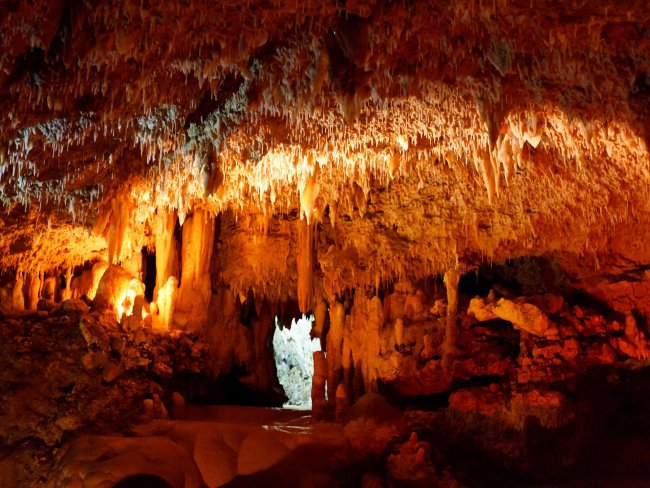 An outward-facing view from just inside the cave entrance. (Image courtesy of the National Park Foundation's Explore Mammoth Cave.)
The Mammoth Cave National Park Association was created to raise the funds needed to acquire the designated property and manage the process of turning the land over to the US Government. In 1927, the Association initiated a campaign in Kentucky that raised approximately $1.2 million in cash, property and "cave lands." It was estimated, however, that approximately $2.5 million would be needed to acquire all the land needed for the park.
On May 3, 1928, Representative Maurice Hudson Thatcher (R-KY) introduced a bill calling for a commemorative 50-cent coin to mark the establishment of the Mammoth Cave National Park. The bill called for up to five million (!) coins to be struck and provided to the Mammoth Cave National Park Association at par value (i.e., face value), which it could then sell at a profit to help fund the acquisition of the desired cave properties.
The bill did not specify or limit where the coins could be produced, stating just that the coins were to be struck "at the mints of the United States." The non-specificity of the legislation opened up the potential for the striking of the coins at Philadelphia, Denver and/or San Francisco or at any combination thereof. The open-ended language of the bill also did not place a time restriction on the orders nor a minimum amount per order.
Such provisions - the same as were included in the legislation authorizing the Oregon Trail Memorial half dollar two years earlier - set the stage for a potential multi-year program that would offer collectors coins from each US Mint facility.
Following the bill's introduction, Representative Thatcher became aware of the Treasury Department's objection to the coin proposal (and commemorative coins in general) and its preference for the striking of commemorative medals instead. As a result, just over a week after introducing the Mammoth Cave coin bill, Thatcher introduced a new Mammoth Cave bill that requested five million
medals instead of coins. The coin and medal bills were each referred to the House Committee on Coinage, Weights and Measures for review, but only the medal bill was considered.
The Committee favorably reported the medal bill on May 26, 1928, but it was not taken up for deliberation by the full House. As such, it died for lack of action. As no companion bill was introduced in the Senate, the overall effort simply faded away.
This lack of action by the full House is a bit surprising considering the medal bill had the support of the House Committee that oversaw coinage matters along with that of the Treasury Department. It is possible that the Mammoth Cave National Park Association changed its mind regarding its acceptance of a medal as a replacement for its desired coin and asked Representative Thatcher to withdraw the medal from further discussion. Medals, then as now, do not typically generate the same excitement among collectors (or the general public) and maybe the Association decided that sales of the medals would not reach the volumes required to generate the profits it needed. The Association would not have been the only group in history to turn down the Treasury's / Congress' offer of a commemorative medal instead of a coin.
Had the coin (or medal) been authorized, it would have been the first US Mint struck piece to be issued in support of a then current or planned US National Park. Considering the subject matter, I could imagine it would have been popular among geology fans and spelunkers (not mutually exclusive) in addition to coin collectors.
A few notes about the park itself.Mammoth Cave National Park officially became the 27th park to be administered by the US National Park Service on July 1, 1941. It is located in south central Kentucky and is centered below the Green River valley. The Park encompass 52,830 acres (down from the original estimate of 70,618) and features over 400 miles of mapped caves with an unknown amount yet to be explored and surveyed. Today, the Park enjoys an average annual attendance of 650,000 with 400,000 taking one or more of the Park's cave tours. You can learn more about the park at:
Mammoth Cave National ParkRead More: Commems Collection






 Posted 12/10/2016 3:15 pm





