| Author |
 Replies: 67 / Views: 6,925 Replies: 67 / Views: 6,925 |
|
|
|
Pillar of the Community
United States
749 Posts |
Thanks Sap  |
|
Valued Member
United States
138 Posts |
|
|
Valued Member
United States
263 Posts |
This will have a serious effect on the coin collecting community! Raw coins now may seem a much safer investment for those willing and able to do proper research. It seems that the TPG companies might be able to install encrypted micro chips in the shells. What do others think? afernbaugh |
|
Pillar of the Community
United States
5318 Posts |
Afernbaugh, I think that's a good idea; and the TPGs need to rise to this challenge vs. assume heightened collector vigilance can solve this problem. I agree there needs to be some kind of secondary encryption for their product. The problem with embedding some kind of smart chip is this cannot be verified for online transactions, a venue that will only continue to expand. Here's an idea I kicked around a while back whereby the TPGs would issue a an encrypted PIN to the collector that wouldn't be visible on the slab. That way, during some part of the transaction, the owner could provide the PIN to the buyer for final verification against a secure TPG database. No doubt there are holes in this process, but the top-tier TPGs need to do something fast or their product will be in question. A while back, I drew up a hypothetical system using an escrow intermediary. Of course, that step is likely too involved for the average internet auction.  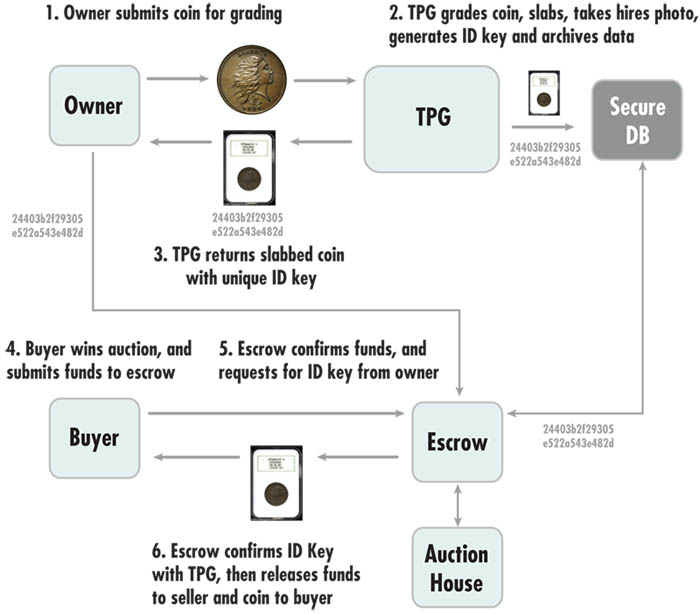 Edited by KurtS
03/29/2008 1:00 pm
|
|
Pillar of the Community
United States
2600 Posts |
What we owe them has not changed, Bryan, unless they purchase more. What those dollars will buy is dropping like a rock.
Jim
|
|
Pillar of the Community
United States
1767 Posts |
Where do these people get these dies? Do the make them?
I've seen on The US Mint site dies are sold. Wouldn't the buyer of these dies have the opportunity to 'mint' their own coins with these dies from the mint as well? Why do they 'tempt' counterfeiters with this sale?
mila_
|
|
Pillar of the Community
United States
790 Posts |
I've got a solution, don't collect anything that is worth faking. I've got oodles of common date coins and feel totally comfortable that they're all real. Prices of coins, both real or fake, rely on the law of supply and demand. The Chinese are messing with the supply side, we can hit back by changing the demand side.
Edited by Jays-Dad
03/29/2008 2:07 pm
|
|
Pillar of the Community
United States
792 Posts |
This isn't too good for coin collectors because of the counterfeit threat that might make people leery and could cause value decreasing in several coins. I don't really collect old coins anyway, I just hunt rolls for error/varieties.
|
|
Pillar of the Community
United States
543 Posts |
Hey Jays-Dad I suppose your suggestion uis one worth pursuing.
|
|
Pillar of the Community
United States
5318 Posts |
"...we can hit back by changing the demand side." And, I think part of the problem is that people are buying slabbed stuff without really knowing the coin--the expectation of expertise is put on the TPG and not the collector, or should I say--"coin investor". This problem will solve itself when people take a real passion in what they're collecting, really learn the coins, and need less assurance from TPGs. Of course, online auctions are a problem because you seldom see enough detail to be sure either way. So I think TPGs must find a way to verify their slabs over the nearly indistinguishable forgeries that will soon flood the market. Otherwise, their product is toast. |
|
Pillar of the Community
United States
1208 Posts |
Why don't we just flood their country with counterfiet Chinese currency?
Give them a taste of their own medicine.
We could print so much phoney paper it would be crazy.
They would have to use a wheelbarrow to carry the cash for a loaf of bread!
|
|
Valued Member
United States
74 Posts |
I like that idea, print a couple billion dollars of chinese funny money. I'd chip in on that.
|
|
Valued Member
United States
66 Posts |
I had one of my own products counterfeited ( no numismatic) by a firm out of China. In the end the some consumers figured out it was bogus but there was little or no way to tell how much they put on the market or how we could stop them. It had an impact on our sales and was not to fun to deal with.
Information is key. Buy only what you know and if its to good to be true it probably is.
|
|
Valued Member
United States
56 Posts |
just wondering, what are the coins made out of?
|
|
Moderator
 Australia
16982 Posts |
quote:
joeb907 asked:
just wondering, what are the coins made out of?
As I said before, it depends on whom they're trying to fool, but the short answer is, "the cheapest thing that will do the job". The cheap, shoddy Chinese replicas you can buy by the containerload for $1 each, are made of whatever cheap, shoddy alloy they can get their hands on. Normally some kind of brass that's been silver-washed or, more accurately, mercury-washed. Not entirely safe, but the health and safety of their workers and the people who buy their "coins" isn't high on their agenda. These coins are often underweight, because the alloy used is nowhere near as dense as silver. The ones designed to fool a close, in-hand inspection are often made of a lead-tin alloy that has the same density as silver, only much cheaper. It even "sounds silvery" when rung or dropped. The colour often isn't quite right, so they may be given a silver wash. If the dies are good, the only way to tell them from a silver coin would be by chemical analysis (eg. XRF). Their highest quality fakes are, of course, made from silver, of the same weight and fineness as the real thing. It's only worthwhile for them to do this for coins where the numismatic value is far higher than the bullion value. Such a coin could only be detected by trace elemental analysis: measuring the impurities in the metal and comparing the results to see if this "chemical fingerprint" matches real coins. Of course, if they melt down genuine common date coins and use the metal to restrike scarce dates, even this technique may not work. Don't say "infinitely" when you mean "very"; otherwise, you'll have no word left when you want to talk about something really infinite. - C. S. Lewis
|
| |
Replies: 67 / Views: 6,925 |







 First Page
 Previous Page


 Posted 03/29/2008 10:57 am





