This will be a pretty esoteric subject, even by the standards of those outliers who frequent the Ancients/Medieval board. But I'm hoping this thread may prove beneficial to folks in the future who may hunt it down via CCF's search function. It'll also be nice to have it available to refer some folks to as the issue discussed below arises.
Recently I wrote to an
ebay seller who had a Parthian drachm incorrectly listed as a Vologases III (Sellwood type 78). The seller's error was understandable since the coin - which was actually a much less common Artabanos II issue - is indeed similar looking to the Vologases III type. In reply the seller sent me a terse "thank you" and continued to list the coin incorrectly. LOL
Sellwood 78's are among the most abundant of Parthian AR types. I once heard a coin buddy say that every Parthian collector starts out with this type as their first coin. While that's of course an exaggeration, it was actually true in my case.
Assuming the link works, here's a thread with a nice example of Albert's (antwerpen2306):
http://goccf.com/t/254344And another thread, with a beauty of Chris' (Chrsmat71):
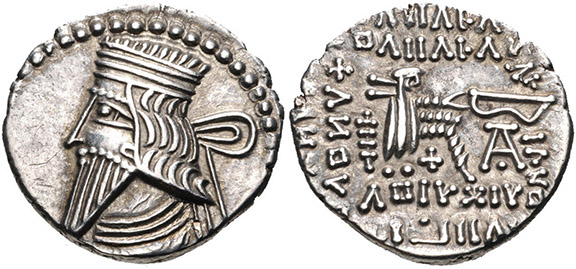
http://goccf.com/t/240204David Sellwood attributed this type as Vologases III in the 1970s and that attribution has stuck for many collectors (including me) and dealers over the decades. However, more recently Dr. G.R.F. Assar reattributed these as the Parthian king Pacoros I (sometimes spelled Pacorus). Either way, whether you call them Volo III or Pacoros, it seems like the Sellwood type 78's should be relatively easy to spot if you know what you're looking for. Here's a nice example, courtesy of CNG:
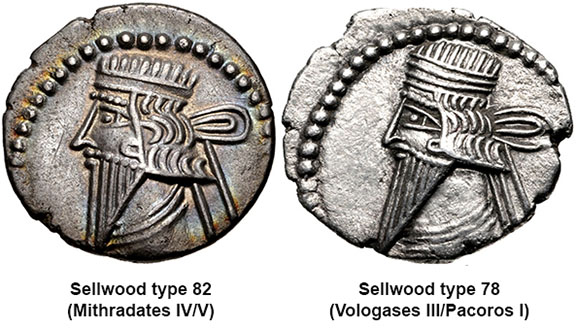
As it turns out, these are commonly misattributed. Sometimes Sellwood 78's are misidentified as other Parthian types. Sometimes it's the reverse situation: other Parthian types are misidentified as Sellwood 78's. For example, one will occasionally see Sellwood's Mithradates IV (Assar's Mithradates V) misattributed as a Vologases III/Pacoros. The mistake is of course due to their visual similarities...the images below are courtesy of CNG:
Below are just a few examples of other misattributed coins. Some are from dealers from the "V" mall who should probably know better.
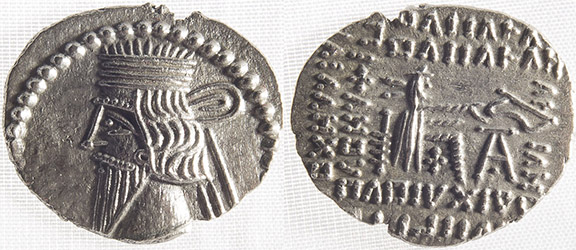
Volo III/Pacorus I misidentified as something else:But first is an example from
ebay. The coin is a Vologases III/Pacoros (Sellwood 78), but it is listed incorrectly as Artabanos II Sellwood 61.7:
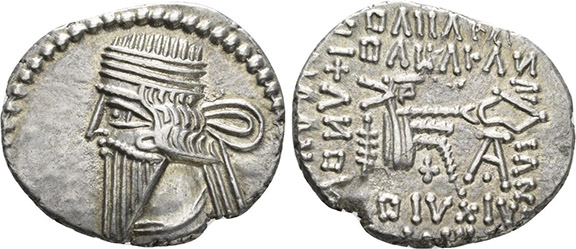
Here is a Vologases III/Pacoros (Sellwood 78) listed by a major European dealer as a Sellwood 74.7, Artabanos III:
 Other types misidentified as Volo III/Pacoros:
Below is a small sampling of coins incorrectly listed as Vologases III/Pacoros (Sellwood 78).
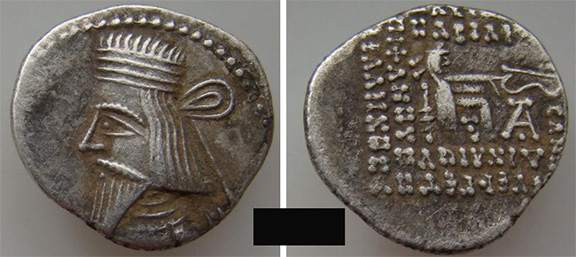
This coin is listed at the "V" mall as Vologases III, Sellwood 78.3. In fact it is a drachm of Artabanos II, Sellwood 61.7:
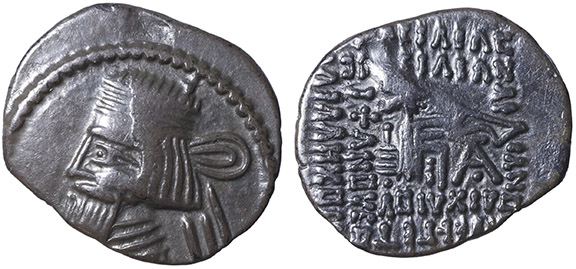
Here's another listed incorrectly at "V" as Volo III, below. While the wear and cropping of the (square cut) beard make i.d.'ing a challenge, it is definitely NOT Vologases III but, rather, one of the following: Artabanos II (Sellwood 63), Gotarzes II (Sellwood 66), or Artabanos III (Sellwood 74):
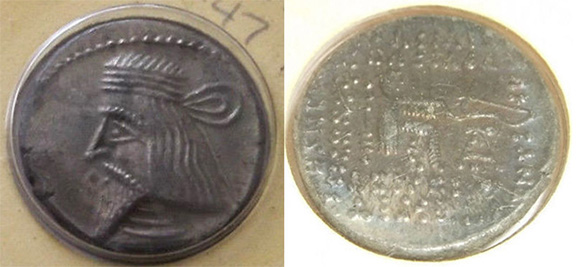
Here is an
ebay example, listed incorrectly as Vologases III. In fact it is a Sellwood 61.7, Artabanos II:
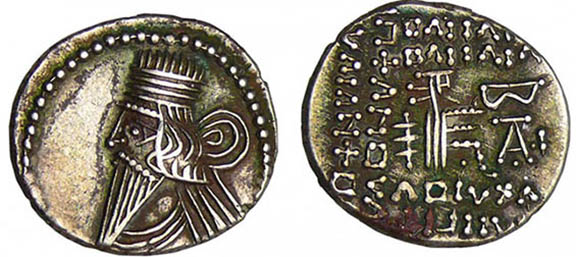
Now, below are my favorite cases of mistaken identity. Both of the coins below were sold through major auction houses a couple of years back, and both were incorrectly listed as the common Vologases III/Pacoros (Sellwood 78) type. The reality is that they are each the
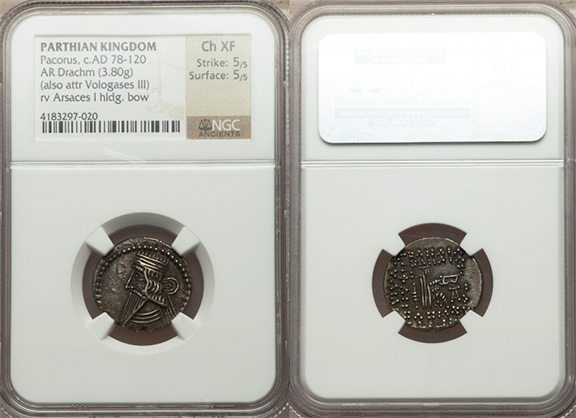
much rarer - and considerably more valuable - Sellwood type 83 "Unknown King." When properly identified these rarely go for less than a $1,000 - meaning about ten times or more what most Sellwood 78's are worth. There is one currently - and correctly - listed at the "V" mall for $2,150. Note that one of the examples below is slabbed. The attribution on the label is incorrect. As I've stated before: apparently no one at NGC owns a copy of Sellwood. (I've spotted a number of incorrectly labeled slabbed Parthians from NGC over the years)
 How to Spot a Sellwood 78:
Okay, so what to look for when trying to distinguish a Vologases III/Pacoros from other Parthian types? Well, fortunately, distinguishing this type from others can be done with just a careful look at the obverse - you don't have to consider the more imposing details of the reverse legends and archer.
1. First consider the hair of the obverse bust. Is it broken into three distinct sets of waves or is it rendered as continuous lines from top to bottom? Vologases III/Pacoros drachms will
always show the hair as three distinct sets of waves. If it is shown as continuous lines from top to bottom, it is
not a Vologases III/Pacoros.
2. Next look at the beard. The Vologases III/Pacoros type will always have a "quadrant" or, more commonly, a triangular beard. It will
never have a square cut beard. If your coin has a square cut beard (parallel edges left and right) it is not a Vologases III/Pacoros.
3. Finally consider the diadem. The Vologases III/Pacoros type will
always have two loops behind the head and three diadem ends hanging downward behind the neck. If you have a coin in hand, purchased as a Volo III/Pacoros, but it has two diadem ends instead of three, it is a Mithradates IV/V. If, on the other hand, you count three loops and four diadem ends - Wow! Pat yourself on the back. You've got an Unknown King worth a lot more than the Volo III you paid for! You are going to turn a sweet profit!










 Posted 03/12/2017 6:06 pm


