| Author |
 Replies: 16 / Views: 4,202 Replies: 16 / Views: 4,202 |
|
Moderator
 Canada
10477 Posts |
"Discovery follows discovery, each both raising and answering questions, each ending a long search, and each providing the new instruments for a new search." -- J. Robert OppenheimerContent of this post is licensed under a Creative Commons Attribution-NonCommercial 3.0 Unported License. See: http://creativecommons.org/licenses...0/deed.en_USMy eBay store
|
|
|
|
Pillar of the Community
Canada
872 Posts |
maybe struck through a die cap fragment?
|
|
Pillar of the Community
United States
819 Posts |
Looks like the polar bear from a toonie
|
|
Moderator
United States
56855 Posts |
Some type of a lamination? John1  |
|
Pillar of the Community
Canada
3234 Posts |
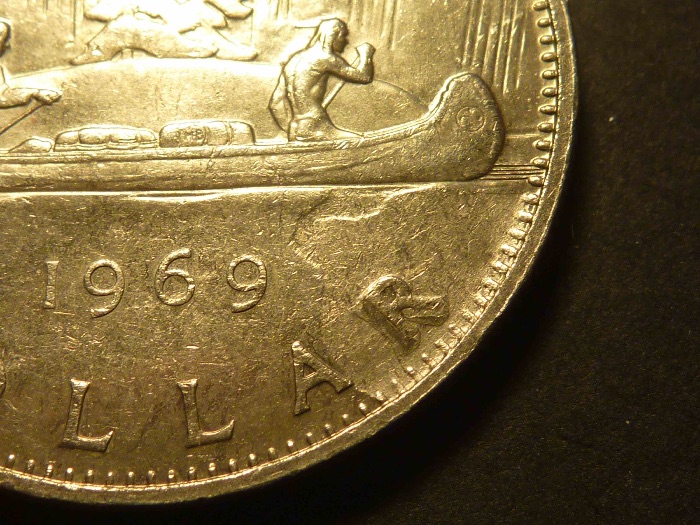
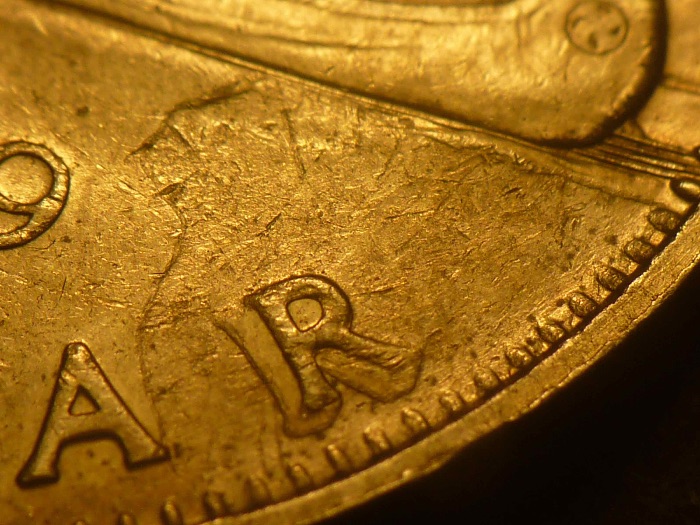
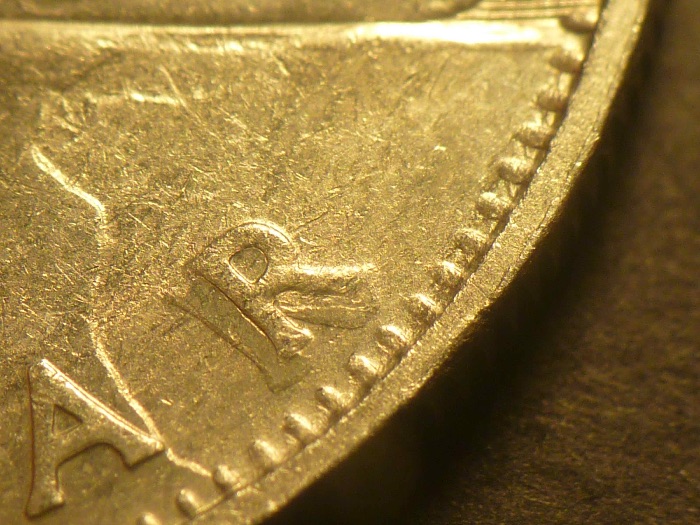
That low expanded "R" to the left is a real head scratcher for me..
It's also interesting how the lower expanded serifs are clipped off or misshapen at ~ 45° on the bottom rights..
|
|
Moderator
United States
23522 Posts |
Quote:
That low expanded "R" to the left is a real head scratcher for me.. Whatever it was struck through had an opening around the R, and otherwise surrounded it. The "extra" to the left of the R is actual, original field at the proper level, and everything else on both sides of the R is covered by the strikethrough. I doubt that was the precise opening in the struck-through fragment; the strike is of enough pressure to force the fragment into die voids to one extent or another. There is, to my mind, a certain element of coincidence in the shape of this fragment - whatever it was - which tends to offer deceptive evidence on the coin, making us read more into it than there actually is. My (very tentative) working theory is this might be struck through a delamination from another planchet. Still working on the "extra thickness" of the "R"....that, and it's not an alloy and unlikely to delaminate....  |
|
Pillar of the Community
Canada
1164 Posts |
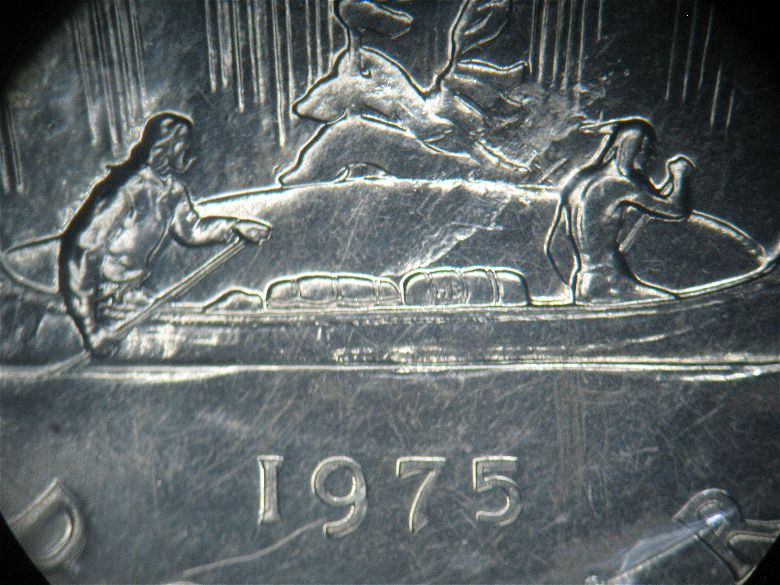 Heres another interesting nickel dollar that fits with the 1969 one. I call this one a 1975 Arrowhead housed in a PL Set and such flaws are scarce in nickel dollars. |
|
Moderator
 Canada
10477 Posts |
I posted this on Mike Diamond's error coin forum. So far, I like this answer the best: Quote:
...it could be an R-shaped hole in the material that was struck through presumably created by a previous strike. Oh well, another cool nickel dollar error added to the collection from my bulk searches - cost to me was $1. "Discovery follows discovery, each both raising and answering questions, each ending a long search, and each providing the new instruments for a new search." -- J. Robert OppenheimerContent of this post is licensed under a Creative Commons Attribution-NonCommercial 3.0 Unported License. See: http://creativecommons.org/licenses...0/deed.en_USMy eBay store
|
|
Pillar of the Community
Canada
2430 Posts |
Thats a nice affordable addition to your collection SPP. It really amazes me when errors roam around in the "Wild" for quite some time before being captured by some collector.
How well circulated is the dollar?
|
|
Pillar of the Community
Canada
846 Posts |
What if.... someone went to repunch the R on the die, used a much bigger size by mistake (thus the huge underlying R), and the plating of the die chips off when that someone smacks the punch on the die (thus the thin layer missing after striking). He doesn't notice it's gone, replaces the die and voila.
There would probably be others made before the error was found.
|
|
Moderator
Canada
10477 Posts |
Quote:
What if.... someone went to repunch the R on the die I have past conversations with Jim Haxby on this very topic. The last time someone tried to manually repunch a working die in Canada, was the Maple Leaf punch designed by Thomas Shingles in 1948 (the 1947 Maple Leaf). Paul Glover might have further insight as to when the last 50-cent working die was actually manually manipulated. The last time a tool was used to manually engrave a Canadian coin was the Arnprior dollars of the early 1950s. "Discovery follows discovery, each both raising and answering questions, each ending a long search, and each providing the new instruments for a new search." -- J. Robert OppenheimerContent of this post is licensed under a Creative Commons Attribution-NonCommercial 3.0 Unported License. See: http://creativecommons.org/licenses...0/deed.en_USMy eBay store
|
|
Moderator
Canada
10477 Posts |
Quote:
How well circulated is the dollar? It is a pretty "baggy" AU coin now... "Discovery follows discovery, each both raising and answering questions, each ending a long search, and each providing the new instruments for a new search." -- J. Robert OppenheimerContent of this post is licensed under a Creative Commons Attribution-NonCommercial 3.0 Unported License. See: http://creativecommons.org/licenses...0/deed.en_USMy eBay store
|
|
Valued Member
Canada
456 Posts |
The 1953 Small Date 50c is the last of the fifty cents where you will find that the last date digit iindifferent positions ie. not replicated across the mintage.., you can also find the 3 repunched idifferently on some coins. Strongly indicative of manual double punching across several reverse working dies.
|
|
Moderator
Canada
10477 Posts |
You know, this coin has that "pull-away" and enlargement phenomena that you see on Cu-plated zinc errors... 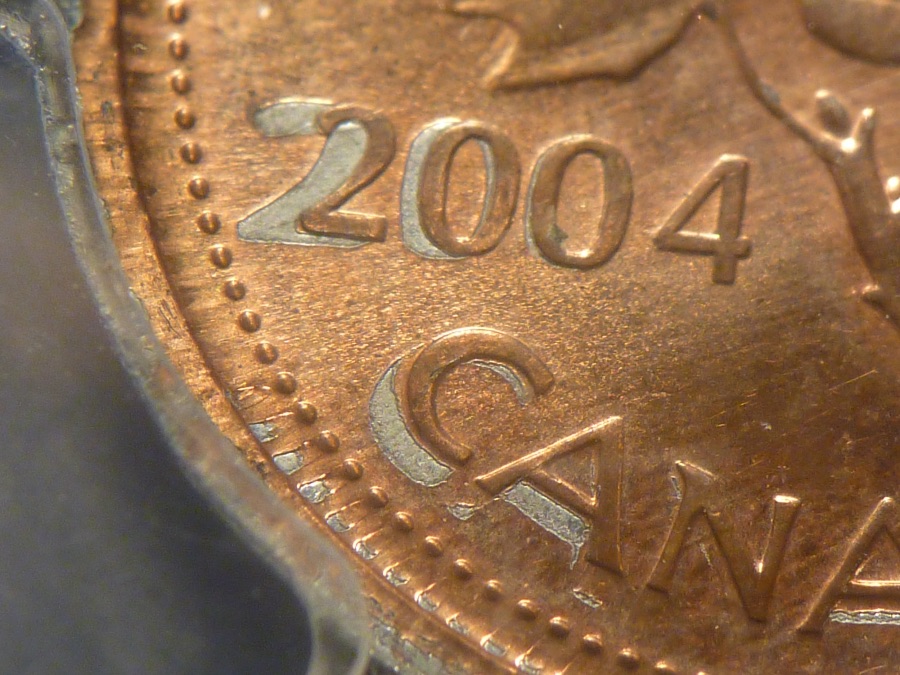 "Discovery follows discovery, each both raising and answering questions, each ending a long search, and each providing the new instruments for a new search." -- J. Robert OppenheimerContent of this post is licensed under a Creative Commons Attribution-NonCommercial 3.0 Unported License. See: http://creativecommons.org/licenses...0/deed.en_USMy eBay store
|
|
Rest in Peace
10197 Posts |
Heavy pressure and tilted die perhaps?
|
|
Moderator
United States
23522 Posts |
Stretchy! Quote:
Heavy pressure and tilted die perhaps?
To my intuition, it could just as easily be a thinner-than-normal cladding (or slightly-off composition) which was incapable of stretching at the same rate as the underlying metal. |
| |
Replies: 16 / Views: 4,202 |









 Posted 11/28/2017 11:25 pm





