Coin Community Family of Web Sites Join Thousands of Coin, Bullion, & Money Collectors
300,000 items to help build your collection! Specializing in Modern Numismatics Coin, Banknote and Medal Collectors's Online Mall Royal Canadian Mint products, Canadian, Polish, American, and world coins and banknotes. Join Thousands of Coin, Bullion, & Money Collectors Royal Estate Auctions - $1 Coin AuctionsVancouvers #1 Coin and Paper Money Dealer


Username:
Password:
Save Password
Forgot your Password?


This page may contain links that result in small commissions to keep this free site up and running.

Welcome Guest! Registering and/or logging in will remove the anchor (bottom) ads. It's Free!

Large Collection Ruined?

To participate in the forum you must log in or register.
Author Previous TopicReplies: 117 / Views: 15,169Next Topic
Page: of 8
New Member
United States
46 Posts
 Posted 01/30/2018  6:36 pm  Show Profile   Bookmark this reply Add Gramps76 to your friends list Get a Link to this Reply
Well I am a very meticulous hands on type of person. I deliberate often for long periods prior to taking on projects. I actually enjoy the research aspect of whatever it is I plan on doing. If I were to even give thought to attempting any sort of restoration/conservation of these coins I would not take any of it lightly. On the other hand, even though I have no intention of selling them I wouldn't want to irreparably damage these pieces of history just as a matter of course. On a more personal note I also wouldn't want to take a lackadaisical approach to manhandling items my Grandfather had such a passion for. I feel guilty enough in assuming they would remain intact for 40 plus years without attention. In hindsight these coins and myself are in this position due to my own lack of judgement. Whatever I decide to do it will be well thought out. I haven't researched yet if there are any extremely rare pieces there, but if there were I certainly wouldn't have anything to do with messing around with them in any way. In all honesty I doubt that I'm going to try and take anything on here myself.....too worried I'd mess them up.
Pillar of the Community
thecoinguy1964's Avatar
United States
1316 Posts
 Posted 01/30/2018  6:39 pm  Show Profile   Bookmark this reply Add thecoinguy1964 to your friends list Get a Link to this Reply
Not a mention one of the use of acetone, or did I simply miss it? I myself have never used it, but I see it mentioned here all the time.
New Member
United States
46 Posts
 Posted 01/30/2018  6:45 pm  Show Profile   Bookmark this reply Add Gramps76 to your friends list Get a Link to this Reply
On the coin I experimented on I tried Acetone first and it didn't remove any of the discoloration.
New Member
United States
46 Posts
 Posted 01/30/2018  6:47 pm  Show Profile   Bookmark this reply Add Gramps76 to your friends list Get a Link to this Reply
I am curious though about how an expert detects that a coin has been dipped? What trace evidence does this dipping leave behind? Does it remove material?
Bedrock of the Community
basebal21's Avatar
13014 Posts
 Posted 01/30/2018  6:48 pm  Show Profile   Bookmark this reply Add basebal21 to your friends list Get a Link to this Reply

Quote:
Not a mention one of the use of acetone, or did I simply miss it? I myself have never used it, but I see it mentioned here all the time.


Acetone wouldn't do anything for toning and spots that developed over years. It's more for removing something fresh like you acidentiqlly touchdd it and want to get the finger print off or some dirt Ect. So far everything he's shown and described needs something more powerful
Pillar of the Community
John77's Avatar
United States
2917 Posts
 Posted 01/30/2018  7:41 pm  Show Profile   Check John77's eBay Listings Bookmark this reply Add John77 to your friends list Get a Link to this Reply

Quote:
I haven't researched yet if there are any extremely rare pieces there


I did notice a 1909-S Indian cent in the one pic... that's definitely a rare coin.

As for now, keep them in a cool, dry place in the house, preferably downstairs where the temperature is least likely to change. As others have mentioned, you probably will want to remove them from their old holders and put them in newer ones with better protection from the elements and additional damage.

CRH Nickeloholic. 1,600,000 nickels searched in eight years! Have found FOUR complete Jefferson sets!
Pillar of the Community
Slider23's Avatar
United States
4469 Posts
 Posted 01/30/2018  7:59 pm  Show Profile   Bookmark this reply Add Slider23 to your friends list Get a Link to this Reply
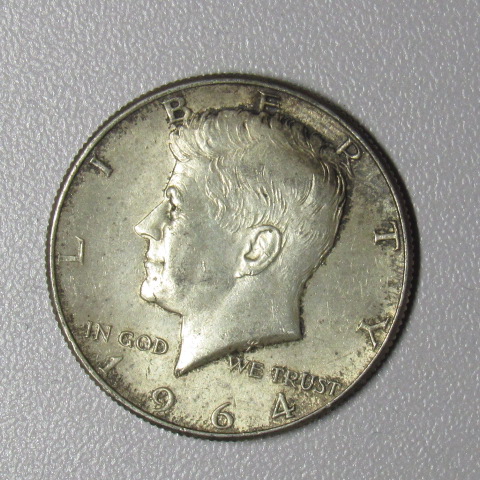
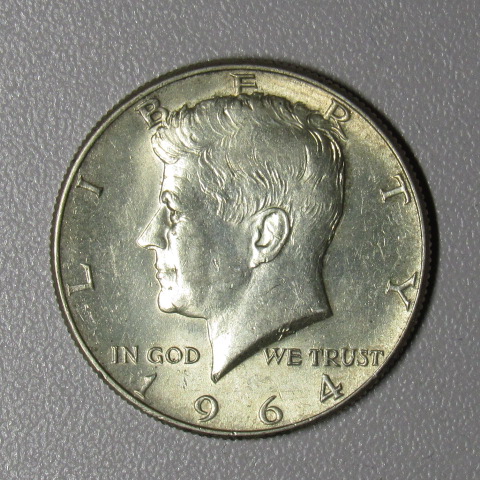
I pulled this coin from my junk silver and did a before and after dip photo to give you an idea of what a dip does to a coin. A dip will strip the surface of the coin and can show all the imperfections that the toning/tarnish is hiding. On this 1964 silver Kennedy the dip did not remove all the tarnish.

Before dip:
Large-Collection-Ruined?

After dip:
Large-Collection-Ruined?
New Member
United States
46 Posts
 Posted 01/30/2018  8:37 pm  Show Profile   Bookmark this reply Add Gramps76 to your friends list Get a Link to this Reply
I think the problem was also caused by the holders. Almost all the coins have discoloration on the edges where the staples are that bled onto the face or reverse. Also they were stored in boxes on end and wherever the plastic was compromised even slightly from them touching there is tarnish. I've been looking them over more closely and I would say 80 percent of them have damage in varying degrees. The whole darn coin looks beautiful and then there are one or two black spots. It's making me feel ill.
Bedrock of the Community
basebal21's Avatar
13014 Posts
 Posted 01/30/2018  9:08 pm  Show Profile   Bookmark this reply Add basebal21 to your friends list Get a Link to this Reply

Quote:
I think the problem was also caused by the holders.


That's exactly what the major problem was, they just aren't meant for decades of storage in any condition without being changed out. Holes in the plastic covering, rusting staples ect.

Don't beat yourself up though, it's not really your fault and no way for you to have known especially considering the internet wasn't even around or in wide spread use for a couple decades after they were stored. There was no easy way for you to research or get the information you needed at the time. It's really not your fault
New Member
United States
46 Posts
 Posted 01/30/2018  10:56 pm  Show Profile   Bookmark this reply Add Gramps76 to your friends list Get a Link to this Reply
Thanks for the encouragement. Does anyone have a specific brand or type of holder to recommend to replace the ones I have? Thanks.
Pillar of the Community
John77's Avatar
United States
2917 Posts
 Posted 01/31/2018  01:02 am  Show Profile   Check John77's eBay Listings Bookmark this reply Add John77 to your friends list Get a Link to this Reply

Quote:
Thanks for the encouragement. Does anyone have a specific brand or type of holder to recommend to replace the ones I have? Thanks.


You're welcome. As for holders, just standard 2x2s suited for each individual denomination you can get at any coin shop or online. They're now made with inert materials as opposed to the ones made in the old days.
CRH Nickeloholic. 1,600,000 nickels searched in eight years! Have found FOUR complete Jefferson sets!
Pillar of the Community
Slider23's Avatar
United States
4469 Posts
 Posted 01/31/2018  08:28 am  Show Profile   Bookmark this reply Add Slider23 to your friends list Get a Link to this Reply


Quote:
I am curious though about how an expert detects that a coin has been dipped? What trace evidence does this dipping leave behind? Does it remove material?


The following was written by Jeff Garrett for NGC on 7/5/2012 that will help answer your questions:

The temptation to dip a dull or dirty coin can be great, but the practice is rife with risk.

Much has been written about the subject of so-called "coin doctoring" in the last couple of years. I don't like this term, as it suggests there is an evil element in the numismatic world trying to destroy our hobby. I don't believe this is true. The subject has been much discussed and even the Professional Numismatists Guild (PNG) struggled for many months trying to define the problem. One thing that has been clarified is that "dipping a coin" is not "coin doctoring." Nearly everyone has heard the term "dipping" but many probably don't know the exact definition. It falls into the general category of rare coin conservation and most certainly is an interesting subject to discuss, especially for non-professionals.

For most, the term "dipping" refers to dipping a coin into a rather mild silver cleaner. There are several brands, but the most commonly used is Jewel Luster. This product has been on the market for decades. It is the bright blue solution familiar to anyone who has been around coins for a while. I have heard that Jewel Luster is actually not blue, but blue dye is added to discourage individuals from exposing their skin to the solution for prolonged periods. If you know someone with blue finger tips—which, believe me, I have seen plenty of—now you know the reason. I'm not sure of the long term health hazards of Jewel Luster, but any negative news on this topic would be of great concern to a large number of coin dealers that I know. It is highly recommended to use rubber gloves and work in a well ventilated area when dipping coins.

Many of you may wonder why individuals dip coins in the first place. The simple answer is the "market demand" for frosty white silver coins. Sometimes, you read Letters to the Editors in numismatic magazines howling about the evil act of coins being cleaned. Nearly all totally condemn the practice, and tout the virtues of fully original coins. The problem is most rare coin buyers prefer frosty white coins to deeply toned coins.

There are three basic types of appearances for silver coins. The most desirable is a beautifully toned example. Attractive toning varies greatly and can be a matter of personal taste. Beautifully toned Morgan silver dollars can bring astronomical prices, and there is even a specialty club devoted to such coins. I would estimate that less than 10% of all vintage Mint State silver coins have survived with what would be considered beautiful or attractive toning. Next are the coins that are frosty white, or nearly white. Most silver coins that are more than 100 years old have some sort of natural toning if they have not been dipped. Frosty white coins probably make up about 20-30% of all silver coins seen. The remaining 60-70% have some sort of natural toning acquired over the years. The appearance of these coins varies greatly. Many have light, golden toning, and I have seen some that were almost black in appearance. The varied appearances are a primary reason that rare coins of the same grade can vary greatly in price.

By reading the above commentary, one could easily assume that the simple answer to getting the most money for a toned coin would be to dip it. Unfortunately, it is not that simple! In fact, it is not even close to simple! Just as there are many varieties of toning there are many possible outcomes of dipping a coin. Dipping an expensive coin can be an exciting or terrifying experience. It is much like buying an extremely expensive scratch off lottery ticket. A moderately toned silver coin can be dipped and turn out to be a sparkling Gem. Sometimes though, the resulting dip will reveal dull surfaces, environmental damage, scratches, hairlines, or other hidden damage and repair. The temptation to dip a dull or dirty coin can be great, but the practice is rife with risk. I have personally seen great success and brutal failures. A friend of mine paid over $100,000 for a 1901-S Barber quarter around 1989. The coin was purchased raw and subsequently submitted for grading. The coin had natural, but rather unexciting, golden toning. It came back MS 66, and was not worth the six-figure purchase price which was paid for it. This particular dealer is famously unafraid of risk and dipped the coin! The result was one of the most spectacular Gems of the issue known. Upon resubmission, the coin graded MS 68 and was sold for a tidy profit. On the other end of the scale, I still have a Monroe Half Dollar that I purchased for over $5,000 around 1990. The coin looked to be a great prospect for dipping and I took the chance. A wide streak of grey environmental damage was revealed that I had not seen. I still have this miserable failure in my collection of hard-learned lessons (along with a few missed fakes).

Trying to predict the potential for success or failure before dipping a coin is very difficult. At the end of the day dipping almost always carries some degree of risk. I have seen about as many coins ruined as I have seen improved over the years. The practice will continue, however, as the market applies a premium to coins with frosty, white surfaces. The next time you are tempted, remember the risk, and get a second opinion, if possible. NGC has worked hard over the years trying to help collectors and dealers with this complicated issue. I applaud them for opening an affiliated company, Numismatic Conservation Services (NCS), and bringing an enhanced degree of professionalism to this subject. Hopefully, this article has given some clarity to an issue that many find mystifying.

Bedrock of the Community
United States
20753 Posts
 Posted 01/31/2018  09:13 am  Show Profile   Bookmark this reply Add just carl to your friends list Get a Link to this Reply
Great information on dipping. However, as I mentioned previously, there is this constant reference to VALUE. How much is it worth? What is it's value? How much did you sell it for? All are normal in dealing with coins of many items of value. BUT if they are yours and you don't plan on ever selling them, value makes little difference. If you just want them to look nice, do with them as you wish and keep in mind where they will be tomorrow.
I put almost all my coins in Albums. Extras go into 2x2 flips and/or plastic rolls. The really best Albums go into Zip Lock Plastic bags. And only to help preserve them for me, myself and I.
New Member
United States
46 Posts
 Posted 01/31/2018  09:44 am  Show Profile   Bookmark this reply Add Gramps76 to your friends list Get a Link to this Reply
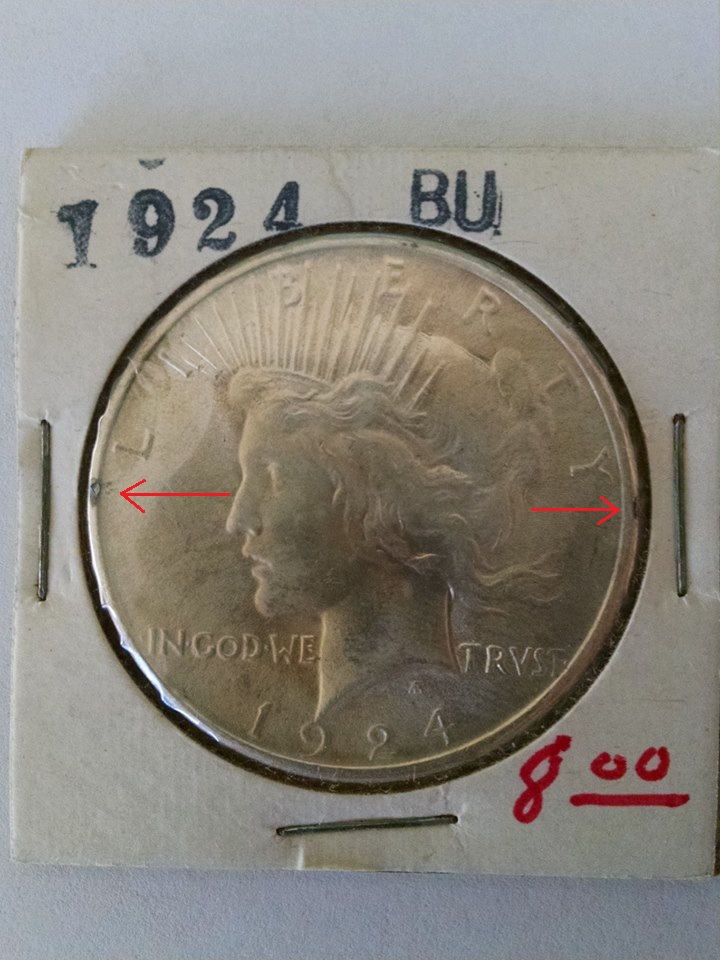
Another question. What would you do with coins like this? There are many with this type of damage. I am assuming it would be a no no to clean the edges of a coin by rubbing even if you were not on it's face or reverse? I think what happened in a lot of these cases is the coins rubbed together in storage and created the tiniest breach in the plastic which allowed environmental forces to get through. What would a pro do with a coin like this? Leave it alone, dip it, something else? For a tiny spot why would you risk the whole coin by dipping it? If I took this to someone how would they remedy this discoloration? Thanks
Large-Collection-Ruined?
Edited by Gramps76
01/31/2018 09:53 am
Bedrock of the Community
basebal21's Avatar
13014 Posts
 Posted 01/31/2018  09:47 am  Show Profile   Bookmark this reply Add basebal21 to your friends list Get a Link to this Reply

Quote:
What would a pro do with a coin like this? Leave it alone, dip it, something else?


They would spot treat it when it's small spots like that. Their exact methods no one knows but them, but in those instances it's unlikely they would treat the entire coin when they just want to fix such a small area
  Previous TopicReplies: 117 / Views: 15,169Next Topic
Page: of 8

To participate in the forum you must log in or register.


Disclaimer: While a tremendous amount of effort goes into ensuring the accuracy of the information contained in this site, Coin Community assumes no liability for errors. Copyright 2005 - 2026 Coin Community Family- all rights reserved worldwide. Use of any images or content on this website without prior written permission of Coin Community or the original lender is strictly prohibited.
Contact Us  |  Advertise Here  |  Privacy Policy / Terms of Use

Coin Community Forum © 2005 - 2026 Coin Community Forums
It took 0.41 seconds to rattle this change. Forums