Coin Community Family of Web Sites Join Thousands of Coin, Bullion, & Money Collectors
Specializing in Modern Numismatics Vancouvers #1 Coin and Paper Money Dealer Royal Canadian Mint products, Canadian, Polish, American, and world coins and banknotes. Join Thousands of Coin, Bullion, & Money Collectors Coin, Banknote and Medal Collectors's Online Mall Royal Estate Auctions - $1 Coin Auctions300,000 items to help build your collection!


Username:
Password:
Save Password
Forgot your Password?


This page may contain links that result in small commissions to keep this free site up and running.

Welcome Guest! Registering and/or logging in will remove the anchor (bottom) ads. It's Free!

Are We On The Verge Of A Cashless Society?

To participate in the forum you must log in or register.
Author Previous TopicReplies: 224 / Views: 28,927Next Topic
Page: of 15
Valued Member
PacoMartin's Avatar
United States
411 Posts
 Posted 03/13/2019  11:45 pm  Show Profile   Bookmark this reply Add PacoMartin to your friends list Get a Link to this Reply
Banknotes comes in denominations that are more suitable for transactions and in denominations that are more suitable for store of value.

Outside of Sweden and Norway there is a worldwide trend where the store of value denominations are increasing faster than GDP growth.

There is a tendency to think that the transactional denominations help the poor, and that was part of Philadelphia's reason for passing the new law. But in reality the poor get robbed more, it is more difficult to start a tiny business since you need a cash register and you have to worry about security, and it is more difficult to get government benefits on less than a monthly basis. Food stamps should be given out weekly instead of monthly because millions spend their money and are hungry at the end of the month.

Personally, I think all the governments of the world should be developing central bank digital currency (CBDC). It would increase vending purchases, allow you to easily load your phone with some cash before visiting another country, and help in taking care of the poor.

table is in $ billions (GDP increased by 226% over years)
Incr.	181%	218%	190%	138%	209%	179%	429%

Year	$1	$2	$5	$10	$20	$50	$100
2017	$12.1	$2.4	$14.8	$19.6	$183.8	$86.4	$1,251.7
2016	$11.7	$2.3	$14.2	$19.2	$177.2	$83.5	$1,154.8
2015	$11.4	$2.3	$13.7	$19.0	$171.3	$79.8	$1,082.2
2014	$11.0	$2.2	$13.1	$18.9	$162.2	$76.9	$1,014.5
2013	$10.6	$2.1	$12.7	$18.5	$155.0	$74.5	$924.7
2012	$10.3	$2.0	$12.2	$17.7	$148.9	$72.5	$863.1
2011	$10.0	$1.9	$11.8	$17.2	$141.1	$69.6	$782.6
2010	$9.7	$1.8	$11.5	$16.6	$130.6	$66.9	$704.6
2009	$9.6	$1.7	$11.2	$16.2	$127.5	$65.3	$656.4
2008	$9.5	$1.7	$11.0	$16.3	$125.1	$64.7	$625.0
2007	$9.3	$1.6	$10.8	$16.2	$121.8	$63.0	$569.3
2006	$9.0	$1.5	$10.5	$16.0	$119.2	$62.8	$564.1
2005	$8.8	$1.5	$10.3	$15.5	$115.4	$62.1	$545.0
2004	$8.3	$1.4	$9.8	$15.1	$107.6	$60.6	$516.7
2003	$8.2	$1.3	$9.7	$15.1	$107.8	$59.9	$487.8
2002	$8.0	$1.3	$9.4	$14.9	$103.7	$58.5	$458.7
2001	$7.8	$1.3	$9.2	$14.7	$100.9	$57.0	$421.1
2000	$7.7	$1.2	$8.9	$14.5	$98.6	$55.0	$377.7
1999	$7.5	$1.2	$9.0	$16.2	$116.1	$64.7	$386.2
1998	$7.0	$1.2	$8.0	$14.3	$90.9	$50.5	$320.1
1997	$6.7	$1.1	$7.8	$14.2	$88.0	$48.2	$291.6
Edited by PacoMartin
03/14/2019 12:00 am
Valued Member
PacoMartin's Avatar
United States
411 Posts
 Posted 03/16/2019  07:58 am  Show Profile   Bookmark this reply Add PacoMartin to your friends list Get a Link to this Reply
I must point out that long before a country goes cashless they will give up handwritten checks. Of all transactions, personal checks are the most expensive and time consuming to process and the most likely to be used fraudulently. Sweden abolished the personal check decades before they started reducing the cash supply.
Moderator
Learn More...
jbuck's Avatar
United States
188643 Posts
Rest in Peace
United States
233 Posts
 Posted 03/17/2019  11:49 am  Show Profile   Bookmark this reply Add ikeyPikey to your friends list Get a Link to this Reply
Neither have I, but my I have let my bank write & mail checks (free).
Moderator
Learn More...
jbuck's Avatar
United States
188643 Posts
 Posted 03/18/2019  10:37 am  Show Profile   Bookmark this reply Add jbuck to your friends list Get a Link to this Reply
I cannot even recall the last time I went to the CU to deposit a check. I use the app on my phone.
Valued Member
PacoMartin's Avatar
United States
411 Posts
 Posted 03/22/2019  12:15 am  Show Profile   Bookmark this reply Add PacoMartin to your friends list Get a Link to this Reply
Checks are by far the most error prone, time consuming, and susceptible to fraud of any transaction mechanism.
Finland stopped using checks in 1993, Poland in 2006. In Denmark, all banks stopped accepting cheques starting on January 1, 2017

BTW the cash supply of banknotes in circulation in Denmark went down in 2018 (just posted two days ago). It went down a tiny 0.4%, but many 1000kr banknotes were exchanged for 500kr banknotes. Denmark, Norway, and Sweden are the only three financially stable countries which are reducing the value of their banknotes in circulation.

Per inhabitant value of banknotes in crculating notes (converted to Euros)
€479 Sweden
€753 Norway
€1488 Denmark
€3555 Euro Area


Valued Member
everything's Avatar
United States
493 Posts
 Posted 03/25/2019  7:08 pm  Show Profile   Bookmark this reply Add everything to your friends list Get a Link to this Reply
Not for a long, long time. The politicians, doctors, lawyers, and CEO's need their blow, and that's a cash trade.
Edited by everything
03/25/2019 7:09 pm
Valued Member
PacoMartin's Avatar
United States
411 Posts
 Posted 03/28/2019  4:43 pm  Show Profile   Bookmark this reply Add PacoMartin to your friends list Get a Link to this Reply
Traditionally people who want to reform the use of cash either aim for the biggest denominations which they feel are the most commonly used for drug deals and other illicit activities. Or they aim for the smallest coins (like pennies) or the smallest banknotes (like the dollar bill).

This new approach by South Korea to eliminate all four denominations of coins is the first attempt to attack the problem this way. Once coins are gone people will stop using small banknotes simply because they will rely on electronic means to make small purchases

It may be South Korea's ultimate goal to stop issuing the large denomination banknote, But they have not publicly made the announcement.

I wonder what the FED can do with currency print orders? For example for 2019 the print order is:
$1 2,502,400,000
$2 153,600,000
$5 729,600,000
$10 339,200,000
$20 1,548,800,000
$50 224,000,000
$100 1,548,800,000
Total 7,046,400,000

Can the Fed simply order a billion $50 banknotes for the year 2020 and zero $20 banknotes? The idea would be to force banks to put $50 banknotes in ATM machines.
Edited by PacoMartin
03/28/2019 4:58 pm
Rest in Peace
United States
233 Posts
 Posted 03/29/2019  09:59 am  Show Profile   Bookmark this reply Add ikeyPikey to your friends list Get a Link to this Reply
'
Q/ Why force the banks to issue only 50s, and deny people the use of 20s?

The criminality-enabling large banknotes I get.

The expense of small coins, I get.

Q/ But why The War on Twenties?

Cheers,

/s/ ikeyPikey

Valued Member
PacoMartin's Avatar
United States
411 Posts
 Posted 03/29/2019  1:41 pm  Show Profile   Bookmark this reply Add PacoMartin to your friends list Get a Link to this Reply
There are 9.2 billion in $20 banknotes in circulation and only 1.7 billion $50 in circulation. For next year the FED ordered 1.55 billion new $20 banknotes and only 0.224 billion new $50 banknotes.

So producing 1 billion $50 banknotes and zero $20 banknotes for one year will not appreciably change the circulating supply.

I am not suggesting a war on $20s, just a little nudge to encourage more use. We are spending a fortune on billions of $20 banknotes when much of Continental Europe, Australia, and Asia has already graduated to a higher denomination for ATM usage.

I should note that 1 billion $50 banknotes as a contingency to cover any unknowns in usage. Right now the FED ordered 1.5 billion $20 banknotes and ~1/4 billion $50 banknotes. So if 1 billion is too much, than the bills won't spoil for the following year.

The Euro currency print order has been somewhat high since 2012 since it is producing the new Europa series of banknotes to replace the old ones, but the Fed is much higher in recent years.

Currency print order in billions of banknotes
Year ... EURO - US FED
2018 3.99 7.40
2017 5.72 7.10
2016 6.22 7.58
2015 6.00 7.23
2014 8.35 7.78
2013 8.00 7.78
2012 8.46 7.96

It's only going to get worse as we feed our addiction to low denomination banknotes.
Edited by PacoMartin
03/29/2019 2:56 pm
Rest in Peace
United States
233 Posts
 Posted 03/29/2019  1:59 pm  Show Profile   Bookmark this reply Add ikeyPikey to your friends list Get a Link to this Reply
'
I am not sure why the Fed would want to get between the bank/ATM company and its customers to affect the preference for 20s vs 50s.

Surely, if the customers wanted higher denominations, the bank/ATM company would accommodate them.

Surely, if they don't, the bank/ATM company is just handing-off its customers to someone who will accommodate them.

I carry cash. I request 50s from the teller. I see cash registers with both "no $100 bills" and "no bills larger than $20" all over town, which makes it a bit of a game to get rid of the 50s ... perhaps I am easily amused.

Lately, come to think of it, I've been taking half my cash in 20s and half in 50s, so perhaps that game has become a little less fun.

I have no idea what options the ATMs offer, but creating a shortage of 20s in order to encourage the dispensing of 50s strikes me as a poor policy choice ... consider the young lady who, late at night, must wait for the cab that will let her pay a ten dollar cab fare with a 50.

Cheers,

/s/ ikeyPikey
Valued Member
PacoMartin's Avatar
United States
411 Posts
 Posted 03/30/2019  3:37 pm  Show Profile   Bookmark this reply Add PacoMartin to your friends list Get a Link to this Reply
Euro Area with roughly the same population as the USA has a lot more fifty denomination banknotes. They don't go to the ATM as often and there is less motivation to carry the "high denomination" notes (over fifty) in a normal day.

USA at the end of 2017
$5 3.0 billion
$10 2.0 billion
$20 9.2 billion
$50 1.7 billion
tot 15.9 billion notes worth $304.6 billion

Euro Area at the end of Jan 2019
€5 1.9 billion
€10 2.5 billion
€20 3.8 billion
€50 10.2 billion
tot 18.4 billion notes worth €620.7 billion

In the USA the $5 and $10 are changemakers, while in Euro Area the €5, €10, and €20 are all changemakers.

It is unlikely that the USA culture will change so dramatically that the $50 will become the dominant banknote like it is in the Euro-Area, but there should be some way to increase circulation of the $50. If we keep printing 1.5 to 2.0 billion new $20 banknotes every year without regard to inflation it is simply a waste of resources.

It has been suggested that one way to decrease the usage of the $20 is to reprint it with an unattractive portrait, but that opens up another whole can of worms.
Edited by PacoMartin
03/30/2019 3:42 pm
Valued Member
PacoMartin's Avatar
United States
411 Posts
 Posted 04/01/2019  11:04 am  Show Profile   Bookmark this reply Add PacoMartin to your friends list Get a Link to this Reply
Regarding the $20/$50 banknote issue, Canada is a good role model. In the last 4 years the $20 banknotes in circulation have increased by 9.9% while the $50 banknotes have increased by 46.0%. The total value of circulating $20 banknotes is $19.57 billion and for $50 banknotes is $16.41 billion.

In comparison over a 4 year period, USA has increased the $20 banknotes in circulation by 18.6% and the $50 banknotes in circulation by a smaller amount of 16.0%. So the currency supply of notes <$100 stays low.


Rest in Peace
United States
233 Posts
 Posted 04/04/2019  6:28 pm  Show Profile   Bookmark this reply Add ikeyPikey to your friends list Get a Link to this Reply
'
Honestly, I'm still missing the point. Cultures differ, business practices differ, currency denomination preferences differ ... in this instance, I don't find the European precedent compelling.

And I also offer apologies to CNBC, but I could not get the relevant page to load cleanly, so here is the public domain data, and their thoughts:

Are-We-On-The-Verge-Of-A--Cashless-Society?


Quote:
$100 bills in circulation soar to a record, hinting at rise in global criminal activity

Published Thu, Apr 4 2019 8:37 AM EDT Updated Thu, Apr 4 2019 11:50 AM EDT

Kate Rooney@Kr00ney

Key Points

U.S. $100 bills in circulation hit an all-time high last year, according to new data from the Federal Reserve out this week.

Meanwhile, overall global demand for cash is slowing down.

Some say the surge in $100 bills in the past decade may be a sign that global corruption is alive and well. These high-denomination bills tend to be the currency of choice for criminals because there's no transaction record, and total anonymity.

Demand for high-denomination U.S. bills is not slowing down, despite less demand for cash in general.

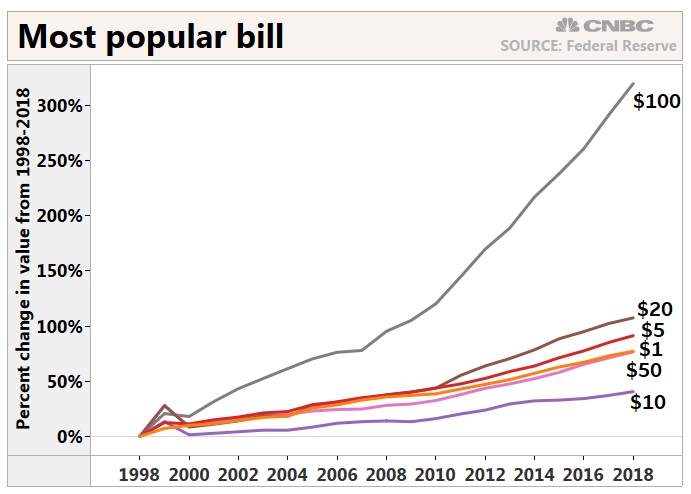
The amount of U.S. $100 bills across the globe in circulation hit its highest level in history last year, according to new data from the Federal Reserve released this week. That total grew by about 7 percent, or $92 billion year over year, to a record $1.3 trillion worth.

The number of outstanding C-notes has doubled since the financial crisis, according to the Fed. But it's probably not due to real demand to spend those large bills.

Growth in U.S. bills between $1 and $20 was much weaker at about 2.6 percent year over year. That slowed from 3.6 percent a year earlier. The weaker demand for small currency is likely due to a rise in mobile payments.

To put the demand in perspective, the rise in $100 bills was three times higher than the increase in small bills. That suggests that these large bills are being used more as a store of value, as the U.S. dollar continues to be the world's reserve currency.

For the most part, economists believe the surge is due to people around the globe wanting to hoard cash — a similar force that's boosted interest in cryptocurrencies. High-denomination currency notes are known as a preferred form of payment for criminals, given the lack of a transaction record, anonymity, and the ease with which they can be brought across borders.

Tracking corruption

Nicholas Colas, co-founder of DataTrek Research who has been tracking the $100 currency boom for about a decade, said he was expecting it to slow slightly. That has yet to happen and as he pointed out, we're approaching the point where every human being on the planet could have two $100 bills in their pocket.

"Demand as a store of value far exceeds the demand for transactional cash," Colas said. "It does lead to challenges if you want to track and deal with corruption, or not paying your taxes, or any of any other thing that cash also incidentally enables."

While evidence is anecdotal and happens on a country-by-country basis, Colas said crime and use on the black market is a contributing factor in demand.

Some economists have called for the abolition of high-denomination bills. Lawrence Summers, a former Treasury secretary and director of the National Economic Council in the White House, wrote an op-ed in The Washington Post in 2016, citing its potential for crime.

A "moratorium on printing new high denomination notes would make the world a better place," he wrote, citing a Harvard research paper written by Peter Sands, former chief executive of the bank Standard Chartered. Sands also argued to scrap the high-value currency notes. Eliminating them "would make life harder for those pursuing tax evasion, financial crime, terrorist finance and corruption," Sands wrote.

The Fed is likely not eager to ease the printing of dollar bills. Colas pointed out that it helps the U.S. remain a reserve currency, and therefore more valuable.

Overseas buyers

Most of it is overseas. A 2018 research paper from the Federal Reserve Bank of Chicago estimates that 60 percent of all U.S. bills and almost 80 percent of all $100 bills are now abroad. That total is up from 15 to 30 percent around 1980, according to research from Ruth Judson, a Federal Reserve Board economist. Judson found that political and economic instability contribute to this demand.

Colas said the Federal Reserve and Treasury are not incentivized to scale back production as long as they profit off of printing bills, then selling them offshore. It's also helpful from a policy perspective.

"It does reinforce the notion of reserve currency status, which is tremendously useful to American monetary policy and foreign policy," Colas said. "There's a desire to keep printing these things."

-30-

Cheers,

/s/ ikeyPikey
Valued Member
PacoMartin's Avatar
United States
411 Posts
 Posted 04/05/2019  12:04 am  Show Profile   Bookmark this reply Add PacoMartin to your friends list Get a Link to this Reply
Year	$1	$2	$5	$10	$20	$50	$100	
2018	12.4	1.3	3.1	2.0	9.4	1.8	13.4	
Billions of notes in circulation

Quote:
High-denomination currency notes are known as a preferred form of payment for criminals, given the lack of a transaction record, anonymity, and the ease with which they can be brought across borders.

Published Thu, Apr 4 2019 Kate Rooney@Kr00ney


The latest data says there are 13.435 billion $100 banknotes in circulation as opposed 12.4 billion $1 banknotes and than 9.4 billion $20 banknotes. The other four denominations are circulating between 1.3 and 3.1 billion notes.

Everyone concentrates upon the ease with which large denomination banknotes can be brought across order, which refers to the value per pound.

But transportation is only part of the money laundering problem.

The $100 banknote circulation is at 13.4 billion, so it is not that hard to spend. The €50 banknotes circulation is
10.2 billion and the €100 circulation is 2.8 billion.

If I was running a money laundering operation in Euro Area I would try to work in €50 banknotes. While admittedly for transportation the €500 banknotes would only weigh 10% as much, it is so much easier to spend the €50 banknotes because they are so common.


Quote:
Meanwhile, overall global demand for cash is slowing down.
Published Thu, Apr 4 2019 Kate Rooney@Kr00ney


I don't see any evidence that supports that claim. Study after study shows that every country is increasing cash at a rate much faster than GDP. The only exception is in Scandinavia (Norway, Sweden, and Denmark). The Scandinavian countries have a very sophisticated, and more importantly, universally accepted app that allows them to make instant transfers of money between bank accounts. The apps are much easier to use than PayPal.
Edited by PacoMartin
04/05/2019 12:11 am
  Previous TopicReplies: 224 / Views: 28,927Next Topic
Page: of 15

To participate in the forum you must log in or register.


Disclaimer: While a tremendous amount of effort goes into ensuring the accuracy of the information contained in this site, Coin Community assumes no liability for errors. Copyright 2005 - 2026 Coin Community Family- all rights reserved worldwide. Use of any images or content on this website without prior written permission of Coin Community or the original lender is strictly prohibited.
Contact Us  |  Advertise Here  |  Privacy Policy / Terms of Use

Coin Community Forum © 2005 - 2026 Coin Community Forums
It took 0.48 seconds to rattle this change. Forums