First Page
 Previous Page



 Posted 09/17/2023 9:49 pm


Apollo 16
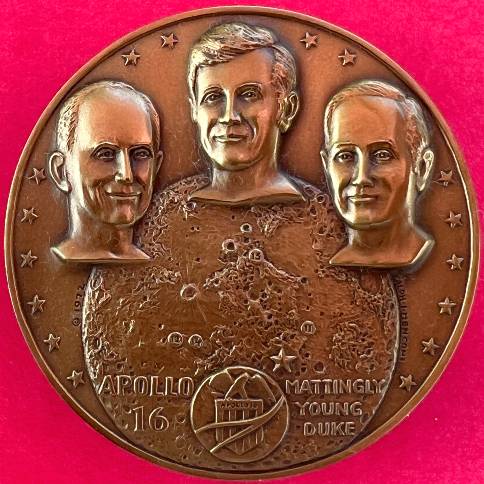
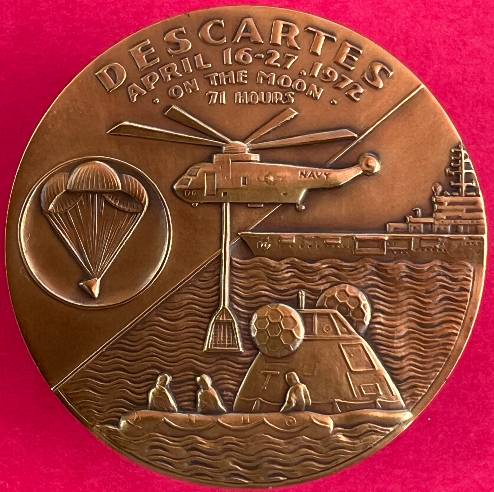
Naval Captain John Young, a veteran of the Gemini program and a member of the Apollo X crew that orbited the Moon in May 1969, was joined on the lunar surface by USAF Lieutenant Colonel Charles Duke at 11:59 a.m., April 21, 1972. Together, they completed a record 20 hours, 14 minutes of "Extra Vehicular Activity" (EVA) in the highland regions near the Crater Descartes, while Lieutenant Commander Thomas K. Mattingly II, orbited above in Casper, the command ship.
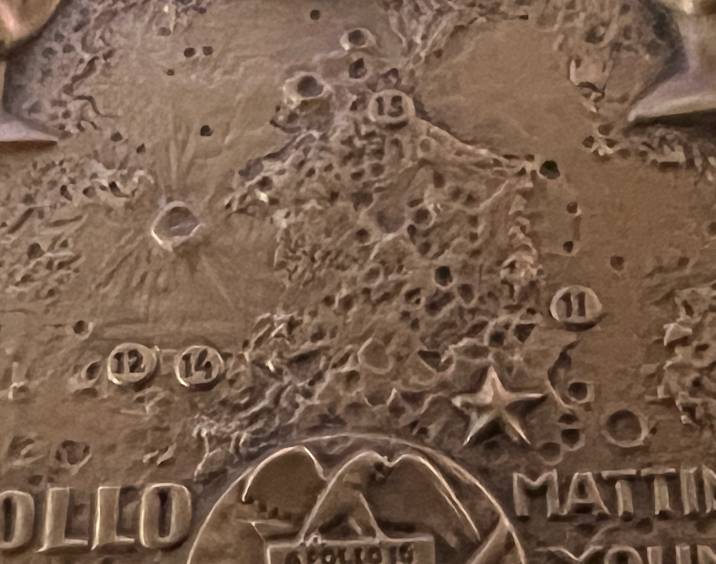
On the medal's obverse, Menconi's portrait of the moon depicts the landing sites of each of the Apollo missions:
The 16 stars on the outer edge of the total design commemorate the mission flight number. The reverse depicts the recovery team, including the U.S.S. Ticonderoga. Dated 1972.
Apollo 17
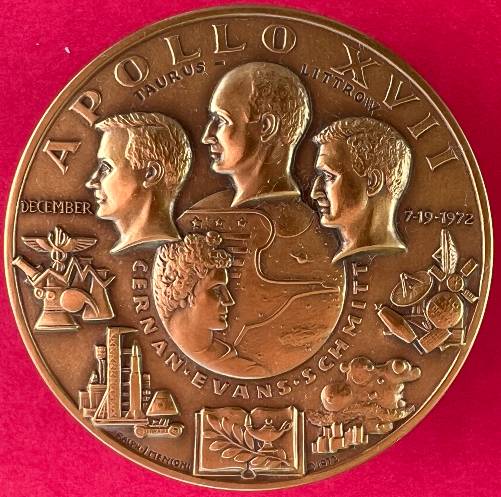
The final Apollo flight in December, 1972, marked the first visit of a civilian scientist-astronaut, geologist Dr. Harrison Schmitt and was led by Navy Captain Eugene Cernan, one of 14 astronauts selected by NASA in October 1963. Like Neil Armstrong, Cernan earned his undergraduate degree at Purdue. Schmitt and Cernan piloted the Lunar Lander Challenger to within 400 ft of their intended target in the Taurus-Littrow valley while Navy Commander Ronald Evans orbited in the command module America above.
"Central in the design of the medal's obverse in the Apollo 17 mission patch, which features the head of Apollo superimposed over an American Eagle. The eagle's wing represents the bars of the U.S. flag. . .the eagle's wing partially overlaps the moon, suggesting a body that has been visited, while both Apollo and the eagle point toward Saturn and a galxy, suggesting other space challenges remain." Symbols arrayed around the lower section of the obverse design "signify knowledge gained in the areas of medicine, science, engineering, exploration, navigation, propulsion, communications, geology. . ."
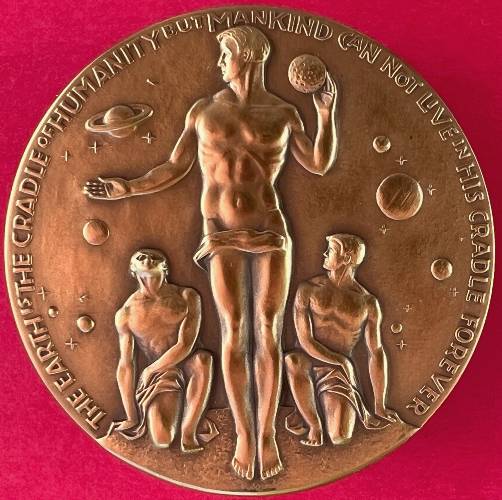
"The reverse. . .depicts the interdependence of US spaceflights from Mercury through Gemini and the Apollo series. . .the kneeling figures of Mercury and Gemini are shown striving to break out of Earth orbit while the central figure, Apollo, has achieved and holds the Moon." Lettering on the outer rim quotes Russian rocket scientist Konstatin Tsiolkovsky:
"The Earth is the cradle of humanity but mankind can not live in his cradle forever." Medal Date: 1972
Naval Captain John Young, a veteran of the Gemini program and a member of the Apollo X crew that orbited the Moon in May 1969, was joined on the lunar surface by USAF Lieutenant Colonel Charles Duke at 11:59 a.m., April 21, 1972. Together, they completed a record 20 hours, 14 minutes of "Extra Vehicular Activity" (EVA) in the highland regions near the Crater Descartes, while Lieutenant Commander Thomas K. Mattingly II, orbited above in Casper, the command ship.
On the medal's obverse, Menconi's portrait of the moon depicts the landing sites of each of the Apollo missions:
The 16 stars on the outer edge of the total design commemorate the mission flight number. The reverse depicts the recovery team, including the U.S.S. Ticonderoga. Dated 1972.
Apollo 17
The final Apollo flight in December, 1972, marked the first visit of a civilian scientist-astronaut, geologist Dr. Harrison Schmitt and was led by Navy Captain Eugene Cernan, one of 14 astronauts selected by NASA in October 1963. Like Neil Armstrong, Cernan earned his undergraduate degree at Purdue. Schmitt and Cernan piloted the Lunar Lander Challenger to within 400 ft of their intended target in the Taurus-Littrow valley while Navy Commander Ronald Evans orbited in the command module America above.
"Central in the design of the medal's obverse in the Apollo 17 mission patch, which features the head of Apollo superimposed over an American Eagle. The eagle's wing represents the bars of the U.S. flag. . .the eagle's wing partially overlaps the moon, suggesting a body that has been visited, while both Apollo and the eagle point toward Saturn and a galxy, suggesting other space challenges remain." Symbols arrayed around the lower section of the obverse design "signify knowledge gained in the areas of medicine, science, engineering, exploration, navigation, propulsion, communications, geology. . ."
"The reverse. . .depicts the interdependence of US spaceflights from Mercury through Gemini and the Apollo series. . .the kneeling figures of Mercury and Gemini are shown striving to break out of Earth orbit while the central figure, Apollo, has achieved and holds the Moon." Lettering on the outer rim quotes Russian rocket scientist Konstatin Tsiolkovsky:
"The Earth is the cradle of humanity but mankind can not live in his cradle forever." Medal Date: 1972
Edited by cptbilly
09/18/2023 10:32 am
09/18/2023 10:32 am