Getting back to this thread, I realized I never posted the fifth spear counterpoise that I mentioned above. It is here:
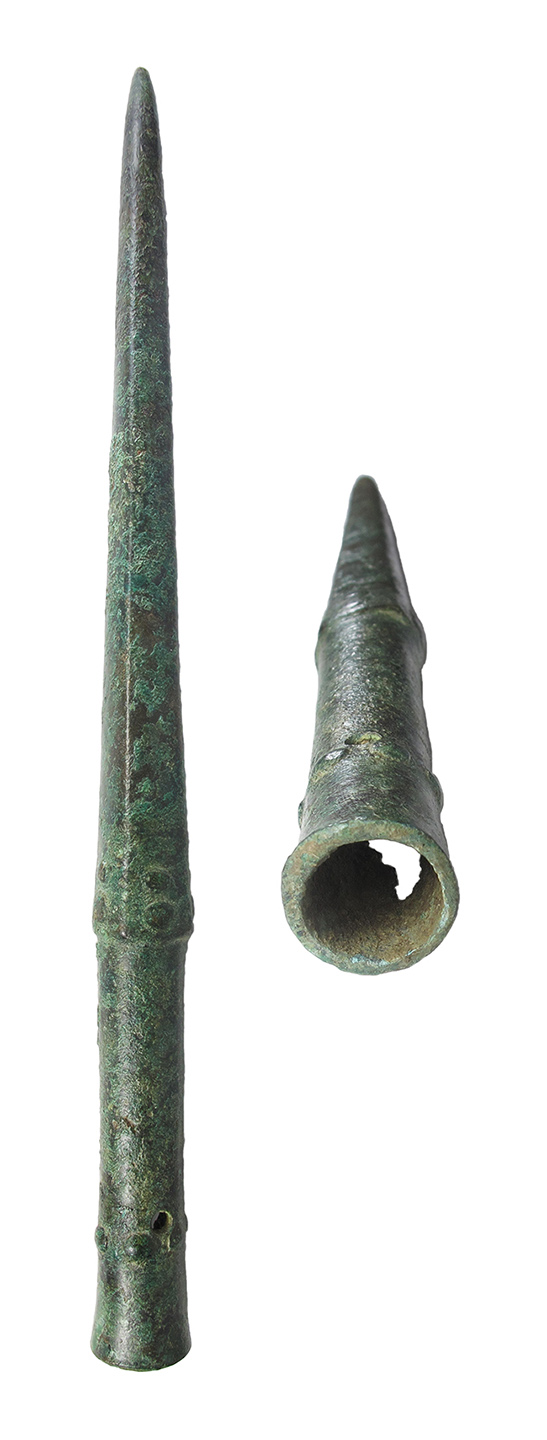
AE Spear Butt (Counterpoise) #05
Western Asia (likely NW Iran)
Early first millennium BC
21.92cm (8.63")
Just added three very interesting spearheads to the collection and gallery this week. They are designated "AE Spearhead #'s 26, 27, and 28" in my inventory. None is a run-of-the-mill, easier-to-acquire, undecorated tanged blade.
Each is likely from Western Asia. (Two of the three are almost certainly from the Gilan region of northwestern Iran, along the southwestern coastal area of the Caspian Sea.) Each likely dates to the Early Iron Age I and II in Iran (1200 - 800 BC).
One (#26) is possibly unique in its particular combination of form and incised decoration.
Another (#27) is very large, measuring to almost 25". It is not only the longest spearhead I now own, but also simply the longest weapon in my collection - period.
The third (#28) is a very rare type that I have wanted for quite a while. I have known of the type only from reference books - and a single other specimen I spotted on the market.
Some images and background are below.
AE Spearhead #26 (below)
Luristan?
1200 - 800 BC
31.6 cm (12.4")
Description:
Elongated blade with shaft encasing tang, incised decoration, tip broken.
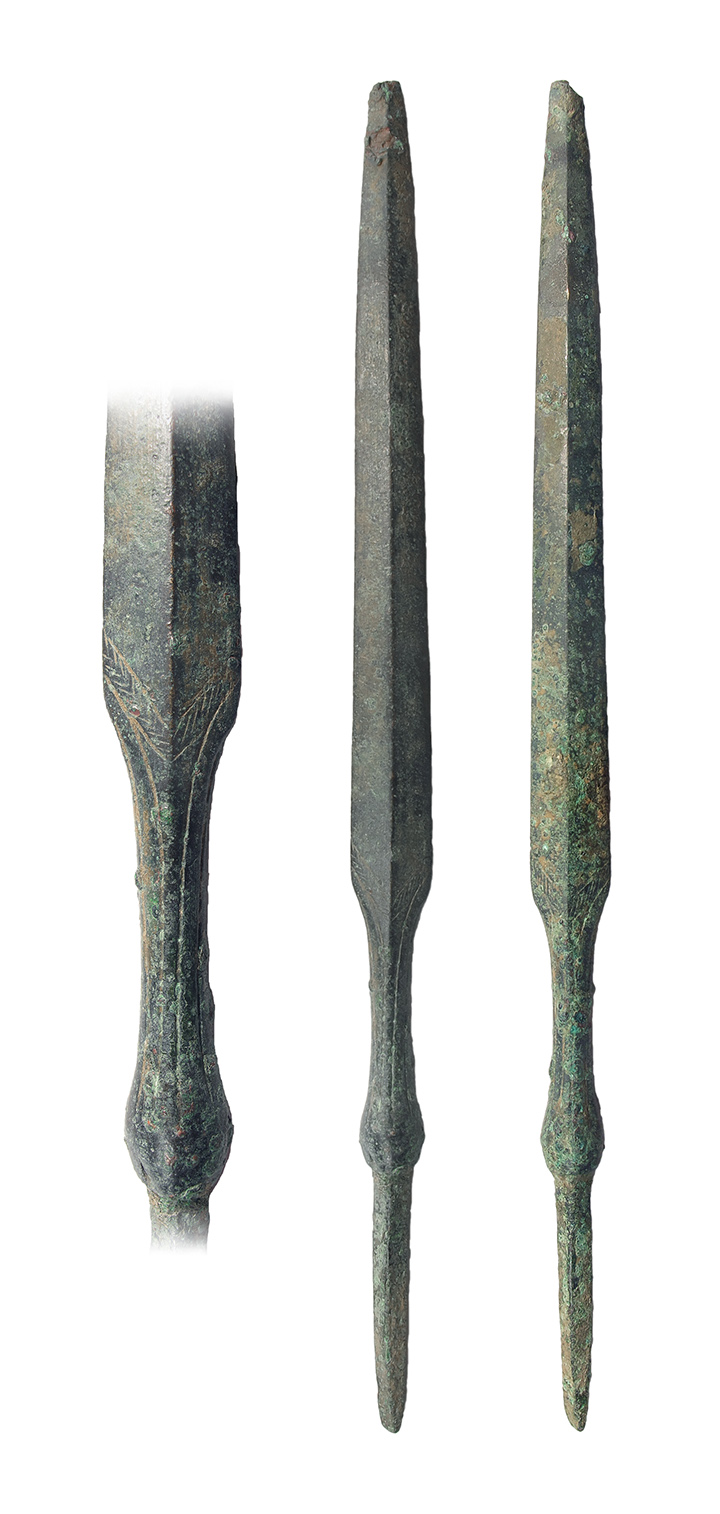
This spearhead (above) is a bit mysterious. Usually, I can ID my weapons with a fair degree of confidence using a number of scholarly references that I have access to. However, I've actually never seen any other specimen quite like this one. The tentative attribution to Luristan (I include a "?" after "Luristan" in its description in my gallery) - is speculative and is based on a slight resemblance to similarly profiled, rare Luristani spearheads I've seen in references. The blade, which is very narrow and long, has a flattened diamond cross-section. Incised geometric decoration is occasionally encountered on ancient Iranian bronze weapons of the Early Iron Age (although more often on daggers and arrowheads).
AE Spearhead #27 (below)
NW Iran (Possibly Marlik)
1200 - 800 BC
62.5 cm (24.6") x 65 mm (2.56")
Description:
Large spearhead with long socket progressing from circular to rectangular cross-section, leaf-shaped blade.
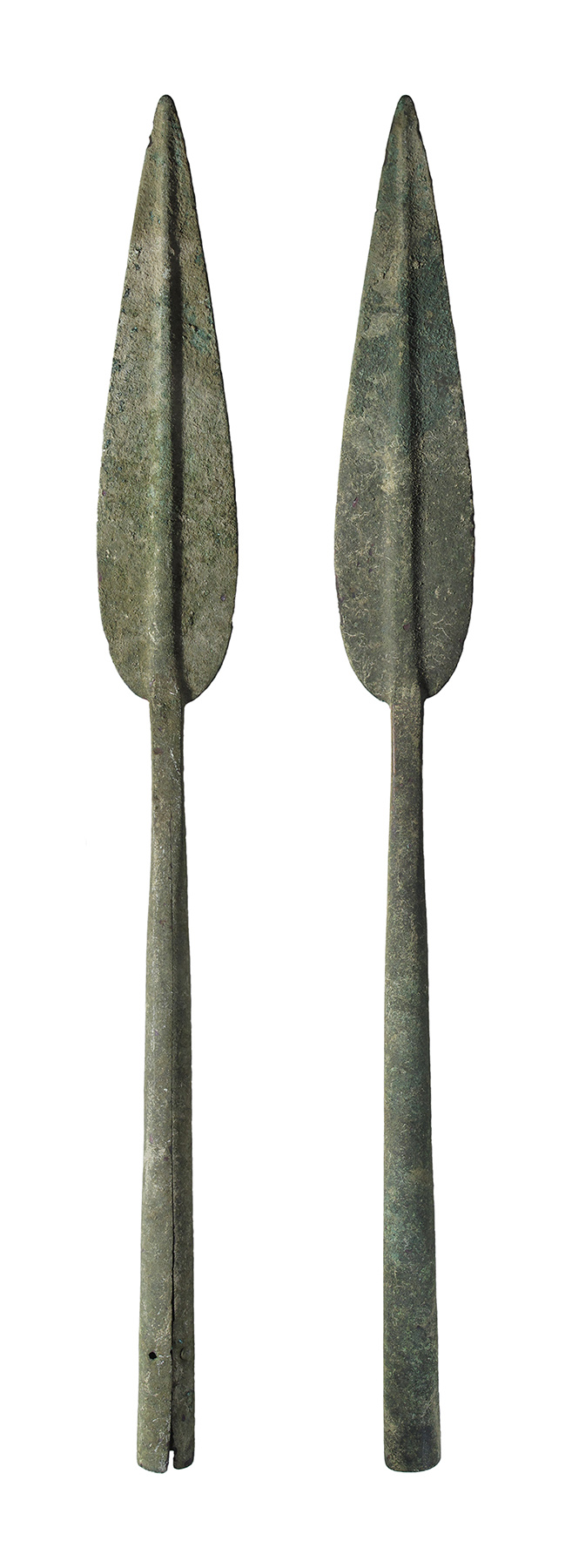
The spearhead above is a type associated with Marlik, an excavated mound in Gilan in northwest Iran. The inhabitants of Marlik "seem to have flourished from near the end of the second millennium B.C. to the beginning of the first...contemporaneously with the last Middle Assyrian kings." (
Art of the Marlik Culture by Charles K. Wilkinson, Curator Emeritus of Near Eastern Art at the Met)
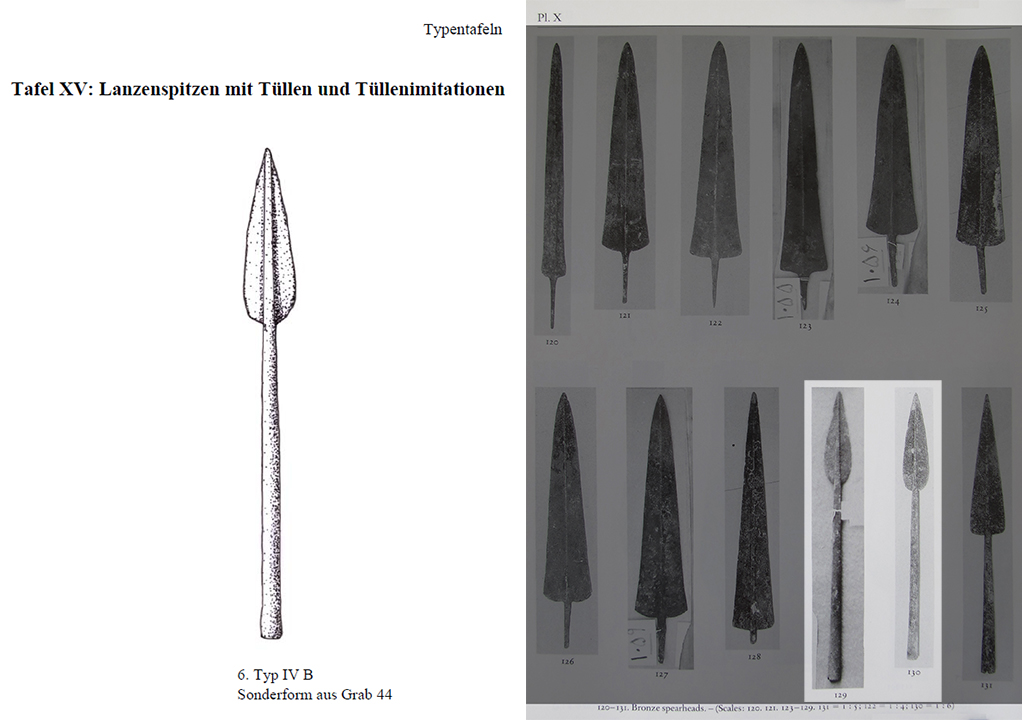
While I do already own one of these with long socket and leaf-shaped blade (AE Spearhead #20 in my gallery) - this new one, at almost 25", is double the length and therefore truly special. To give a sense of how large this new monster is, I am including a photo for context below. It shows the two Marlik spearheads as they currently reside, side-by-side in one of my display cases. I also include reference pics of the type from Christian Konrad Piller's
Untersuchungen zur relative Chronologie der Nekropole von Marlik (
Investigations on the Relative Chronology of the Necropolis of Marlik) and Ezat O. Neghaban's
Weapons from Marlik.
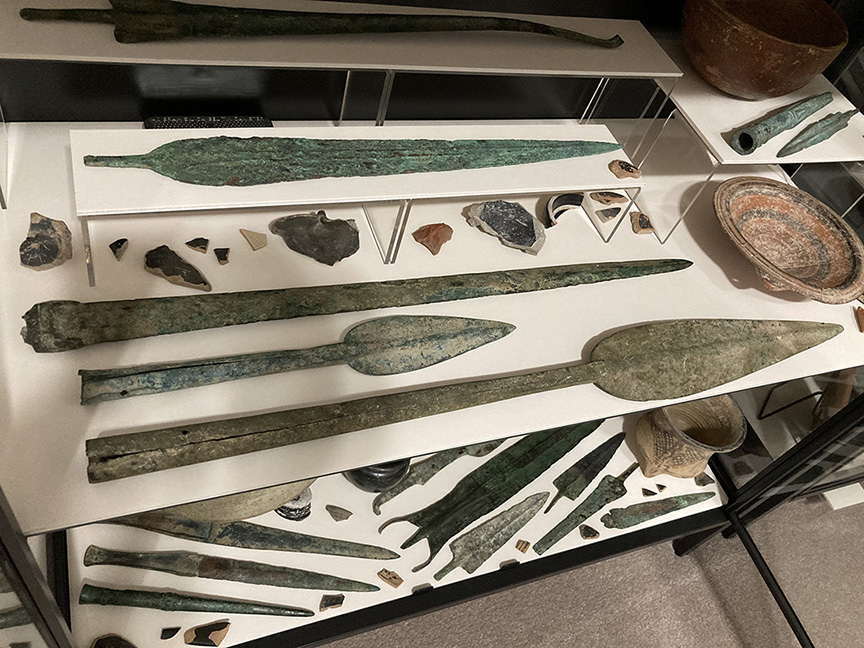
AE Spearhead #28 (below)
NW Iran (Possibly Marlik)
1200 - 800 BC
23 cm (9")
Description:
Long, hollow cylindrical socket (damaged at end); two bands encircling socket to help secure spearhead to shaft; incised horizontal lines near rounded shoulders; pronounced circular-sectioned midrib tapering toward point; small losses.
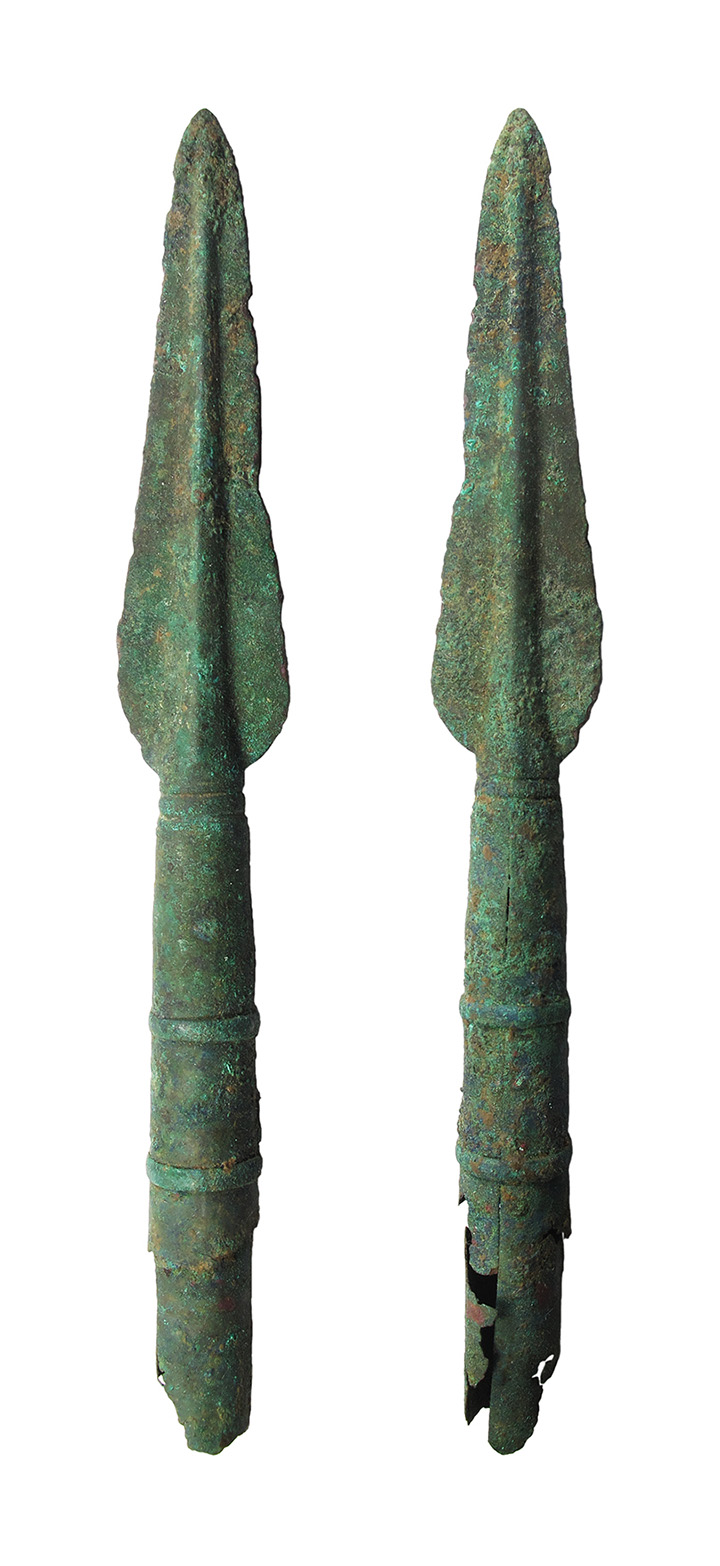
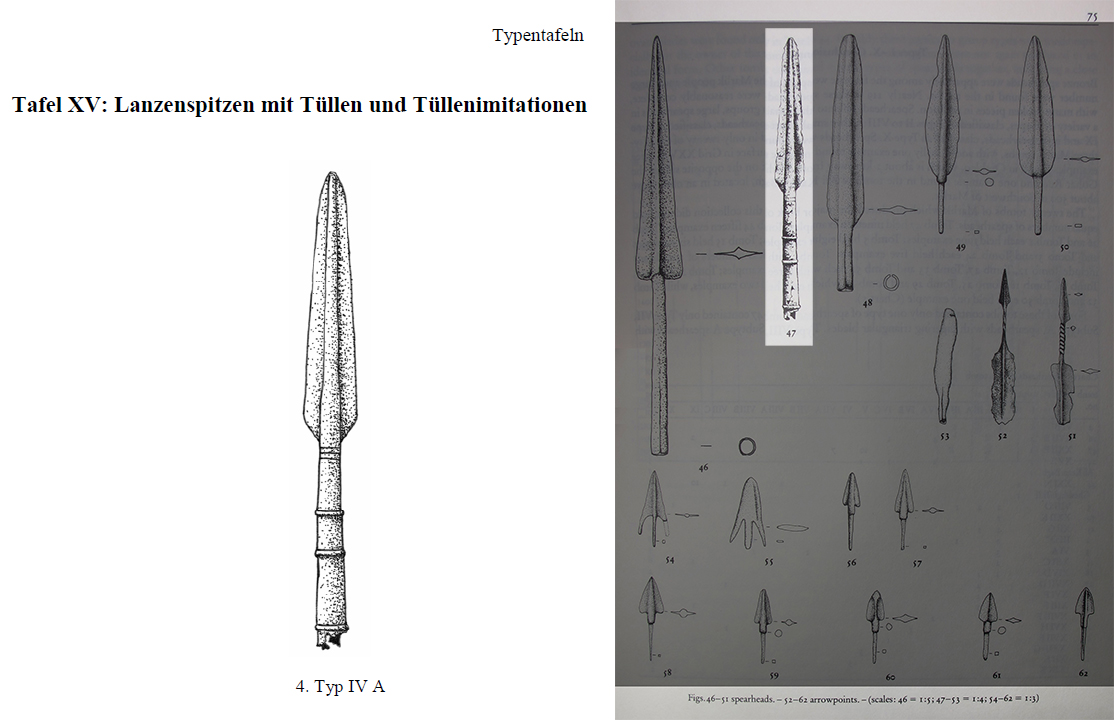
AE Spearhead #28 is a rare type also associated with Marlik. Its most striking (pardon the pun) feature is the two bronze bands encircling the socket. Reference illustrations of the type, from Piller and Neghaban, are below.








 First Page
 Previous Page


 Posted 05/14/2022 5:19 pm


