| Author |
 Replies: 638 / Views: 59,857 Replies: 638 / Views: 59,857 |
|
|
|
Pillar of the Community
United States
7067 Posts |
Good, informative write-up as usual. Nice, roomy flan in relation to the imagery on this one.
|
|
Pillar of the Community
 Spain
2752 Posts |
 with Bob, enjoyed the write up... Jim at 23mm one of your bigger Greek coins? Must feel quite different in hand?.....Paul Edited by Palouche
09/30/2020 7:06 pm
|
|
Pillar of the Community
 United Kingdom
1168 Posts |
Thanks Bob. There is such a difference to the very tight flan sizes that most coins have, and less chance of any detail being lost. It is indeed one of the bigger Greek bronzes in the collection, Paul. The larger coins feel very nice in hand, whereas I hardly know that the small ones are there! 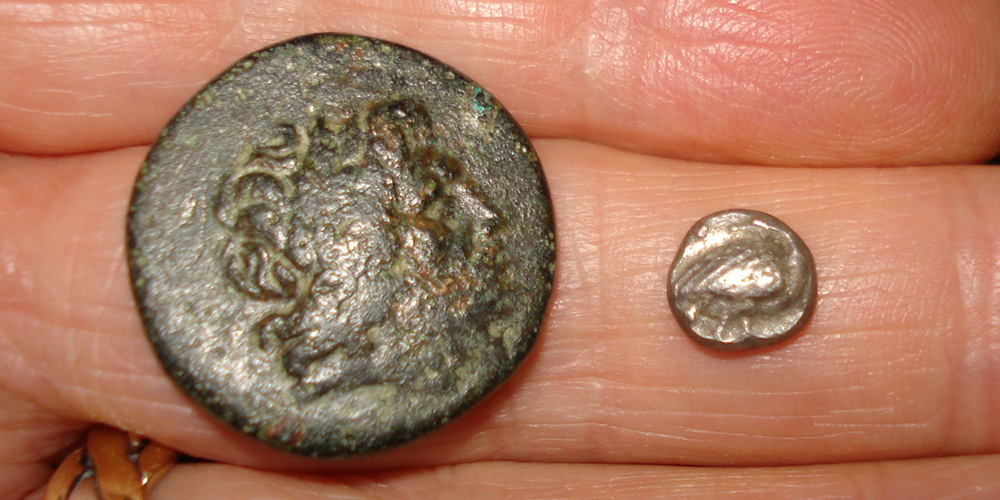 |
|
Pillar of the Community
United Kingdom
1168 Posts |
This coin from Olbia is the smallest coin in the collection, with a diameter of only 7 mm. Olbia was an important commercial port for the export of cereals, fish, and slaves to Greece, and for the import of Attic goods to Scythia. It was noted for it's unusual cast dolphin money, which circulated around the 5th century to the 4th century BC. The ancient city is located on the shore of the Southern Bug estuary (Hypanis) in Ukraine, near the village of Parutyne. The lower part of the town consisted mainly of dockyards and the houses of artisans, but is now almost completely submerged in the Bug River. The upper town contained the residential quarter, which was composed of square blocks and centred on the agora. In the early 5th century, a temple to Apollo Delphinios was built on the site. It has been mooted that the cast dolphin money may have originated from sacrificial tokens used in the Temple of Apollo Delphinios. 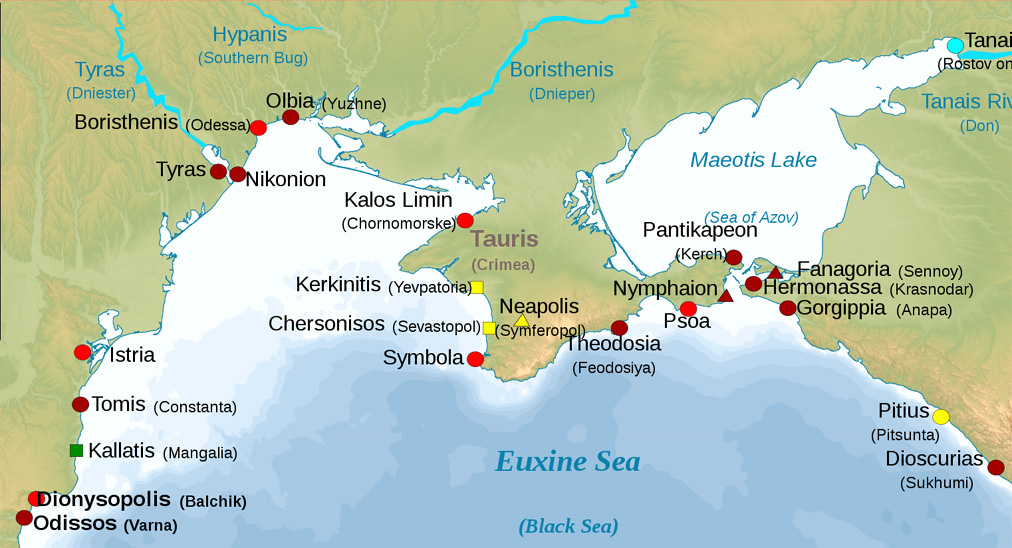 To this day there is a large population of bottle-nose dolphins in the Black Sea. Ancient Greek mythology acknowledges the dolphin, Delphinus, as the "Sacred Fish" and it appears as a theme many times in Greek mythology. A dolphin helped Poseidon locate the mermaid Amphitrite who he brought back to his golden palace to be his Queen. As a reward, Poseidon placed the dolphin in the constellation Delphinus. 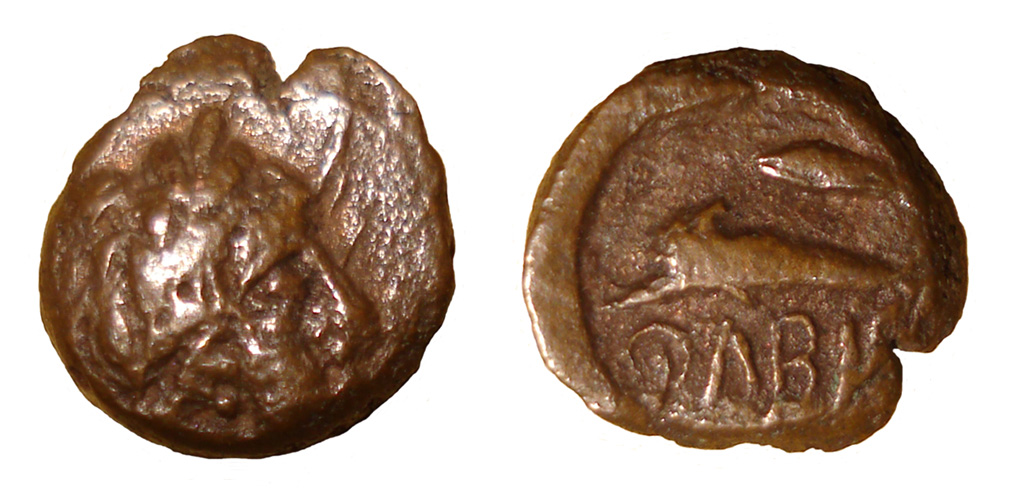 Thrace Sarmatia Olbia ca. 330 - 300 BC. Obverse: Head of Apollo right. Reverse: Dolphin swimming left; corn grain above; ΟΛΒΙΟ below. Bronze. Diameter: 7 mm. Weight: 0.7 gr. Anokhin 113. |
|
Pillar of the Community
Russian Federation
5186 Posts |
Very neat! 7 mm ancient silvers come in very many kinds, but a 7 mm bronze is pretty peculiar. It must have been one of the least-diameter bronze coins ever issued. I doubt it would have bought much at the time.
I also have a coin from Olbia, though I don't think it features a dolphin (I don't recall offhand what it does feature), and of course it is much larger (18 mm, IIRC).
|
|
Pillar of the Community
United Kingdom
1168 Posts |
Quote:
Very neat! 7 mm ancient silvers come in very many kinds, but a 7 mm bronze is pretty peculiar. It must have been one of the least-diameter bronze coins ever issued. I doubt it would have bought much at the time. I have a couple of small silver coins (8 mm to 10 mm) featuring animals, but this is the first bronze coin I've seen of this size. No, it would not have bought much at the time, and was just small change. It is pretty neat though, and my first dolphin. |
|
Pillar of the Community
Spain
2752 Posts |
Wow Jim that's small!....It always amazes me how much recognisable detail can be portrayed on such small flans!
Thanks for the write up and congrats on your first dolphin.
ps...Nice photo comparing the size difference, really puts it into perspective!
|
|
Pillar of the Community
United Kingdom
1168 Posts |
Quote:
Nice photo comparing the size difference, really puts it into perspective! Thanks Paul. There isn't the same tactile quality when handling a tiny coin, as there is with a large bronze, but the appeal for me is in the fine detail that the engraver achieves on such a small scale. It was great to get not only the dolphin, but to find it on such a tiny bronze. Something I hadn't come across before. I got my first griffin. Well, at least it's the head of a griffin. Northernmost of the Ionian cities, Phokaia (Phocaea) lay on the boundary with Aeolis. It was located near the mouth of the river Hermus (now Gediz), and situated on the coast of the peninsula separating the Gulf of Cyme to the north, and the Gulf of Smyrna (now Izmir) to the south. The ancient Greek geographer Pausanias says that Phocaea was founded by Phocians under Athenian leadership, on land given to them by the Aeolian Cymaeans, and that they were admitted into the Ionian League after accepting the line of Codrus as kings. Following the Lydians, the Phocaeans were among the earliest in the world to make and use coins as money. The earliest coins were made of electrum, from early in the 6th century until the time of Alexander. A series was produced in conjunction with the Lesbian mint of Mytilene. Many of the coins feature a griffin, or a griffin's head. Since classical antiquity, griffins were known for guarding treasures and priceless possessions. In Greek and Roman texts, griffins were associated with the gold deposits of Central Asia. As Pliny the Elder wrote, "griffins were said to lay eggs in burrows on the ground and these nests contained gold nuggets." A classical folklorist, proposes that the griffin was an ancient misconception derived from the fossilized remains of the Protoceratops found in gold mines in the Altai mountains. Phocaea had two natural harbours, allowing it to develop a thriving seafaring economy, and to become a great naval power. Their sea travel was extensive. They were said to have traded with the Greek colony of Naucratis in Egypt, which was the colony of their fellow Ionian city Miletus. They are also said to have helped settle Amisos on the Black Sea, and Lampsacus at the north end of the Hellespont. Phocaea's major colonies however were to the west. These included Alalia in Corsica, Emporiae and Rhoda in Spain, and Massalia (Marseille) in France. According to Herodotus the Phocaeans were the first Greeks to make long sea-voyages. Herodotus also relates that they so impressed Arganthonios, king of Tartessus in Spain, that he invited them to settle there, and, when they declined, gave them a great sum of money to build a wall around their city. Recent archaeological surveys have shown that the city of Phocaea was large for the archaic period. Herodotus gives an idea of the size of Phocaea by describing the walls as having a length of several stadia. This was based on the circumference of a typical sports stadium of the time, with one stadion being equal to 600 Greek feet. 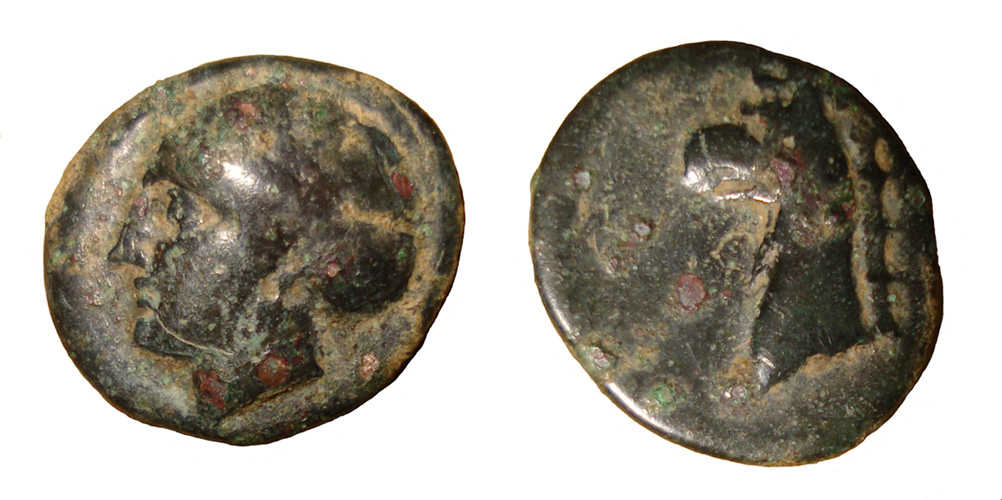 Ionia Phokaia 350-300 BC Obverse: Head of nymph (or Aphrodite?) left, with hair in sphendone. Reverse: Head of Griffin Left. Bronze. Diameter: 12 mm. Weight: 1.6 gr. SG 4537 Edited by Novicius
10/02/2020 8:26 pm
|
|
Pillar of the Community
Spain
2752 Posts |
 ....Nice coin!...I know you've been trying to pick up a griffin for a while now Congrats! Jim whilst I was researching my Hermes coin from Phokaia I came across some really interesting articles about some quite recent archaeological digs in and around the area. They'd just unearthed some big Griffin statues and were looking into the impact this creature had had on the local community....But I can't find it now!! If I do I'll send a link. |
|
Pillar of the Community
United States
7067 Posts |
Congrats on your first griffin, Jim!
|
|
Pillar of the Community
United Kingdom
1168 Posts |
Thanks Paul and Bob. Yes, if you can find the article I'd love to see it Paul. A bit of help needed with this one. Originally listed as Spain, Castulo, 2nd cent BC. Obverse: Diademed head right, palm before. Reverse: Bull right, crescent above. Burgos 558. There is no palm to be seen on the obverse, and there is no crescent on the reverse, so it is doubtful that it would be Burgos 558. The nearest match I can find is: https://www.acsearch.info/search.html?id=4282268The head on the obverse looks typical of the type. The CN would be on the left of the bust reading upwards, and the VOC S T F would be to the right of the bust reading upwards. The VOC is visible on my coin. On the reverse of the ACSearch coin there is a CN and a crescent above the bull, and FVL CN F before. However, on my one there is C N F V L above the bull. All the others I've seen have crescents above the bull on the reverse, apart from my one. The one on ACSearch is 23 MM in diameter, but mine is much smaller at 18 mm. The reverse is off-centre, so it is impossible to tell if there was anything in the exergue. Can anyone shed some light on it? 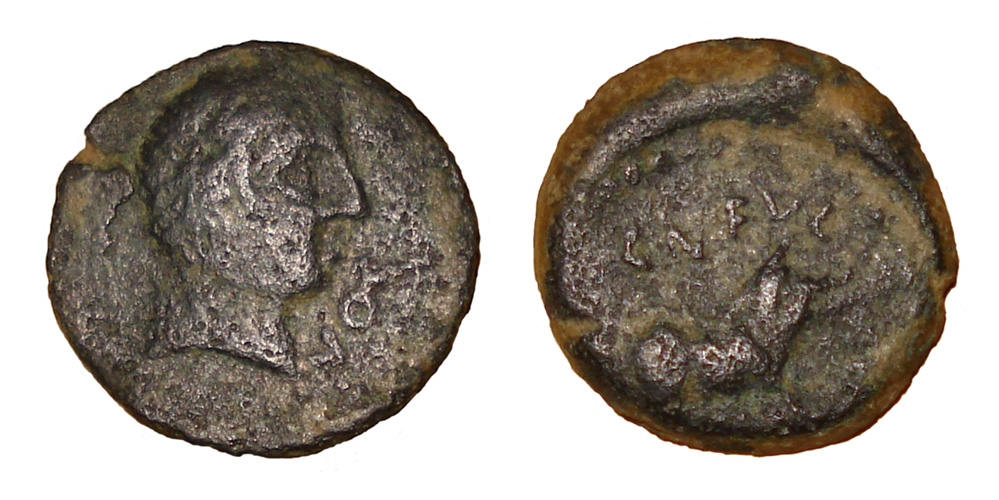 |
|
Pillar of the Community
United States
7067 Posts |
I agree with your readings of the remnants of legends. I would guess this is an interesting variant of the Castulo type you describe - perhaps sans crescent.
|
|
Pillar of the Community
United Kingdom
1168 Posts |
It sure looks that way Bob. I've looked through dozens of pages, and hundreds of images without a decent match. It has been the most frustrating coin to try to research so far.  |
|
Pillar of the Community
United Kingdom
1168 Posts |
Though older, this coin from Miletus was much easier to research. Miletus, (romanized: Miletos), was an ancient Greek city on the western coast of Anatolia, near the mouth of the Maeander River in ancient Caria. Its ruins are located near the modern village of Balat, in Aydin Province, Turkey. Before the Persian invasion in the middle of the 6th century BC, Miletus was considered to be among the greatest and wealthiest of Greek cities. 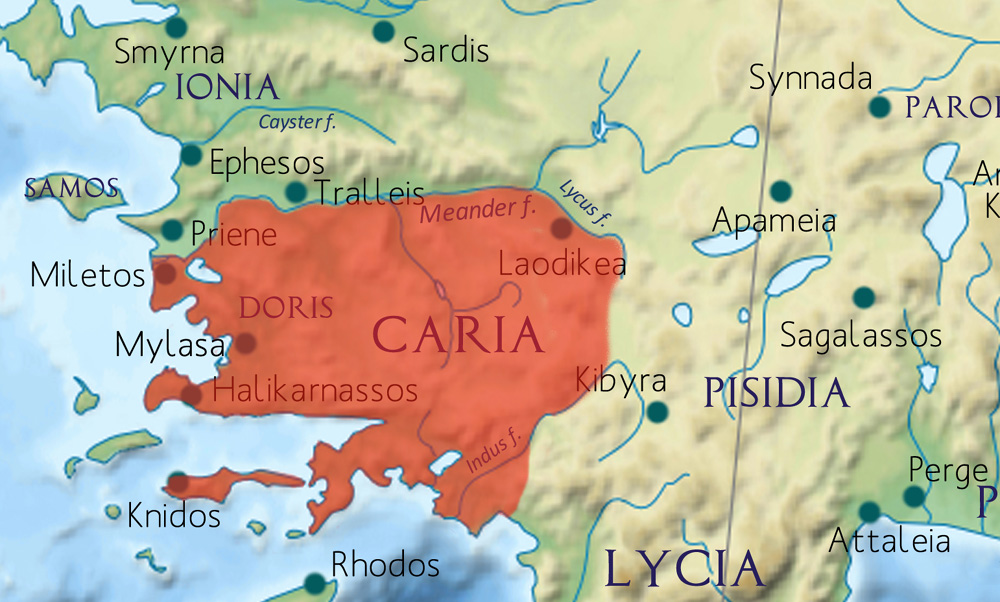 The earliest evidence of a settlement at Miletus dates to the Neolithic period. Evidence of the first settlement has been made inaccessible due to the rise in sea level, and the deposit of sediments from the Maeander river. This coin would have been minted around the period when Alexander the Great liberated the city from Persian rule. It appears to be a scarce, uncommon early issue, and most likely the earliest form of AE issue from Miletus. In 387 BC the Peace of Antalcidas gave the Persian Achaemenid Empire under king Artaxerxes II, control of the Greek city-states of Ionia, including Miletus. When Artaxerxes II died in 358 BC he was succeeded by his son Artaxerxes III. In 355 BC Artaxerxes III forced Athens to conclude a peace which required its forces to leave Asia Minor (Anatolia) and acknowledge the independence of its rebellious allies. Alexander the Great of Macedonia laid siege to Miletus in 334 BC, liberating the city from Persian rule. During this period the city reached its greatest size, occupying within its walls an area of approximately 90 hectares (220 acres). Alexander died in 323 BC, and Miletus, and his satrap of Lydia, Asander, came under the control of Ptolemy. In 312 BC, Macedonian general Antigonus I Monophthalmus sent Docimus and Medeius to free the city and grant autonomy, restoring the democratic patrimonial regime. In 301 BC, Antigonus I was killed in the Battle of Ipsus by the coalition of Lysimachus, consisting of Cassander, ruler of Macedon; Lysimachus, ruler of Thrace; and Seleucus I Nicator, ruler of Babylonia and Persia. Miletus then maintained good relations with all the successors, after Seleucus I Nicator (founder of the Seleucid Empire) made substantial donations to the sanctuary of Didyma, and returned the statue of Apollo that had been stolen by the Persians in 494 BC. 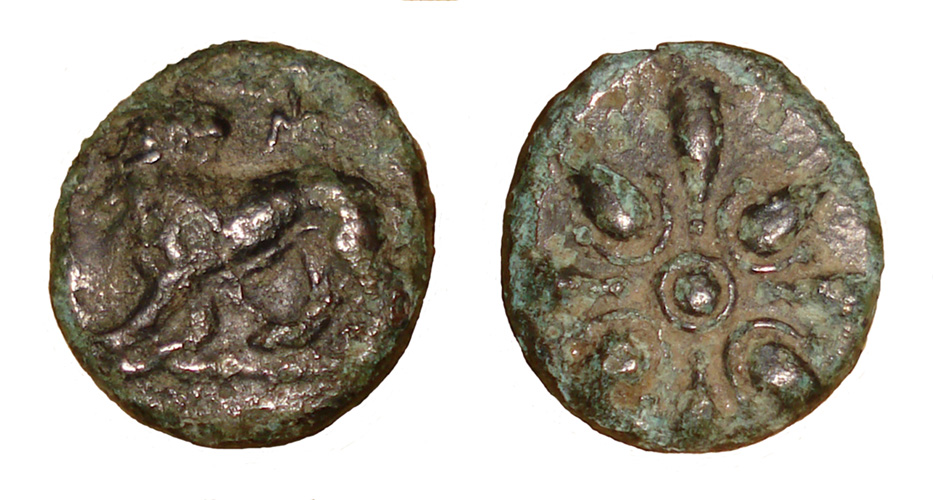 Ionia, Miletus, 350 - 300 BC. Obverse: Lion walking left, head reverted, looking at Miletus monogram. Reverse: Stellate pattern. Bronze. Diameter: 13 mm. Weight: 1.9 gr. SNG Cop 972-3. Edited by Novicius
10/06/2020 7:15 pm
|
|
Pillar of the Community
United States
7067 Posts |
What a nicely designed coin.  And what a great thread this has become. Very informative. Thanks for the continuing history lessons, Jim. |
| |
Replies: 638 / Views: 59,857 |





 First Page
 Previous Page


 Posted 09/30/2020 7:02 pm





