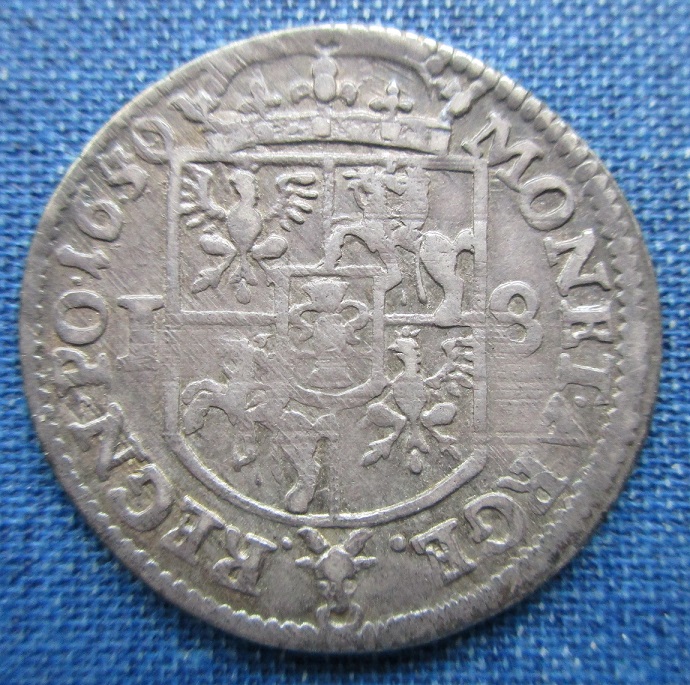
Since not everyone may want to read the history that follows, I will put this question at the beginning rather than the end: can you think of a monarch who reigned for a long time, yet never issued coins in his name?
Stanislaw Leszczynski was such a monarch, and an interesting figure of mid-18th century Europe. Born to a powerful Polish family at a time when Poland was increasingly a pawn in the power struggles of the major European states, he became King of Poland and Grand Duke of Lithuania in 1704, after Charles XI of Sweden invaded Poland, deposed the incumbent king, Augustus II "The Strong" (who was simultaneously Friedrich August, elector of Saxony), and engineered Stanislaw's accession. But when Charles' fortunes took a turn for the worse in 1709 with military defeat at the hands of Russia, Augustus II was restored, and Stanislaw was forced to flee.
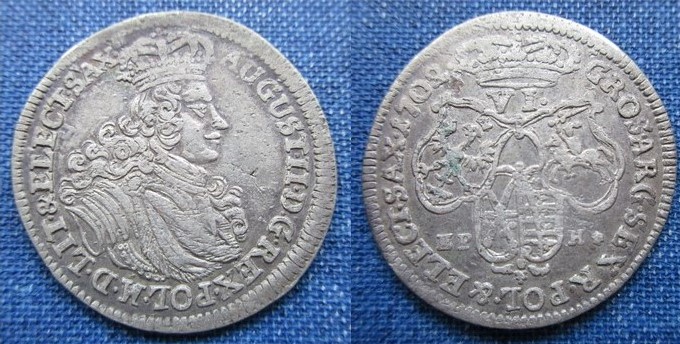
Here is a Polish 6 groschen (szostak) of the first part of Augustus II's reign:
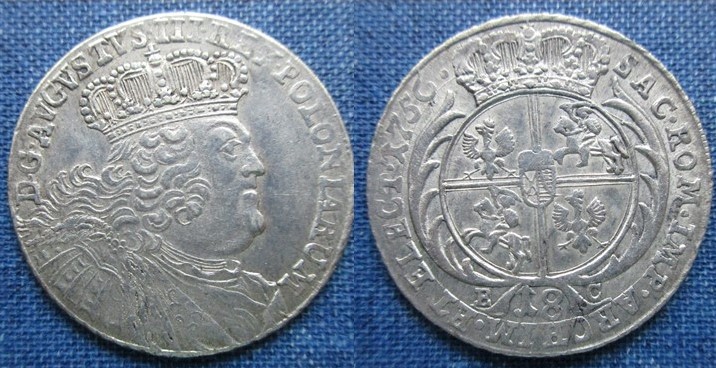
But this was not the end of Stanislaw's involvement in Polish (or European) politics. Augustus died in February 1733, and Stanislaw laid claim to the Polish throne a second time, supported by the Polish nobility, Sweden and France (in the meantime, his daughter had married Louis XV), while Hapsburg Austria and Russia supported Augustus' son, triggering the War of the Polish Succession, in which Stanislaw was deposed after a brief 9 month second reign. When the dust finally settled with the Peace of Vienna in late 1735, it was agreed the Polish crown would go to the Saxon, who became king Augustus III. Here is an 18 groschen coin with this Augustus' portrait:
A sort of consolation musical chairs followed. Stanislaw would get the crown of the Duchy of Lorraine, bumping the incumbent duke, Francis Stephen (who reigned 1729-1737). Lorraine had been a fief of the Holy Roman Empire, and always a target of French royal ambitions. According to the Peace, Lorraine would pass from Stanislaw to the King of France (his son-in-law) upon Stanislaw's death, thus ending the 690 year run of the House of Lorraine. Stanislaw ruled Lorraine for 29 years years, dying at the ripe age of 88 in 1766. His legacy is in the elegant neoclassical Place Stanislas and Place de la Carriere in Nancy. France, which form a UNESCO World Heritage site.
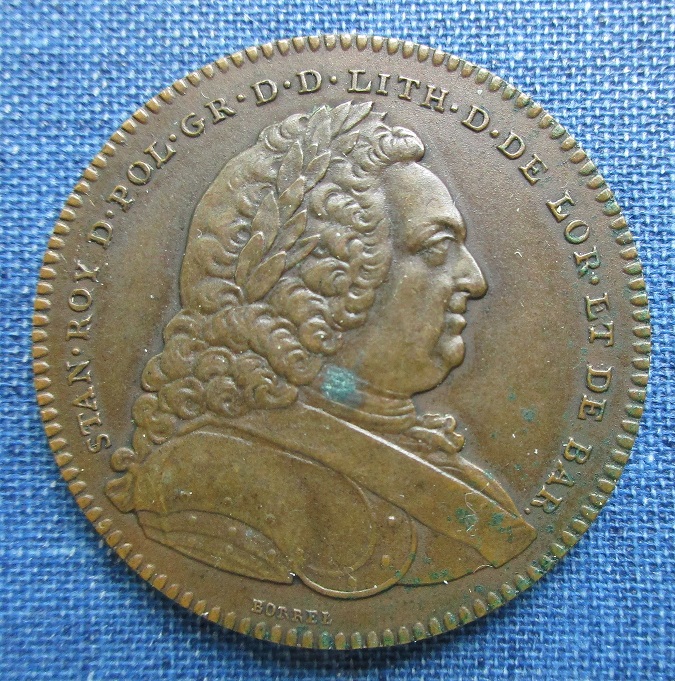
As he never issued coins, here is a commemorative medal dated 1750, with a portrait of Stanislaw Leszczynski:
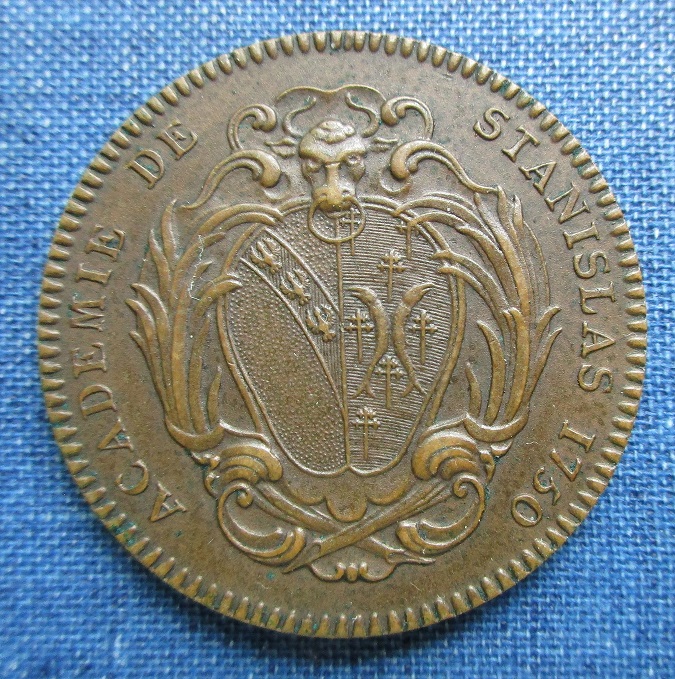
The last duke of the Lorraine dynasty, Francis Stephen, who had been displaced by Stanislaw, became Duke of Tuscany, but more importantly, would go on to marry the Hapsburg empress Maria Theresa, and found the house of Hapsburg-Lorraine.
Enough history... Here are the numismatic consequences.
1. Poland. Stanislaw is one of only two Polish kings in the modern era who did not issue coins for circulation in Poland. The other was Henry Valois, later Henry III of France, who ruled for less than 15 months in 1574-75. Prior to Stanislaw's reign, the Polish royal mints of the late 17th century (Bromberg, Krakow) had been more-or-less abandoned by the Saxon Polish kings, who instead minted coins for use in Poland at their German mints of Dresden and Leipzig between about 1704 and 1750. So Stanislaw would have needed to re-open mints in Poland in order to issue coins either in 1705-1709 or 1733-36, but did not.
2. Lorraine. With the end of the line of hereditary Dukes of Lorraine in 1737, the coinage of Lorraine also ended (practially speaking, it ended in 1728 with the prolific coinage of the second to last duke, Leopold). Here again, Stanislaw decided not to use his right to coin, maybe in deference to his son-in-law, the King of France, or to hasten the integration of coinage systems between France and Lorraine.










 Posted 07/11/2020 7:45 pm


 . I had never considered that.