NGC -
An elusive medal represents a challenge for collectors of higher grades.The Wilson dollar was struck to commemorate the opening of the Manila Mint on July 6, 1920, which was the first and only US mint established outside the continental United States. The obverse is a well-executed bust of then-president, Woodrow Wilson. The reverse features "Juno Moneta," the goddess of money and minting, kneeling and supervising a young boy who is pouring coin planchets (or blanks) into a coining press.
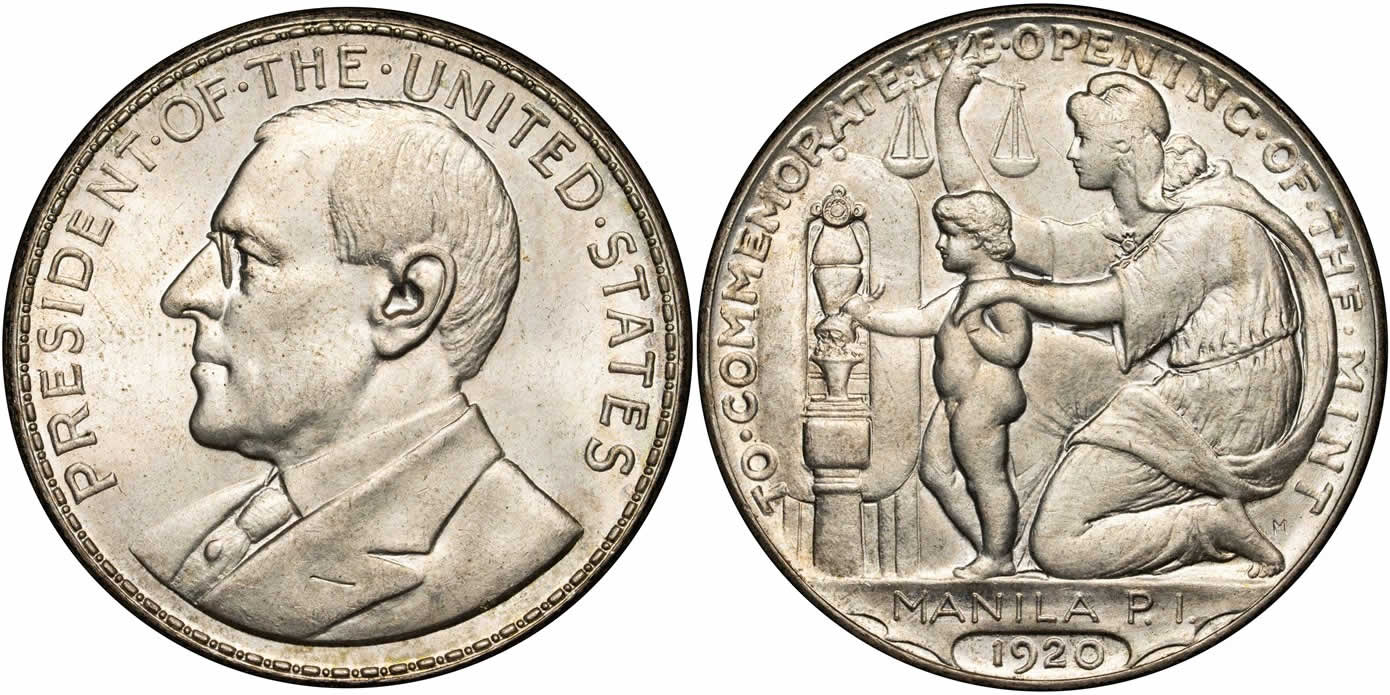 An example of the Wilson dollar in Silver (HK-449). Silver examples contain as much as 20 percent copper.
This popular design is difficult to acquire in uncirculated condition.As Spain had ceded the Philippine Islands to the United States after the Spanish-American War in December 1898, the new mint was to strike coinage that would replace the Spanish colonial money that was circulating. The Philippine Mint records show that 2,000 medals were struck on the first day of operation but does not clarify what metal type these were. While they were never legal tender, the pieces circulated in the Philippines prior to World War II. The mintage records show the following:

2,200 pieces in silver (HK-449)
3,700 pieces in copper (HK-450)
5 pieces in gold (HK-1031)
NGC also certified a brass specimen that didn't have the "M" on Wilson's shoulder. This piece brought over $7,000 in Heritage's January FUN 2015 auction. The silver medals were sold for $1, and the copper ones were offered for $0.50 each.
Supposedly, only 5 gold medals were struck, with one presented to Wilson himself, and another given to the Secretary of War, with three other examples retained in the Philippines and lost during World War II. In recent years, five examples have come to auction, with the finest known — graded NGC MS 62 — bringing $74,750 in 2008. A sixth example was certified by NGC in 2017, and is pictured below.
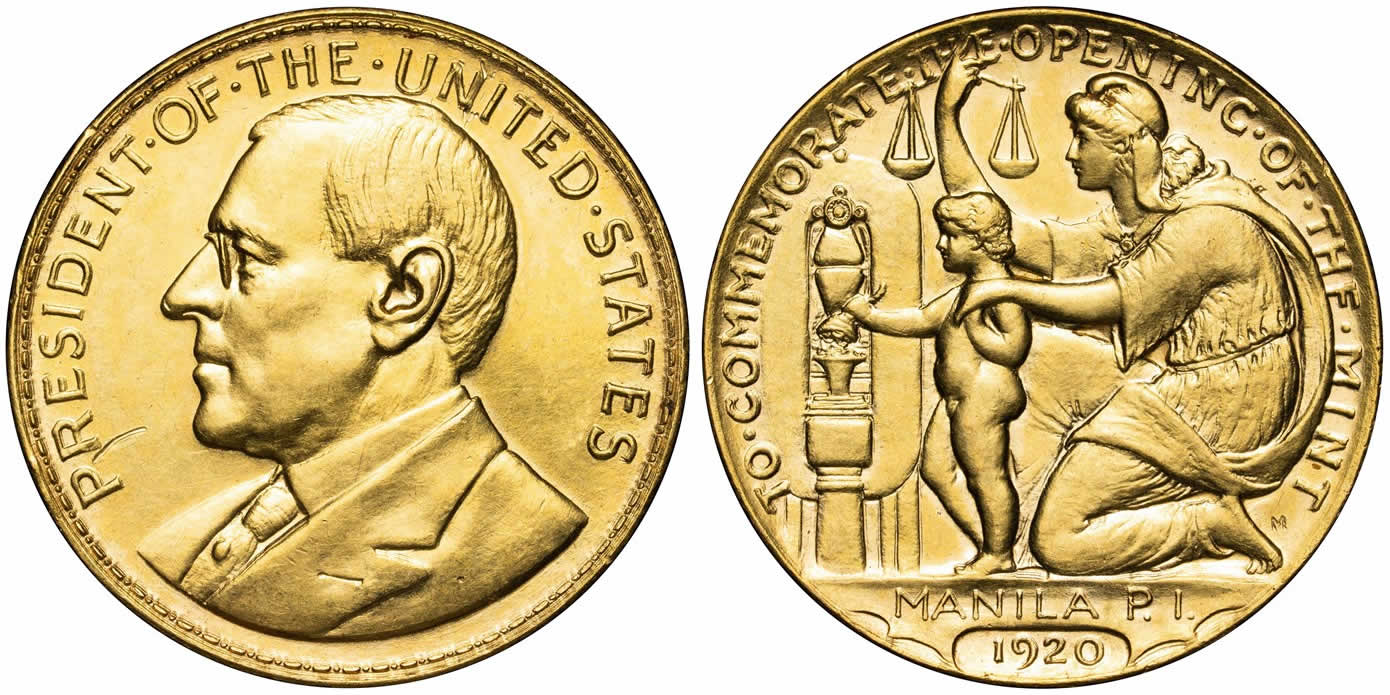 A sixth example of HK-1031 was certified by NGC. This piece has a prominent mark adjacent to the "R" in "PRESIDENT". It graded NGC MS 60.
Many of these medals come heavily corroded, and are often cleaned at that. This is because during World War II, the remaining inventory at the Manila mint was moved to Corregidor before Manila was captured in 1942. To prevent the Japanese from seizing and profiting from these pieces, the government dumped their unsold surplus of medals, along with 16 million Pesos, into Manila Bay.
Recovery efforts began in 1942 and continued for some years afterward. Many of the coins and medals were salvaged, but most of them were heavily corroded from the saltwater. Unfortunately for collectors, never-submerged examples are rarer. While one of the corroded examples can be had for under $100, a nice mint state example in any metal type can easily sell for over $1,000.
Because these medals are quite scarce, and nice copper specimens sell for as much as silver ones, counterfeits of copper specimens are somewhat common. Many of these are poorly cast, and exhibit heavy pitting on the surfaces, as well as significant loss of fine details. These poorly executed counterfeits are made from lead, with an outer layer of copper. It is important not to confuse medals corroded from saltwater with those that are cast counterfeits.
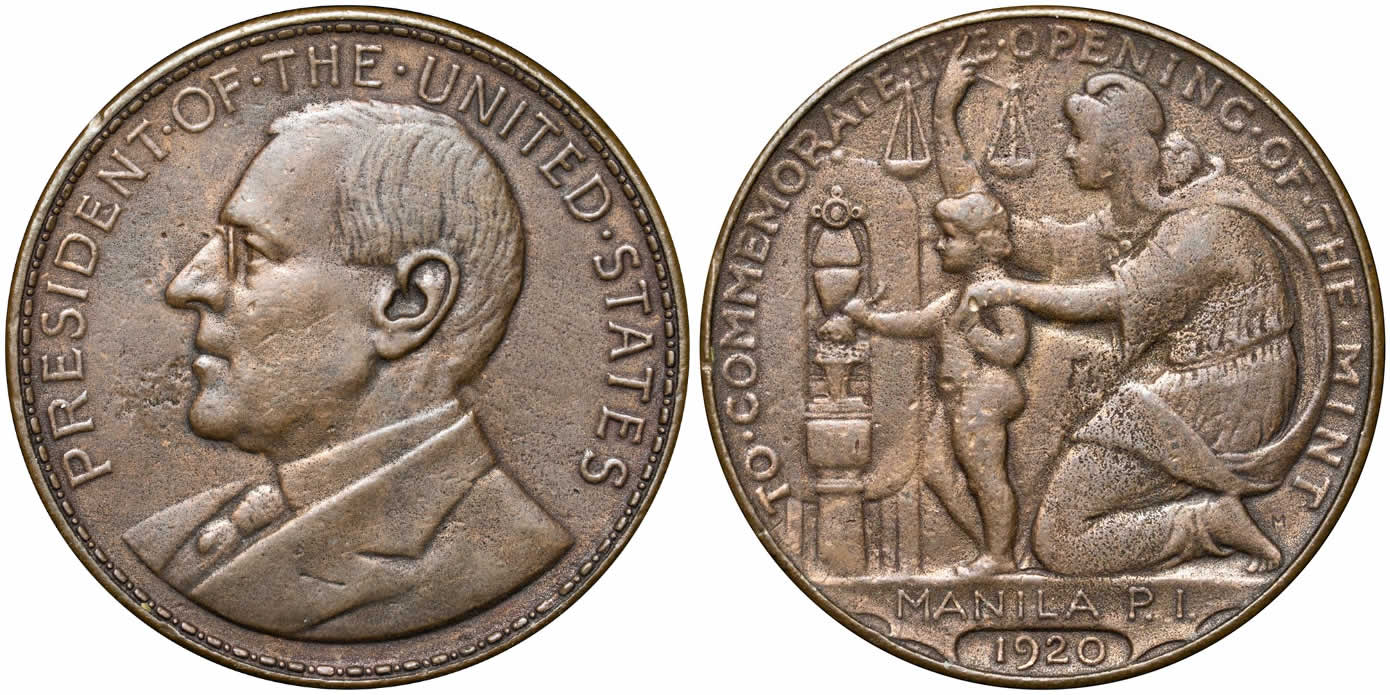
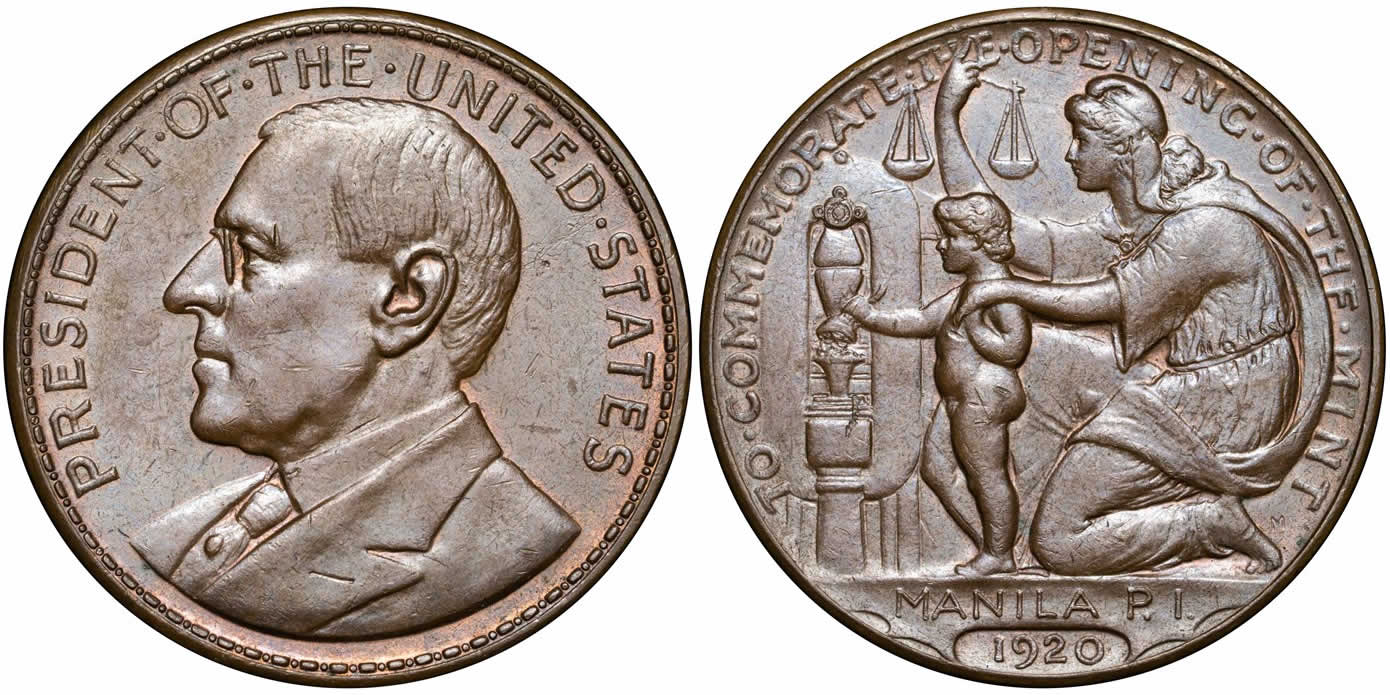 The counterfeit (top) exhibits "mushy" details and pitted surfaces. Genuine pieces exposed to saltwater damage should still exhibit hints of mint luster in the recesses.
 A view of the counterfeit's edge shows the piece has been well-filed to hide an edge seam.
The Wilson dollar has been reported by publications over the years as having been designed by Clifford Hewitt, but some individuals have pointed to evidence showing this is false. One major reason this may be incorrect is that the design is a modified mirror image taken from US Assay Commission medals struck in the 1880s and 90s, which were designed by George T. Morgan.
We do know that the dies for this medal were cut by Morgan, whose initial appears on the obverse and reverse. Morgan had become the Mint's Chief Engraver after
Charles Barber's death in 1917, and by this time in 1920, he was nearly 75 years old. Though past his prime, Morgan once again proved his ability to produce an exquisite piece of art that collectors would continue to relish.
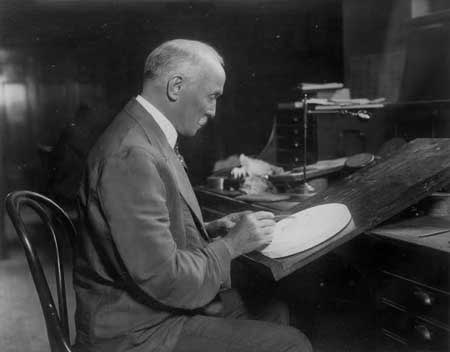 George T. Morgan was employed by the Philadelphia Mint for 48 years, where his skills as an engraver were held in high esteem. The Morgan dollar remains one of the most popular designs in US coinage.








 Posted 03/18/2021 04:04 am





