The 1916-17 William McKinley Birthplace Memorial Gold $1.00 coins were sponsored by the National McKinley Birthplace Memorial Association ("Association"). The Association was incorporated by the US Congress on March 4, 1911.
Per the legislation, "the object of the corporation shall be to perpetuate the name and achievements of William McKinley, late President of the United States of America, by erecting and maintaining in the city of Niles, in the State of Ohio, the place of his birth, a monument and memorial building."
With this, the Association's multi-year journey to complete the construction of the Memorial in Niles, OH began.
(Note: The Birthplace Memorial in Niles, OH should not be confused with the William McKinley National Memorial in Canton, OH. The latter was sponsored by a different group and serves as McKinley's final resting place vs. a memorial to his birthplace.) Representative William Albert Ashbrook (D-OH) introduced a coinage bill on behalf of the Association during the First Session of the 64th Congress on December 6, 1915; the bill called for 100,000
silver dollars.
(You can read my "What if?" post about the silver dollar proposal here.) (A bill calling for the coin was actually introduced in the Third Session of the 63rd Congress by Ashbrook on February 20, 1915, but that session of Congress adjourned before the bill could be considered.)
The House Committee on Coinage, Weight, and Measures met for its Hearing on Ashbrook's bill on January 13, 1916; Ashbrook was Chairman of the Committee at the time.
Colonel Joseph G. Butler, Jr. of Youngstown, OH, a lifelong friend of McKinley, was the lead voice of the Association at the Hearing; he also was responsible for initiating the coinage proposal with Ashbrook. Butler commented early in his statement to the Committee that though he helped raise funds for the construction of the William McKinley National Memorial In Canton, OH, he never fully supported it because "It is simply a tomb, and that is all. I had in mind at that time that it should have been something of a more useful and educational nature." The planned National McKinley Birthplace Memorial was intended to fulfill Butler's desires, as it was scheduled to include a museum for McKinley items, public meeting space and a public library in addition to its memorial statue of McKinley. As President of the Association, Butler was certainly in a position to drive the group's efforts re: the Memorial.
During the Hearing, Col. Butler requested that a gold dollar be struck instead of the originally-proposed silver dollar. He stated that the change would enable the memorial coin to be more aligned with McKinley's support of the gold standard for US currency and the fact that such a stance, he believed, was a significant factor in McKinley winning the 1896 election over William Jennings Bryan. McKinley signed the Gold Standard Act on March 14, 1900.
Following a supportive Hearing outcome, the coinage bill was reported by the Committee with a recommendation for passage; the report included the recommendation to change "silver" to "gold" throughout the bill's language.
The legislation authorizing the gold $1.00 coin moved through the House and Senate without opposition and was approved by President Woodrow Wilson on February 23, 1916.
The coin features a left-facing portrait of William McKinley on its obverse and a front view of the Birthplace Memorial building on its reverse. A the statue of McKinley that is in the open-air Court of Honor in the center of the building can be seen on the coin in between its two middle columns.
Charles Barber was responsible for the obverse of the coin; George Morgan handled the reverse.
1916 McKinley Birthplace Gold Dollar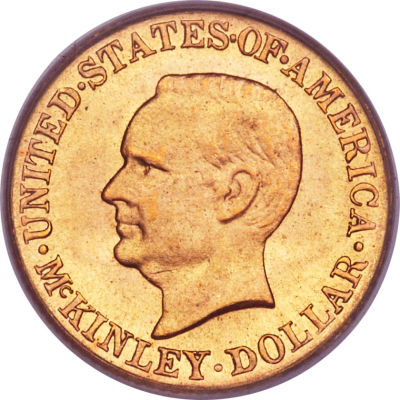
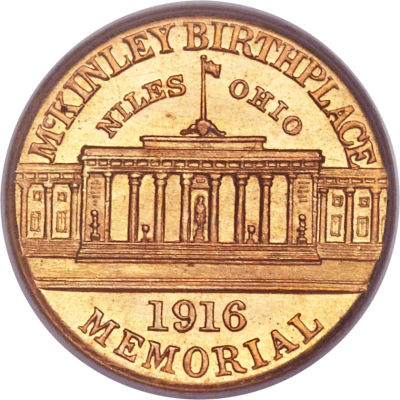
Per US Mint reports, 20,000 of the 1916-dated coins were struck (not including 23 coins reserved for assay) and 10,000 were later returned and melted, along with the 23 assay coins. The Mint also reports that 10,000 of the 1917-dated coins were struck without any being returned to be melted. Final mintage figures in current references on the series vary, with ranges of 10,000 to 20,000 for the 1916 issue and 5,000 to 10,000 for the 1917 issue. Market prices for the two dates are generally close, which leads me to think that the Mint's figures are likely the most on target.
Regardless of which figures are the actual final totals, it is clear that sales of the coin were much lower than expectations. Was the $3.00 price being asked by the Association the reason? Quite possibly. Paying 200% more than the face value of a coin was not something a large number of circa-1917 Americans rallied around.
The Memorial building was completed in 1917 with its dedication ceremony taking place on October 5, 1917. Ex-President William H. Taft gave the dedication speech at the ceremony. Today, the Birthplace Memorial includes a museum, public library, meeting space and an open-air Court of Honor in which stands the John Massey Rhind statue of William McKinley that is seen on the coin.
William McKinley Birthplace Memorial - Front View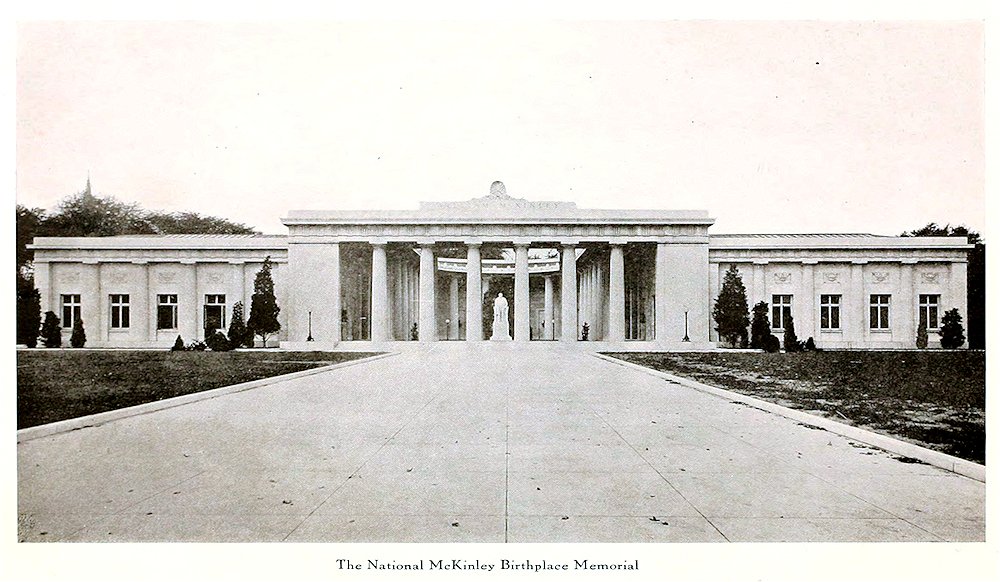 (Image source:
 The National McKinley Birthplace Memorial, Erected by the National McKinley Birthplace Memorial Association.
Booklet published in 1918. Public Domain.)William McKinley Birthplace Memorial - Court of Honor View with McKinley Statue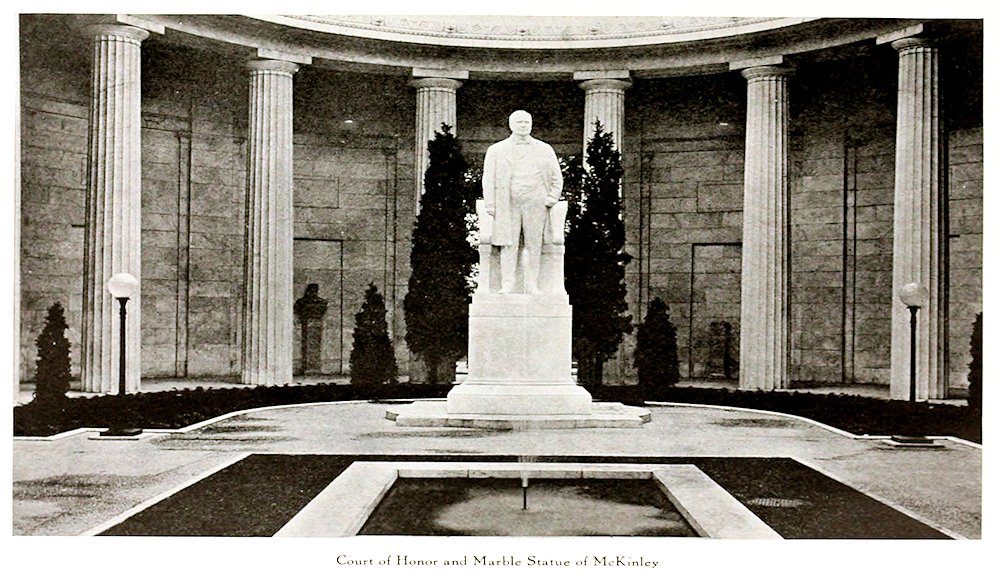 (Image source:
 The National McKinley Birthplace Memorial, Erected by the National McKinley Birthplace Memorial Association.
Booklet published in 1918. Public Domain.)You can access other of my posts about commemorative coins and medals here:
Read More: Commems Collection.








 Posted 03/14/2021 6:16 pm


 )
)


