|
This page may contain links that result in small commissions to keep this free site up and running.

Welcome Guest! Registering and/or logging in will remove the anchor (bottom) ads and the security checks. It's Free!
To participate in the forum you must log in or register. | Author |
 Replies: 105 / Views: 11,350 Replies: 105 / Views: 11,350 |
|
|
|
Pillar of the Community
 4628 Posts |
Not at all, that was the Goldmine we went to, as well you have to bend your head as the tunnels are all about 5ft 2 in tall and were dug by Cornishmen! I am 5ft 10 tall and 4ft wide! Here is my 6th token from New Plymouth! 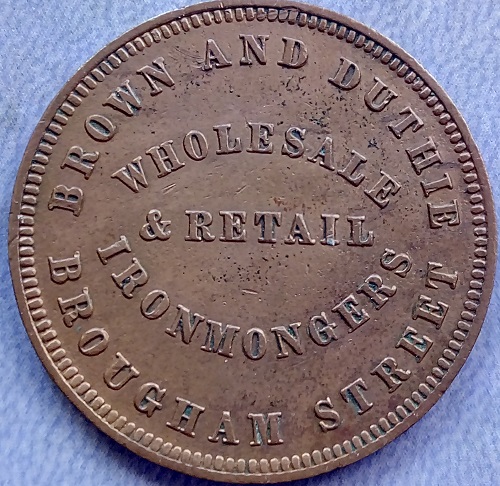 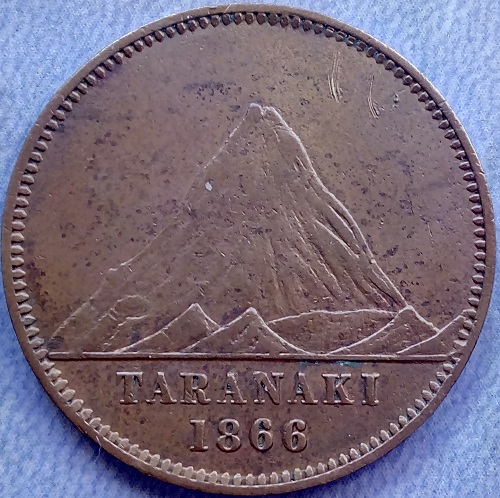 Brown and Duthie, New Plymouth - Bronze One penny 30mm - dated 1866 showing a fanciful image of Mt Taranaki. Condition of this token - aEF Brown and Duthie, New Plymouth - Bronze One penny 30mm - dated 1866 showing a fanciful image of Mt Taranaki. Condition of this token - aEFMy best token for the time being, conditionwise - this coin has lamost no wear and plenty of lustre left. It is very attractive and was issued when the Maori Wars were raging in Taranaki. They were Ironmongers and sold metal fittings and metal ware at their shop in Brougham street New Plymouth. The token was minted in Melbourne and a desirable piece. John Duthie was another intrepid Scotsman who came here in 1863 and by 1866 was running this shop in New Plymouth, he was only 25. https://en.wikipedia.org/wiki/John_...(politician)Later on he set up a shop in Whanganui and then Wellington, later becoming an MP and quite a fat man by the time he died in 1915! He became obscenely wealthy and his mansion in Wellington is a protected building. This token is fairly common in lower grades, but expensive in this state. The image of Mt Taranaki is one of the most imaginative and prettiest on a token. The slope is at 50 degrees or more, in reality the mountain is about 20 - 30 degrees.  Mt. Taranaki - Egmont as it is now, it seldom does not have snow on it. Mt. Taranaki - Egmont as it is now, it seldom does not have snow on it. |
|
Pillar of the Community
United States
1077 Posts |
Taranaki Maunga! Not far from Paritutu Rock, which is alleged by some to be the main feature depicted on this penny token issued ca. 1866 by John Gilmour of New Plymouth. In the foreground, shown in and around New Plymouth's harbor, are a kiwi, a Maori canoe, palm trees, and a fern plant. I've not been able to find any background on Mr. Gilmour. Renniks 149; Andrews 143. (31mm) 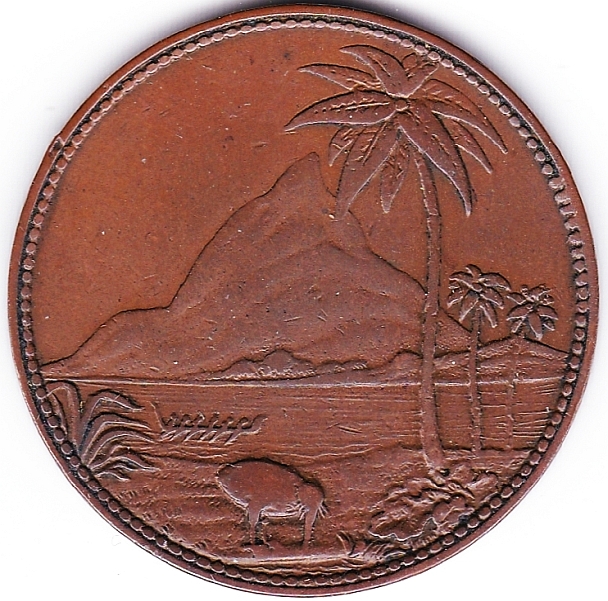 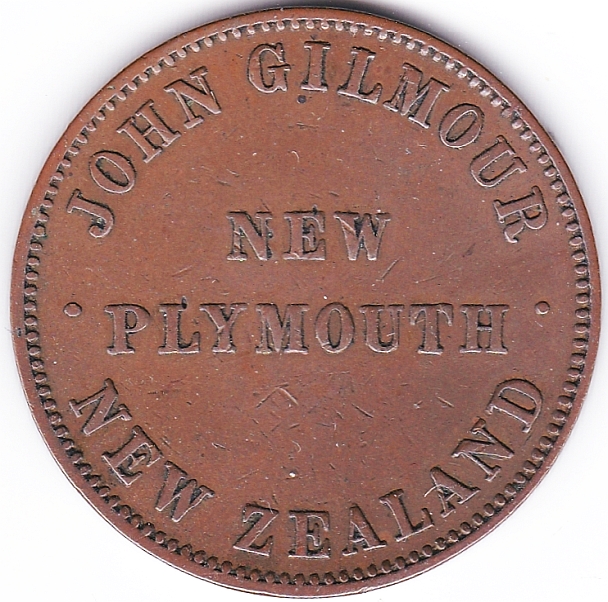 "If everything seems to be under control, you're just not going fast enough."
--- Mario Andretti
|
|
Pillar of the Community
4628 Posts |
Hi Daltonista, nice token - love the detail.
My Roker book also has little about Mr Gilmour, but it is known that between 1872 and 1884 he had moved to Auckland and was a Draper operating out of his own premises. It is likely he was also a Draper in New Plymouth, the token itself was minted at some unknown British mint.
Bertrand disagrees over date of issue, suggesting the token dates from 1875, this does not fit if he was in Auckland in 1873. He likely left New Plymouth in the late 1860s like many did during the Maori wars.
|
|
Pillar of the Community
4628 Posts |
Daltonista, your stuff is stunning too, gradewise I would grade your pieces at.
Waters - VF/almost so
Cosmo club - EF/AU Stunning (But more of the later ones are high grade VF to UNC)
Gilmour - I would say this is a high Fine - however its is very clean, neat and has no damage or verdigris so it would attract a VF price.
My tokens in order from first to last.
Advance New Zealand - a nice darkened VF example, some may even say gVF, light overall wear.
Dunedin 1858 token - light verdigris and stains - darkened, but otherwise goodFine and a nice piece.
Milner and Thompson (Alliance Tea Company) - lots of stains and verdigris, but this would grade VF, the lettering is sharp.
Grattan - Thames Hotel - aFine/Fine, still an average nice token
McCaul - VF as well, despite some staining
Duthie/Brown - a very nice coin aEF, couple of scratches on mountain sides.
Scratches, pitting, verdigris is acceptable as long as it does not overwhelm the coin. After all these are old copper or bronze pieces. Less acceptable is cleaning and sadly being New Zealand there is a lot of this. My coins are generally not cleaned which helps.
|
|
Pillar of the Community
United States
1077 Posts |
Princetane, if I were still collecting British Oceania, that Roker book would certainly be a necessity for my library. The best I could find to supplement my Andrews back in the 1980's when I was accumulating these was the Renniks catalog, which covers both NZ and Oz tokens of the 19th century. Based on a quick scan, my "holdings" in Aussie tokens comprise about 45 pieces, perhaps double the size of my NZ hoard. (I should really be thinking about disposing of these soon!) Renniks seems to be updated only sporadically, and of course there are no reliable or price-competitive North American vendors, so I have to search every year or so to nail down the latest edition from the publisher. This is the one I've got currently: 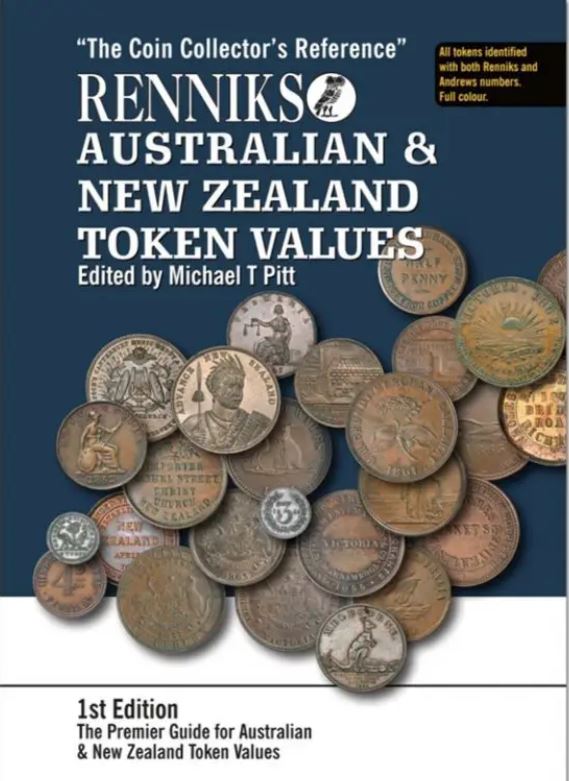 Not sure why it's called the "1st Edition," as I've got a bunch of them going back to the late 1970's, I believe. Maybe it's on account of the new author/editor. In any event, it's good for photos, mints, production info, and mostly for distinguishing between and among the many varieties that were struck, but on the downside it provides just about zero background on the issuers of these historic pieces. I gather from your posts and from a 2017 write-up I found this morning in The E-Sylum that this is where Roker's book would become invaluable to anyone who wants to get past the little pieces of copper/bronze/silver for more in-depth coverage. (Silver only in Australia, I guess.)
"If everything seems to be under control, you're just not going fast enough."
--- Mario Andretti
|
|
Pillar of the Community
4628 Posts |
Daltonista - I didn't even know Renniks did a Tokens catalogue - that is cool. I may even buy one as once I have most of the 75 or so Kiwi tokens, I intend to collect the Australian and British ones too.
I use a basic Bertrand which is a small A4 catalogue that lists the tokens and prices but not much more, the section on later ones and communion token is much better.
On the other hand I have won 5 more tokens and will write these up when I get them!
|
|
Moderator
 United States
196100 Posts |
Great looking tokens! The additional photos and information are both very interesting!  |
|
New Member
New Zealand
46 Posts |
Wow everyone, thanks so much for the eye opening info!! This is so new to me!
|
|
Pillar of the Community
4628 Posts |
You're welcome, it is all a journey of discovery for me too. I have admired these tokens for years and only now have I decided to stick my feet in the waters of collecting them. Standard circulation coins are easier, but these are a different kettle of fish. Fortunately with tokens of my own country we have less than 80 main types (However varieties of most exist - some rare). While I am waiting for my next group of tokens to arrive (Hopefully not long as I paid for courier) I will discuss the other types of tokens I have. In addition to the Tradesmens Tokens of 1857 to 1882, we also have 3 other types. I say that as no women issued a token - only men. 1. Medallets - these are things like my 1901 Ophir medallet, often made for a Royal Visit, an Exhibition (NZ had several major ones between 1865 and 1940 - main ones 1865 Dunedin, 1882 Christchurch, 1889 Dunedin, 1906 - 07 Christchurch, 1913/14 - Auckland, 1925/26 South Seas in Dunedin and 1939/40 Centennial in Wellington). They were also issued for events like Dominion Day on Sep 26 1907 and other things like the visit of Baden Powell, Scout Jamborees, the great White Fleet in 1908 and 1925. Also Province anniversaries. Medallets are a lot of fun as most were in cheap metals (Copper, White Metal, Brass) and even good metals like silver and gold. 2 - Communion Tokens - these are mostly rare and expensive, exclusive to Presbyterian churches for immigrants of Scottish origin, these small metal tokens were paid in lieu of the collection in a church. Most are from Otago and Southland, the two southernmost provinces of NZ, (With chilly and wet weather that suits the canny Scots). Often square or oblong they had the name of the church or town, a year on them and sometimes a biblical phrase. Most are very old dating from the 1840s to 1870s and most were locally made. I don't collect them as they are rare, expensive and many fakes have come on the market. Also being a Catholic/Jewish atheist - Presbyterian stuff does not interest me at all. However if you have any communion tokens - Please, please by all means show them on this thread if you like   . Edited by Princetane
08/16/2021 02:34 am
|
|
Pillar of the Community
4628 Posts |
Some examples of "Medallets" 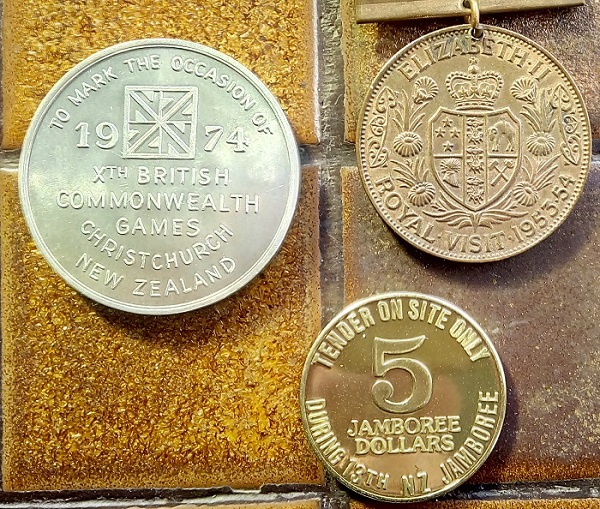 All very modern and including a 1974 Aluminium medal thing celebrating the Commonwealth Games in Christchurch. The 1953/54 Royal Visit (Every schoolkid in NZ got one, and they are very common - rare without the hole though). Also 5 Jamboree dollars from a Scout Jamboree in 1993. This would count as a type 3 thing being a piece of scrip, special purpose, discount tokens. 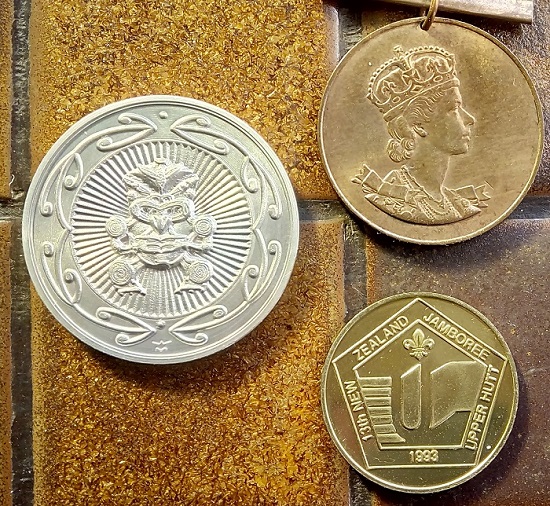 These pictures are reduced to the limited bandwidth (originally the 700px pictures were 357kb - is there anyway to make them lower kb or up this limit). These are not medals, as a medal typically will be something you get for bravery, supreme achievement or some form of glory. Medallets may look like medals and being medal orientation ( then again so are most coins) and have precious metal - but to get one you have to only pay some money or do very little (Like be a schoolkid or a scout rather than win a bravery thing). 3. Special Purpose, Discount and Scrip tokens - these are tokens often given away or earnt by a company, co op or individual and such tokens give the holder some item (A bar of soap, loaf of bread etc), a discount ($10 off a new piano or a Dr Dre album), or they are scrip meaning they are tokens that have credit on them. Scrip is quite common in America in the past, used on farms, factories and institutions, prisons and camps - often the recipients were marginalised and the worthless tokens had some perceived value to the institution that the receiver could use to buy goods and services. In my case we are talking about Farmers Co - ops, the only type here in NZ, similar to a mine or plantation in the states and the tokens had values usually from a few pence (cents) to several shillings and pounds (Dollars in USA). The tokens would be paid in partial or full payment of wages or credit (Sometimes cash money would be given too). Usually they were only redeemed in a company or co op store and often had restrictions on what they were good for (Food stamps are fairly good example of this type of thing). My guess is no doubt prices were marked up and these items were issued solely to keep the worker betrothen to their employer or company. The companies/co ops, prisons, authorities no doubt made a killing on these things. Made out of base metals, they usually had no or very restricted value outside the company/authority on the token. "I sold my soul at the company store" - Tennessee Ernie Ford 1955, |
|
Pillar of the Community
4628 Posts |
Wairarapa and United Farmers Co - op tokens 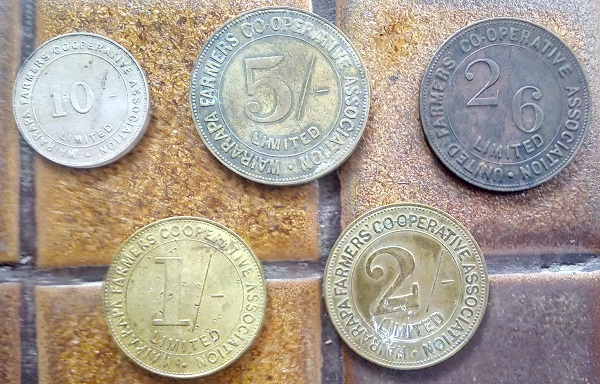 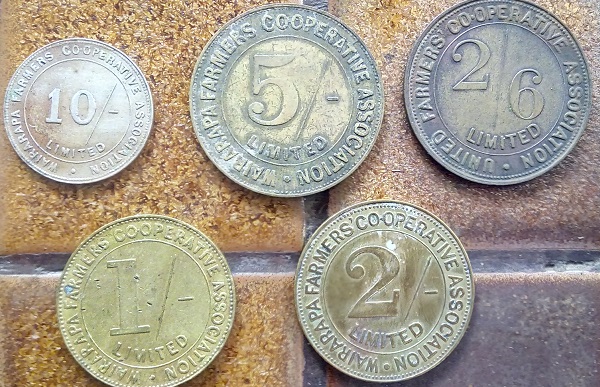 5 tokens - Scrip Farmers Co Ops 1920s to 1940s. 5 tokens - Scrip Farmers Co Ops 1920s to 1940s.I can find out little about these, except that the Wairarapa Farmers Co op started in 1907 and no doubt paid these tokens to their labourers and share milkers, rather the grandees and squatocracy that owned the farms. The 10/- one is cupronickel, all the others are brass, the 10/- is 23.5mm and the size of a shilling. The 2/6 token I thought was Wairarapa but is the United Farmers Co - op a similar group. These two along with New Plymouth Farmers and Oamaru Co op society issued these types of things usually in brass and or cupronickel in values from 1/- to 20/- or in some cases 40/-. Dates are not exact but the style of lettering and values suggest that these are early/mid 20th century and saw most use in the 20s and Depression (The arrival of abundant local coin in 1934 probably saw them resigned to history. Most of these are fairly cheap around $10 - $20 per token and about Fine to EF condition (Mine are all VF sans the 2/- and 5/- which are worn Fine ones). Such coins would have been misery for their holders and no doubt would have been glad to get real money eventually. They are very interesting and add to our numismatic history! Finally for you Americans and Canadians, in the 1920s it was around $3 to a £1, so these tokens would have been face value wise worth around $1.50 for the 10/- down to 15 cents for the 1/-.  Edited by Princetane
08/16/2021 12:24 am
|
|
Pillar of the Community
Australia
9838 Posts |
Quote:
"I sold my soul at the company store" - Tennessee Ernie Ford 1955, Me too. I have been chained to wheel now for 43 years. Black Sorrows 1989. :) Steve :) |
|
Moderator
United States
196100 Posts |
Fantastic examples! |
|
New Member
New Zealand
46 Posts |
Wow guys, I feel like a very minute spec of plankton in this vast & wonderous ocean that you, 'big fish' are so knowledgeable about #129402;#129303;#128519;
|
|
Pillar of the Community
United States
1077 Posts |
Just dropping by to add another of the older coppers, this time a Kirkcaldie and Stains 1/2d (25mm) that was issued in 1874, by most accounts. Established in 1863, these "Drapers and Outfitters" became a major retail presence in Wellington as a department store and in fact survived for over 150 years. Renniks 312, Andrews 312, KM Tn36. (My apologies for the lint on the scanner!)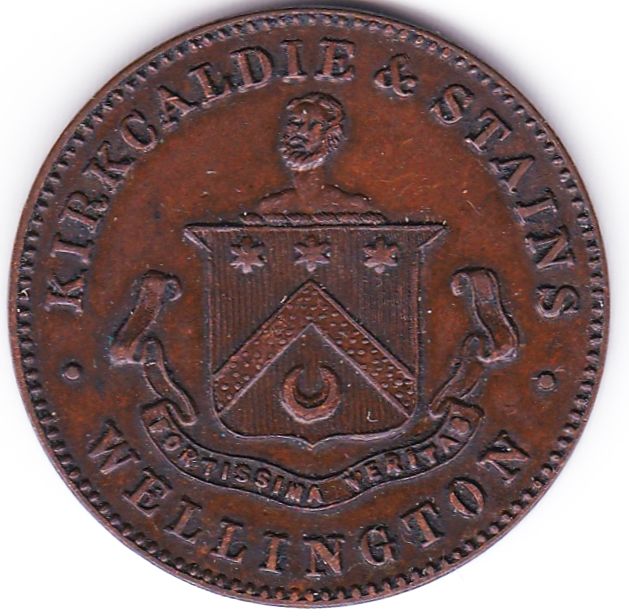 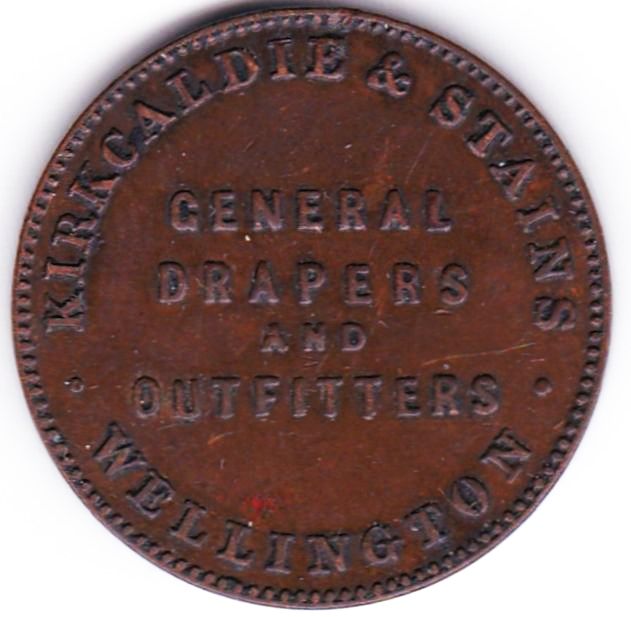 Wikipedia has a page devoted to the business itself, but a fairly concise summary is pasted in below, cribbed from the website of Australia's Museums Victoria: Bronze [halfpenny] Token, minted by an unknown British mint. Issued by Kirkcaldie & Stains, Wellington, New Zealand, circa 1875. The business was founded by Englishman John Kirkaldie, who had been apprenticed as a draper; and Scot Robert Stains, who had a retail trade background. The met in Sydney and decided to pool their capital to establish a business in New Zealand. They settled on Wellington as the place, and their first store was the hulk of a wrecked ship, at Lambton Quay. In 1886 Robert Stains returns to England and the partnership was dissolved. The business remained in the hands of the Kirkcaldie family until the 1930s. In 1931 the business was sold to British Overseas Stores, who sold it to the Renouf Corporation (later Hellaby Holdings) in 1985. Kirkcaldie & Stains closed in 2016. "If everything seems to be under control, you're just not going fast enough."
--- Mario Andretti
Edited by daltonista
08/17/2021 12:25 am
|
| |
Replies: 105 / Views: 11,350 |
To participate in the forum you must log in or register.
Disclaimer: While a tremendous amount of effort goes into ensuring the accuracy of the information contained in this site, Coin Community assumes no liability for errors. Copyright 2005 - 2026 Coin Community Family- all rights reserved worldwide. Use of any images or content on this website without prior written permission of Coin Community or the original lender is strictly prohibited.
Contact Us | Advertise Here | Privacy Policy / Terms of Use
|
| Coin Community Forum |
© 2005 - 2026 Coin Community Forums |
| It took 0.48 seconds to rattle this change. |
 |
|
| |
| |







 First Page


 Posted 08/14/2021 12:06 am


