Proposals for the New Rochelle half dollar were introduced in Congress in January 1936. Senator Royal Samuel Copeland (D-NY) introduced a bill in the Senate on January 6th; Representative Charles Dunsmore Millard (R-NY) introduced his bill in the House of Representatives on January 22nd.
Often such bills are mirror images of each other and are referred to as
companion bills - the bills being discussed here had similar objectives - "commemoration of the two hundred and fiftieth anniversary of the founding of the city of New Rochelle, N. Y." - but they did not mirror each other exactly. The Senate bill, for example, called out the role the Huguenots played in New Rochelle's founding; the Huguenots were not mentioned in the House bill. The Senate bill named and authorized the Westchester Coin Club as the sponsor of the coin; the House bill specified the Mayor of New Rochelle as the sponsor.
(Note: Regardless of the bill's final language, the Coin Club was the catalyst behind the coin.)The two bills did align on other matters: for example, both bills allowed for coins to be struck at more than one US Mint facility, for coins to be ordered for any desired quantity (up to the authorized maximum) and as often as desired - no restrictions on either. Also, both required payment for ordered coins before they could be delivered (a standard provision of just about all US commemorative coin bills).
The House bill moved along at a quicker pace, and, even though it was introduced two+ weeks after the Senate bill, soon gained traction as the bill that would be considered by both chambers of Congress. The House Committee on Coinage, Weights, and Measures recommended the House bill's passage, but did have several recommended amendments. The most noteworthy was the recommendation to increase the proposed 20,000 maximum mintage to 25,000.
The full House considered and accepted the Committee recommendations and sent the bill to the Senate where it was immediately referred to the Senate Committee on Currency and Banking. The Senate Committee supported the bill's objective, but had numerous recommendations for changes to tighten up its language. Rather than providing a list of recommended changes, it offered an amendment in the form of a substitute. Noteworthy for the Senate substitution, the proposed language maintained the key provisions of the House bill. Namely, the Mayor of New Rochelle continued as the coin's sponsor and the maximum mintage continued to be 25,000. It did alter the House bill by adding a limitation of where the coins could be struck - minting was to be limited to a single Mint facility.
Each chamber concurred with the changes made by the other and the amended bill was sent to President Roosevelt for approval. The bill became law with Roosevelt's signature on May 5, 1936.
The coin was struck in 1937 and provided to the local First National Bank of New Rochelle ahead of the coin's "1938" date; the Westchester Coin Club spearheaded the delivery of mail orders ($2.18 for a single coin, including postage) while area banks handled local sales ($2.00 per coin). Eventually, 9,749 unsold coins were returned to the Mint to be melted leaving a net total of 15,266 coins. Overall, not a runaway success but a program of reasonable success considering the lingering effects of the US Depression and the fact the bubble had burst on market speculation in US commemorative coins.
1938 New Rochelle, NY 250th Anniversary of Founding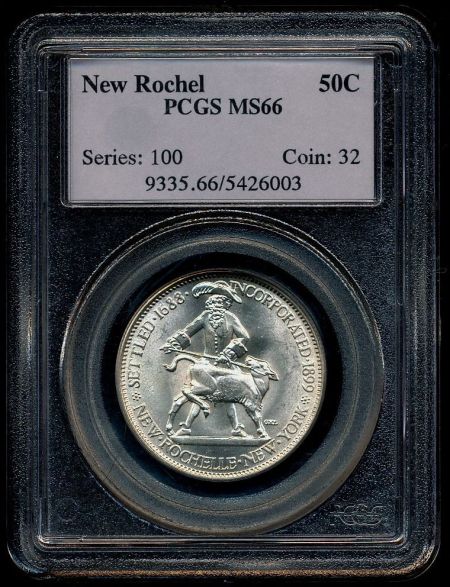
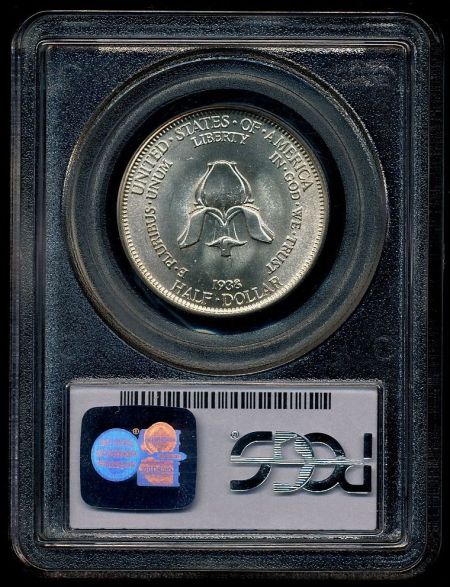
For more on the New Rochelle half dollar, check out:
-
1938 New Rochelle, NY 250th Anniversary-
1938 New Rochelle, NY 250th Anniversary - Revisited-
1938 New Rochelle, NY 250th Anniversary - Coins Designed by a Woman Thread-
1938 New Rochelle, NY 250th Anniversary - Coins Depicting an Agriculture Theme Thread-
1938 New Rochelle, NY 250th Anniversary - Coins with Flora ThreadFor other of my posts on commemorative coins and medals, see:
Commems Collection






 Posted 10/24/2021 12:12 pm





