The Act to amend the authorization for the Booker T. Washington half dollar to allow for the striking of the George Washington Carver - Booker T. Washington (GWC-BTW) variety went into force on September 21, 1951. Though the new authorization came fairly late in the year, the Mint was able to strike a good supply of 1951-dated coins in December, using all three Mint facilities to do so. It produced 110,018 coins in Philadelphia, 10,004 in Denver and 10,004 in San Francisco; the counts at each mint in excess of the even thousands represented coins struck for assay purposes, not distribution to the public - a total of 26 assay coins were struck.
The GWC-BTW half dollar was jointly sponsored by the George Washington Carver National Monument Foundation and the Booker T. Washington Birthplace Memorial. The Carver National Monument was created in Diamond, Missouri, the birthplace of George Carver (later George
Washington Carver based on his admiration for BTW). Sydney J. Philips was the president of both organizations and was the driver behind the BT and GWC-BTW coins. Interestingly, he was not the originator of the idea for the BTW coin - such was suggested to him by Fred R. Splawn, the president and a principal of the Royal Crown Beverage Co., Inc. of Montgomery, Alabama. Of course, once the BTW half dollar was in play, Phillips didn't need additional help with the concept of a second coin after sales of the first slowed dramatically - hence the GWC-BTW half dollar!
The first public sale of the coins took place during the first week of January 1952. Per contemporary newspaper accounts, the coins were first sold in Joplin, Missouri during a festival held by the city to mark "Carver Day." George Washington Carver's birthplace, Diamond, MO, is a small town southeast of Joplin; he was celebrated in Joplin as a "home town" hero who "made good" as an internationally-known scientist. Missouri Governor Forrest Smith had declared January 5 as "Carver Day" for the entire state; it appears the Joplin festival was a cut above other celebrations in the state.
The festival drew attendees from the surrounding cities and states and included addresses by local and out-of-town dignitaries, a youth festival that featured exhibit booths created by local youth groups, an entertainment program and the formal presentation of the first Carver Achievement Award. The launch of the Carver-BTW half dollar at the festival was most definitely a feather in its cap!
GWC Trivia: Carver is known to have developed over 300 food, medicinal, agricultural and industrial uses for the peanut, but, contrary to the oft-repeated myth, he did not invent peanut butter! Such distinction goes to physician John Harvey Kellogg who filed a patent for it in 1895.1951 George Washington Carver - Booker T. Washington Half Dollar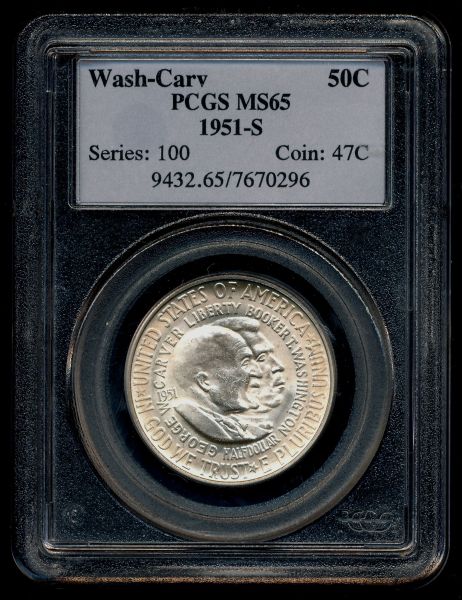
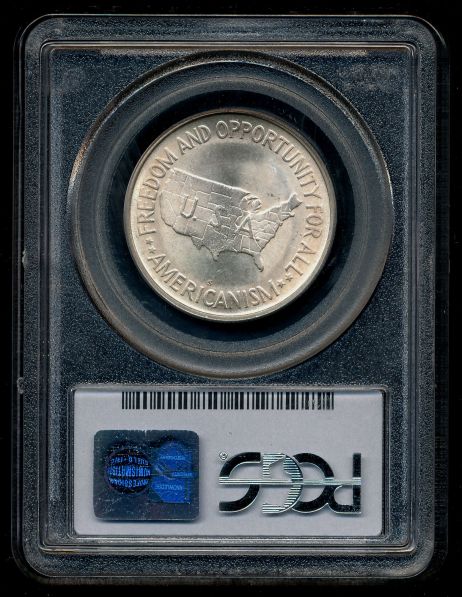
To learn more about the GWC-BTW commemorative half dollar, check out:
-
1951 George Washington Carver - Booker T. Washiington Half Dollar-
1951 Carver vs. Carver-Washington-
1956 Booker T Washington Half Dollar #3Other of my posts about commemorative coins and medals can be found here:
Commems Collection.






 Posted 12/13/2021 12:08 pm





