Note: This post is not about US commemorative half dollars that mark US Territory anniversaries (e.g., the 1936 Wisconsin Territorial Centennial piece), but rather coins struck by the US for an event being marked by one of its Territories.Within the classic US commemorative coins series (1892-1954) there are two programs, one a single-coin, the other a three-coin, that were struck for territories of the United States vs. stateside sponsors.
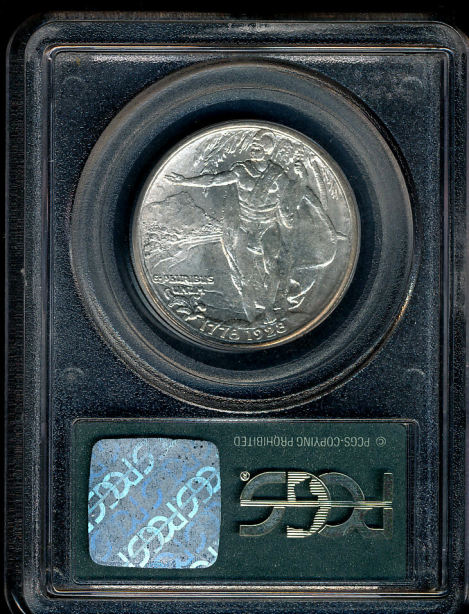
First up, the 1928 Hawaiian (European) Discovery Sesquicentennial:At the time the 1928 Hawaiian (European) Discovery Sesquicentennial half dollar was struck and issued, Hawaii was an organized incorporated territory of the US - it wouldn't become a state until August 21, 1959; Hawaii officially became a US Territory on on August 12, 1898; on April 30, 1900 the Territory was legally organized via the Hawaiian Organic Act. The Act "organized" the government of the new territory and established its capital and legislative processes and provisions.
When the Hawaiian half dollar was proposed and discussed with the US Treasury Department in 1928, Secretary Andrew Mellon stated that his Department had "no objection to the bill for the reason that the issue of the proposed coin is for a Territorial government enterprise. It is sponsored entirely by the Territorial government of Hawaii."
1928 Hawaiian (European) Discovery Sesquicentennial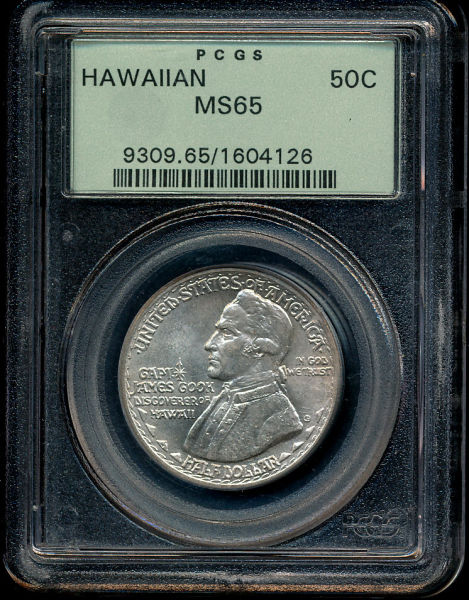
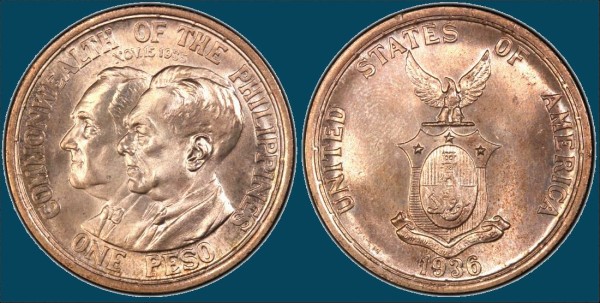
 Second on the list is the 1936 US-Philippines Commonwealth set:
The Philippine Islands became a US Territory as a result of the US' victory over Spain in the Spanish-American War of 1898. As part of the post-war treaty, the US was entitled to purchase the Philippine Islands for $20 million and took possession of Puerto Rico and Guam. (Also, the Treaty established an independent Cuba.)
The PI were first administered by a military government, but this was replaced in 1902 when the Territory was established and the Insular Government was created. The PI continued to operate under this civilian government as a US Territory until November 10, 1935 when it transitioned to being a Commonwealth of the United States.
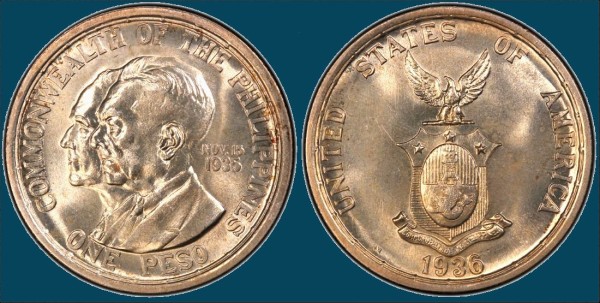
To help celebrate the transition, a set of three commemorative coins were struck by the Manila Mint (operating as a "sort of" Branch of the US Mint). The Manila Mint struck the coins used in the Philippines from its opening in 1920 until it was bombed and essentially destroyed by Japan during World War II. US Mint facilities in Philadelphia, Denver and San Francisco were used for US-Philippines coinage prior to 1920 and then again beginning in 1944. All of the coins struck for use in the Philippines during its Territory and Commonwealth years includes the legend "UNITED STATES OF AMERICA" to clearly indicate the official linkage.
Three commemorative coins were struck for the Commonwealth transition, two One Peso coins and one 50 Centavos piece. All of the coins feature Manual Quezon, the first President of the Philippines (under the Commonwealth Constitution).
Of course, the Philippines never became a US State; the islands gained full independence on July 4, 1946.
US-PI Commonwealth Commemorative Coins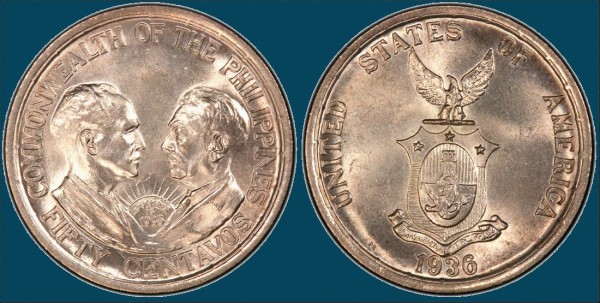
To learn more about the Hawaiian half dollar, check out:
-
1928 Hawaiian (European) Discovery Sesquicentennial -
1928 Hawaiian (European) Discovery Sesquicentennial - Revisited-
1928 Hawaiian (European) Discovery Sesquicentennial - Bank of Hawaii Auction-
1928 Hawaiian (European) Discovery Sesquicentennial - The Hawaiian ChieftainTo read more about the US-PI commemorative coins, see:
-
1936 US-Philippines CommonwealthFor a quick post-US Philippines commemorative coin comparison, check out:
-
1947 Philippines MacArthur Commemorative CoinsFor other of my posts about commemorative coins and medale, see:
Commems Collection. 






 Posted 02/14/2022 11:51 am





