One of my earliest posts here on CCF concerned the Texas Independence Centennial Half Dollar. Looking back, I see that it lacks the depth-of-story of my later posts. So...
Texas has a very interesting history. It was initially explored by Spanish Conquistadors (beginning in 1519) who encountered Native Americans from multiple Nations/tribes who were already established in the area. Between 1519 and 1848, the flags of six nations flew over Texas soil (more on this later), including Mexico from 1821 to 1836. To foster continued settlement of the area - and to keep it away from potential French encroachment - Mexico allowed American settlers to enter Texas and make land claims. The American settlers ("Texians") soon outnumbered the Mexican population and eventually rose up against Mexico to fight for their independence. The battle wasn't an easy one, but, eventually, Mexico was defeated and the Republic of Texas was declared.
Counter to the belief of many collectors, the Texas Independence Centennial Half Dollar was not struck to commemorate the 100th anniversary of Texas Statehood, but rather the area's victory over Mexico and its hard-won independence/birth of the Republic of Texas.
Companion bills for the commemorative half dollar to mark the 100th anniversary of the Independence of Texas from Mexico were introduced in the House and Senate in late May 1933, during the First Session of the 73rd Congress. The bills proposed to commemorate "the one hundredth anniversary in 1936 of the independence of Texas, and of the noble and heroic sacrifices of her pioneers, whose revered memory has been an inspiration to her sons and daughters during the past century."
The bills called for up to 1.5 million coins (!) to be struck for the American Legion Texas Centennial Committee, of Austin, Texas. The coins could be requested by the Centennial Committee "all at one time or at separate times, and in separate amounts, as it may determine." as long as they were pre-paid. This "loose" language gave the Centennial Committee the ability to request coins over multiple years in whatever quantities they desired - hence, a program that lasted from 1934 through 1938 with some very small annual issues.
Also, the language of the bills provided the flexibility for coins to be struck "at the mints of the United States" which allowed for coins to be requested from Philadelphia, Denver and San Francisco. As no restriction was placed on the date struck onto the coin, the legislation authorizing the program also allowed for the creation of what would become a 13-coin program with coins struck in five different calendar years (1934 through 1938) and at all three US Mints active at the time (P/D/S).
The bills faced little, if any, opposition, and both were favorably reported out of their respective Committee (House: Committee on Coinage, Weights, and Measures; Senate: Committee on Banking and Currency). The Senate was the first to consider and pass its bill. As a result, the House dropped consideration of its version of the bill and passed the Senate version. The approved bill was examined and signed in both chambers, then presented to the President. The coin bill was signed into law by President Franklin Delano Roosevelt on June 15, 1933 - three years before the actual anniversary year!
The American Legion Texas Centennial Committee selected Pompeo Coppini to prepare the designs and models for their coin. Coppini was born in Italy in 1870. He grew up in Italy and studied art at Accademia di Belle Arte. He moved to the US in 1896, initially taking residence in New York City. In 1901, he moved to San Antonio, Texas where he became a US citizen in 1902 and developed a steady clientele for his work. He subsequently opened studios in Chicago and New York City, spending time in each city, but maintained a residence in San Antonio (where he also set up a studio). Following his time away in Chicago and New York, Coppini returned to Texas and lived the remainder of his life in San Antonio; he died in 1957 at the age of 87.
The obverse design of the coin features a large, five-pointed star (symbolic of Texas, the Lone Star State) with a bald eagle perched in front of it. IMO, the design exudes power.
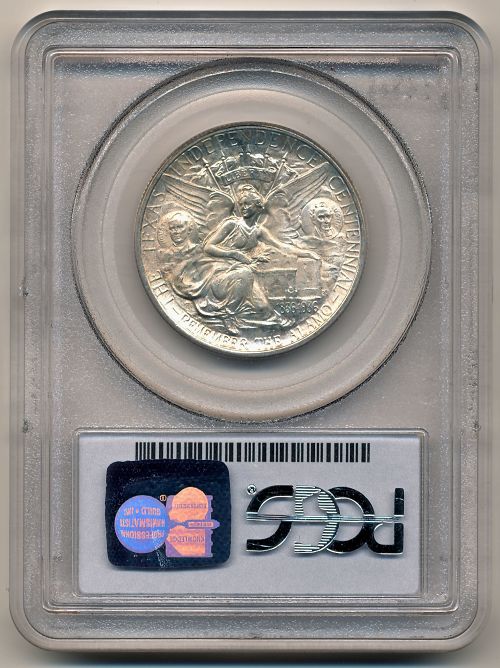
To describe the coin's reverse as "busy" or "crowded" would be an understatement. Kneeling at its center is the allegorical female figure of
Winged Liberty. Her left arm rests on the Alamo, the battle site that, even in defeat, helped inspire the Texans/Texians as they fought for their independence ("Remember the Alamo!"); further to her left (viewer's right) is a cameo portrait of Stephen F. Austin who is generally referred to as the "Father of Texas" for his efforts to colonize Texas beginning in 1825. To
Victory's right is a cameo portrait of Sam Houston, the first Commander-in-Chief of the Texas Army, the first President of the Texas Republic after it declared independence and a US Senator from Texas after it became a State in 1845.
Above
Victory is seen "LIBERTY" on a banner/scroll along with the six different national flags that have flown over Texas: 1. Spain (1519-1685; 1690-1821), 2. France (1685-1690), 3. Mexico (1821-36), 4. Republic of Texas (1836-45), 5. United States (1845-1861; 1865-present) and 6. Confederate States (1861-65).
Coppini's designs were approved by the Commission on Fine Arts (CFA) in late June, 1934 and the first coins were struck in Philadelphia roughly four months later - October, 1934. They soon thereafter went on sale for $1.00 each, with profits from sales going to help fund the construction of the Texas Historical Museum on the campus of the University of Texas in San Antonio. I've read that over $90,000 was ultimately raised from sale of the full program's coins (i.e., from all years struck).
With such a large number of coins potentially at its disposal - up to 1.5 million! - the Coin Committee looked to sell at least one of the coins to every family in Texas. It was an ambitious goal, and one that was never reached. Sales for the coin started off in 1934 relatively strongly with sales of over 61,000 coins, but tapered off fairly quickly in the years that followed. In 1935, sales were roughly 50% of 1934 at ~30,000, but fell to ~27,000 in the 1936 (the actual Centennial year!), ~19,500 in 1937 and less than 11,500 in 1938. The final year's sales total was just 17.5% of first-year sales! Collectors certainly grew "tired" of the program as it continued on. Overall, the Texas program generated sales of 149,478 coins.
In an effort to boost lagging sales, the sponsor attempted to get additional designs for the coin program approved by Congress. You can read the story here:
1934-38 Texas Independence Centennial - There Could Have Been Five!As noted, in 1934, the coins were sold for $1.00 each by the sponsor; in subsequent years, however, individual coins were sold for $1.50 and three-coin PDS sets were priced at $4.50.
1934 Texas Independence Centennial Half Dollar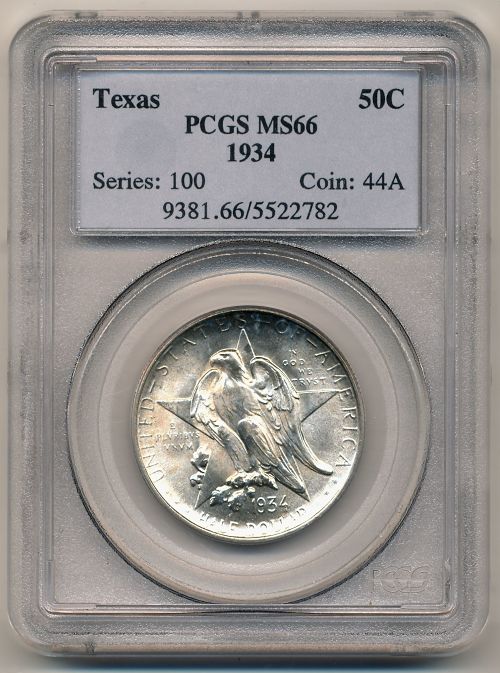
For more on the Texas half dollar, check out:
-
1934-38 Texas Independence Centennial -
1934-38 Texas Centennial - There Could Have Been Five!-
1934-38 Texas Independence Centennial - Coins Depicting Places Thread-
1934-38 Texas Independence Centennial - Coins Depicting Mythology Thread-
1934-38 Texas Independence Centennial - Coins Depicting Stars ThreadFor other of my posts about commemorative coins and medals, check out:
Commems Collection. 






 Posted 02/20/2022 3:01 pm





