Time to revisit another classic era US commemorative coin...The bill calling for a commemorative half dollar to celebrate the 100th anniversary of the admission of the State of Alabama to the Union was introduced by Representative Lilius Bratton Rainey (D-AL) on February 28, 1920. The
Alabama Centennial Commission was the coin's sponsor, though it was not named in the bill. Immediately following its introduction, the bill was referred to the House Committee on Coinage, Weights, and Measures. (Historical Note: The Centennial of Alabama's Statehood occurred in 1919 vs. 1920 - the proposal was late!)
The original bill called for the striking of 100,000 25-cent pieces. During the Hearing on the proposed coin, Committee member William Albert Ashbrook (D-OH) questioned Representative Rainey as to why a 25-cent piece was asked for vs. a 50-cent coin as other states had requested (e.g., Illinois, Maine, Massachusetts (Pilgrim)). Rainey responded, "It will make no difference to me." After a brief exchange among Committee members, Rainey continued, "As far as I am concerned, the coinage of the 50-cent piece will be all right. Perhaps it will be better." Such remarks suggest that Representative Rainey did not thoroughly review the history of similar commemorative coinage bills while preparing his, and that his primary concern was to secure approval for a commemorative coin (i.e., a fundraising vehicle for the
Alabama Centennial Commission) regardless of the type of coin specified.
After confirming for the Committee that the State of Alabama would pay for all costs associated with the coinage of the piece, Rep. Rainey then requested the Committee consider allowing an update to the bill so that it called for the striking of 200,000 coins vs. the originally requested 100,000. He stated, "I believe it would be more satisfactory to our State." The Committee did not specifically object to the request but responded to Rep. Rainey by noting the potential difficulty in selling so many coins and reminding him that they had only authorized 100,000 coins for the other states. Rep. Rainey backed off the request without further discussion and acknowledged that the only approved change to his bill would be the change from a 25-cent coin to a 50-cent piece.
The House Committee reported the bill favorably and recommended that it be passed with its recommended amendments.
When the bill came up for debate in the House in late March 1920, Rep. Rainey initiated the discussion with extended remarks concerning Alabama's distinguished history, "inestimable material wealth" and "eminent statesmen, orators, soldiers, educators, and sterling citizenship." He concluded his remarks with, "In all that is good and great for the advancement of America, whether it be sacrifice in time of war or labor in days of peace, Alabama is ever ready to respond with all her resources and with all her strength."
Rep. Warren Gard (D-Ohio) then raised the question of whether the continued issuance of commemorative coins would have an impact on the integrity of the nation's coinage. He noted the increasing number of commemorative coin proposals and stated, "Are we not getting away from the stability of design which makes people understand what it means, and are we not in danger of laying ourselves open to fantastic and frivolous currency which in the future must be redeemed by the issuance of stable coins representing 50 cents?" Gard was not in favor of commemorative coins such as the Alabama coin!
Representative Albert Henry Vestal (R-IN), Chairman of the House Committee, acknowledged the seriousness of the issues raised by Representative Gard and noted that the Secretary of the Treasury was also in favor of limiting such special issues of coins. Vestal noted, however, that the Treasury did not have specific objection to the Alabama coin.
Vestal assured Gard that his comments would be shared with the Secretary of the Treasury and then moved that the question of the bill be taken. The House passed the bill without further discussion, and then moved on to discuss the bill that called for 50-cent pieces in commemoration of the 300th anniversary of the landing of the Pilgrims.
The Senate Committee on Banking and Currency reviewed the Alabama bill and found no reason to not concur with the House on its passage. As such, the bill was passed by the Senate without debate.
After being signed in both chambers, the bill was presented to the President for approval and was signed into law by US President Woodrow Wilson on May 10, 1920. It became Public Law 66-200.
It is impossible to leave the discussion of the Alabama half-dollar without noting the unusual aspects of its chronology. The centennial of Alabama's statehood occurred on December 14, 1919; Alabama was the 22nd state. The bill seeking a coin to mark its centennial was not introduced in Congress until more than two months later (February 28, 1920). And though the coin was approved in May of 1920, it was not struck by the US Mint until late in 1921 due largely to delays in finalizing the designs for it. I believe the timing of the coin's late availability negatively impacted its overall sales (it sold ~65% of it authorized limit). Unfortunately, it would not be the last time that actual commemorative dates were considered to be of lesser importance than the potential funds that sales of such coins would generate.
1921 Alabama Statehood Centennial Half Dollar, Plain Variety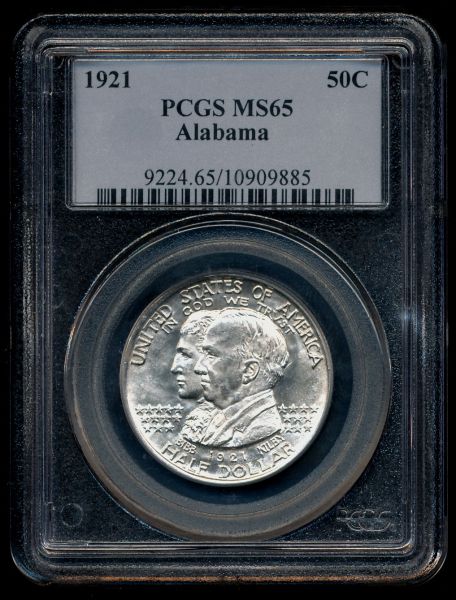
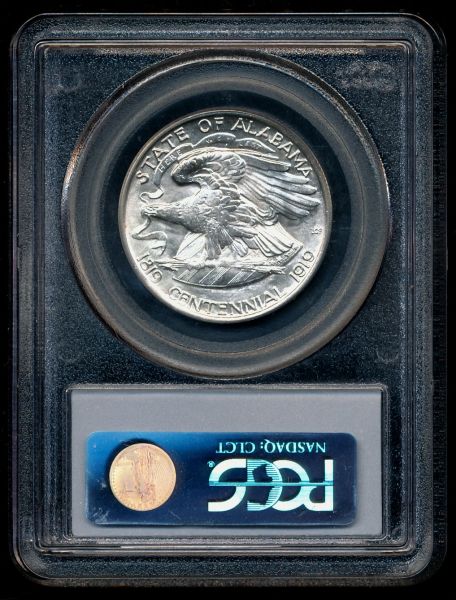
For more on the Alabama half dollars, check out:
-
1921 Alabama Statehood Centennial Half Dollar - Plain Variety-
1921 Alabama Statehood Centennial Half Dollar - 2X2 Variety-
1921 Alabama Statehood Centennial Half Dollar - Official Seals On Classic US Commemoratives - Part II-
1921 Alabama Statehood Centennial - Monroe-Wilson Design-
1921 Alabama Statehood Centennial - Coins with Stars Thread-
1921 Alabama Statehood Centennial - Coins Designed by a Woman Thread-
1921 Alabama Statehood Centennial - Coins with Conjoined Portraits ThreadFor other of my posts about commemorative coins and medals, see:
Commems Collection. 






 Posted 03/09/2022 09:43 am





