| Author |
 Replies: 90 / Views: 9,681 Replies: 90 / Views: 9,681 |
|
|
|
Pillar of the Community
Canada
1560 Posts |
I will also call this genuine
|
|
Pillar of the Community
United States
2018 Posts |
 Good luck! I think you have a winner. Keep us posted. |
|
Pillar of the Community
United States
1358 Posts |
How often do these come up for sale? This is a true rarity coin, not a novelty coin such as a 1913 Liberty nickel. Edited by thecoinguy1964
04/04/2022 6:56 pm
|
|
Pillar of the Community
United States
2018 Posts |
There are currently 14 of them listed on ebay. Can't say that about the 1913 Nickel. |
|
Pillar of the Community
United States
1028 Posts |
It's an interesting point. This so called "pattern" or "non pattern" isn't exactly rare. With 2000 estimated to be made, these are for sale much more than you would expect and are usually seen at every major auction. It's crazy to think that an 1858 Indian cent pattern is much rarer, yet can be had much cheaper. Same goes for the 1859 with shield IHC or the 1863 bronze cent pattern. It is the popular one to go after, therefore demand keeps the prices up. |
|
Pillar of the Community
United States
2189 Posts |
I say genuine. I posted an altered 1856 a few years back. The 8 was altered to a 6. here is the link to the old topic if it is a help to anyone. http://goccf.com/t/198157 |
|
Pillar of the Community
United States
2869 Posts |
|
|
Pillar of the Community
United States
3207 Posts |
I have little experience with FE cents. Looking at the OP's coin vs the PCGS one presented, the alignment of the date relative to the denticles appears different on the two coins. That makes me think fake.
|
|
Pillar of the Community
United States
4233 Posts |
@nick10 That is a good observation, however there is a genuine example on PCGS with the same alignment with the denticles. PCGS top, OP below: 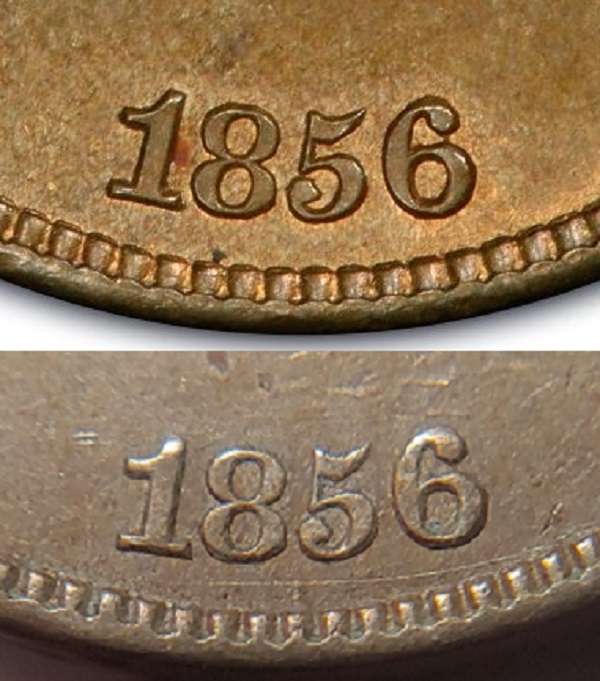 I note some common features, for example the subtle blemish between the knob of the 6 and the loop below which I see on most of the genuine PCGS coins. |
|
Bedrock of the Community
United States
11966 Posts |
Quote:It's an interesting point. This so called "pattern" or "non pattern" isn't exactly rare. With 2000 estimated to be made, these are for sale much more than you would expect and are usually seen at every major auction. It's crazy to think that an 1858 Indian cent pattern is much rarer, yet can be had much cheaper. Same goes for the 1859 with shield IHC or the 1863 bronze cent pattern. It is the popular one to go after, therefore demand keeps the prices up. I think that there is a good reason for this. Every collector I know owns a Red Book, where only a very small number of patterns and trial pieces are featured. I, like others, grew up leafing through the Red Book, dreaming of owning so many coins that were always out of reach. It wasn't until recently that I found that J. Hewitt Judd published a pattern guide for the Red Book series. People are into what they knew and learned about early on. They probably sell just a small number of copies of the pattern reference compared to the ubiquitous Red Book. Although each pattern issuance is scarce or rare, there really is a huge number of pattern and trial coinage issues struck at the mint. 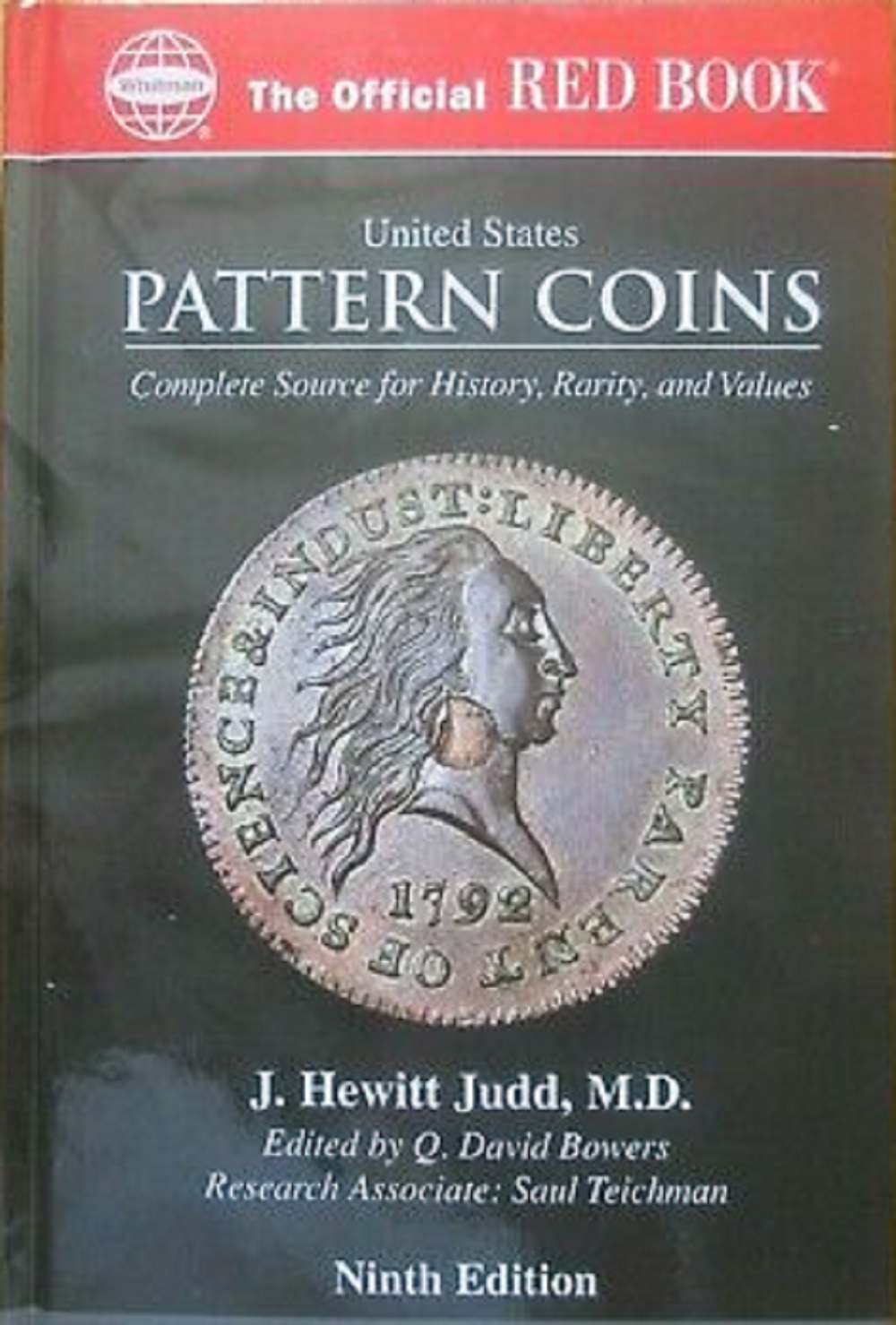 IN NECESSARIIS UNITAS - IN DUBIIS LIBERTAS - IN OMNIBUS CARITAS THE MAN IN THE ARENA, Theodore Roosevelt at the Sorbonne Paris on April 23, 1910: " It is not the critic who counts; not the man who points out how the strong man stumbles or where the doer of deeds could have done better. The credit belongs to the man who is actually in the arena, whose face is marred by dust and sweat and blood, who strives valiantly, who errs and comes up short again and again, because there is no effort without error or shortcoming, but who knows the great enthusiasms, the great devotions, who spends himself in a worthy cause; who, at the best, knows, in the end, the triumph of high achievement, and who, at the worst, if he fails, at least he fails while daring greatly, so that his place shall never be with those cold and timid souls who knew neither victory nor defeat." My coin website: https://fairfaxcoins.comEdited by numismatic student
04/09/2022 02:34 am
|
|
Pillar of the Community
United States
1028 Posts |
Any update here? Looking forward to seeing the results!
|
|
Pillar of the Community
 United States
2858 Posts |
It was put into the PCGS system one week ago today and is currently in grading. Hoping for the results next week.
|
|
Pillar of the Community
United States
9810 Posts |
Quote:
Hoping for the results next week. Excellent and fingers crossed! that's it is a good one.  "Buy the Book Before You Buy the Coin" - Aaron R. Feldman - "And read it" - Me 2013! ANA Life Member #3288 in good standing since 1981, ANS, Early American Coppers Member (EAC), Colonial Coin Collectors Club member (C4), Conder Token Collector Club member (CTCC), Civil War Token Society (CWTS) member, Liberty Seated Collectors Club (LSCC) & Numismatic Bibliomania Society member (NBS), USMex, Member in good standing, 2¢ variety collector. See my want page: http://goccf.com/t/140440 |
|
Bedrock of the Community
United States
17884 Posts |
Quote:It wasn't until recently that I found that J. Hewitt Judd published a pattern guide for the Red Book series. Actually Whitman adapted Judd's book INTO the Red Book Series. Dr Judd's goes back quite a ways into the 1950's. Long before the Red Book Series was even dreamed of. I believe Dr Judd was dead before the Red Book Series of books ever began. Edited by Conder101
04/20/2022 7:14 pm
|
|
Pillar of the Community
United States
9810 Posts |
Quote:Condor101 I believe Dr Judd was dead before the Red Book Series of books ever began. Not often I can get one over on Condor101, Gary usually schools most of us here at the CCF and on other coin forums, however in this instance, Dr. Judd was most definitely alive for the Red Book, in fact he was a professor at the University of Nebraska when it was first published. He was probably heavily involved in US Pattern coins before the Red Book came to be though. John Hewitt Judd Biography Born in Dawson, Nebraska, May 12, 1899. He received B.S. from the University of Nebraska in 1922 and Doctor of Medicine degree from Nebraska in 1924. Married Ellanore Baxter September 14, 1935. (She died 11/6/1986). They had one daughter. Professor at the University of Nebraska 1930 to 1964. In 1942 he became chairman of the Department of Ophthalmology. He was a member of the Masons. A resident of Omaha, Nebraska. He was life member number 65 of the ANA. Past president of the Central States Numismatic Society. He served on the ANA board of governors 1945 to 1951, as first vice president 1951 to 1953 and as 29th ANA President August 26, 1953, to August 27, 1955. He received the association's Medal of Merit in 1948. He had the "Best-of Show" exhibit in 1949 and the first named Howland Wood Trophy for his exhibit of pattern coins in 1952. Received the Farran Zerbe Award in 1955. He served on the Assay Commission for 1965. Author of United States Pattern, Experimental and Trial Pieces. The first edition was published in 1959. The seventh edition in 1982 was revised by A. Kosoff. Walter Breen is acknowledged for his research. His pattern collection was sold to Abe Kosoff. Other parts of his collection were sold at auction by Superior in June 1977 and by Stack's in March 1980. He died in Omaha on December 23, 1986  Credit to: Pete Smith, American Numismatic Biographies "Buy the Book Before You Buy the Coin" - Aaron R. Feldman - "And read it" - Me 2013! ANA Life Member #3288 in good standing since 1981, ANS, Early American Coppers Member (EAC), Colonial Coin Collectors Club member (C4), Conder Token Collector Club member (CTCC), Civil War Token Society (CWTS) member, Liberty Seated Collectors Club (LSCC) & Numismatic Bibliomania Society member (NBS), USMex, Member in good standing, 2¢ variety collector. See my want page: http://goccf.com/t/140440Edited by westcoin
04/20/2022 8:44 pm
|
| |
Replies: 90 / Views: 9,681 |







 First Page
 Previous Page


 Posted 04/04/2022 3:29 pm





