



Coin Community Family of Web Sites Join Thousands of Coin, Bullion, & Money Collectors
Royal Canadian Mint products, Canadian, Polish, American, and world coins and banknotes. Specializing in Modern Numismatics Shop for APMEX Bullion on eBay!300,000 items to help build your collection! Coin, Banknote and Medal Collectors's Online Mall Join Thousands of Coin, Bullion, & Money Collectors Vancouvers #1 Coin and Paper Money Dealer


Username:
Password:
Save Password
Forgot your Password?


This page may contain links that result in small commissions to keep this free site up and running.

Welcome Guest! Registering and/or logging in will remove the anchor (bottom) ads. It's Free!

Commems Collection Classic: 1936 Cincinnati Music Center 50th Anniversary - Origin Story

To participate in the forum you must log in or register.
Author Previous TopicReplies: 7 / Views: 1,239Next Topic  
CCF Master Historian of USA Commemoratives
Learn More...
commems's Avatar
United States
12255 Posts
 Posted 05/07/2022  11:01 am Show Profile   Bookmark this topic Add commems to your friends list Get a Link to this Message Number of Subscribers
I recently posted about how the controversy surrounding the 1936 Cincinnati half dollar might have possibly been avoided. In that post, I touched upon some of the content presented here. So, if you've already read that one and sense a bit of deją vu while reading this post - that's the reason! If you haven't yet read the other post, it would be a great follow-up to this one.


The call for a 1936 Cincinnati half dollar came via a pair of bills introduced in the House and Senate in January 1936. The House bill, introduced first by Representative William Emil Hess (R-OH), called for half dollars "in commemoration of the Fiftieth (Golden) Anniversary of Cincinnati, Ohio, as a center of music, and its contribution of the annual May festival to the art of music for the past fifty years." The Senate bill, introduced by Senator Robert Johns Bulkley (D-OH), sought coins "in commemoration of the fiftieth anniversary of Cincinnati, Ohio, as a center of music, and its contribution to the art of music for the past fifty years."

Each of the bills called for 15,000 50-cents pieces to be struck for the benefit of the Cincinnati Musical Center Commemorative Coin Association, of Cincinnati, Ohio (the brainchild of Thomas G. Melish). Both bills allowed for multiple Mint facilities to be used to strike the coins, with the House version specifying that 10,000 coins were to be struck in Philadelphia, 3.000 in San Francisco and 2,000 in Denver. Neither bill included a specification for the year that was to appear on the coins nor did they specify an expiration date for coining authority.

The Senate bill was the first to move forward. It was referred to the Senate Committee on Banking and Currency, from which it was quickly reported back with a recommendation for passage without amendment; no Hearing was held. Based on the Committee Report, the bill was passed in the Senate without objection and sent to the House for its consideration and concurrence.

The original House bill was referred to the House Committee on Coinage, Weights, and Measures where it was also viewed favorably (without a Hearing). When the Committee reported on the bill, it recommended that it be amended such that the mintage was raised to 25,000 (from 15,000) and the specification of mintage figures by Mint facility be removed. The recommended amendments did not ever come up for consideration in the House, however, as the Senate version of the coin bill was substituted and acted upon by the House and its version was laid on the table. The Senate version of the bill was passed by the House via unanimous consent.

So, the bill capping the coin's mintage at 15,000 was the version that moved forward. It was signed into law by US President Franklin Delano Roosevelt on March 31, 1936.

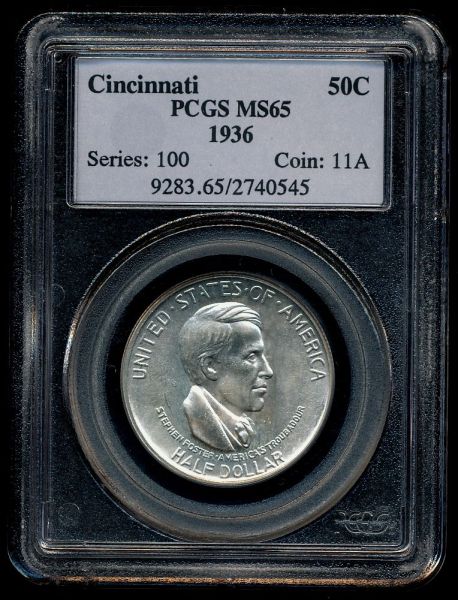
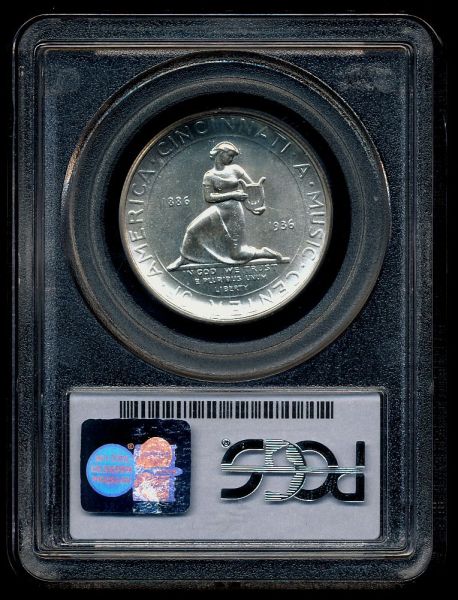
Constance Ortmeyer was commissioned to create the designs for the coin, and promptly created several design sketches. When asked to review the designs, the Commission on Fine Arts (CFA) objected to the coin's historical inaccuracy and to the prominent inclusion of Stephen Foster as a key figure in Cincinnati's musical history (it didn't believe he had any credentials for such recognition - an accurate assessment!). It stated that it "was at a loss to connect a fiftieth anniversary in 1936 with a movement that began in 1873." (Letter from CFA to Director of the Mint, May 1936.) (See "Controversy" link below for more.)

The CFA's objections did not derail the Association's efforts, and the original proposed designs, with some modifications, were carried forth to the struck coins, supporting continued criticisms.

Less than a month after the original coin bill's approval, a new bill was introduced in the Senate, in April 1936, by Senator Bulkley that sought up to 50,000 additional coins. Though it was passed in the Senate, the bill did not pass the House (it was not reported out of Committee) and thus the coin's authorized mintage remained at 15,000. (See the link below for details.)

1936 Cincinnati, OH Musical Center 50th Anniversary
Commems-Collection-Classic:-1936-Cincinnati-Music-Center-50th-Anniversary---Origin-Story Commems-Collection-Classic:-1936-Cincinnati-Music-Center-50th-Anniversary---Origin-Story


For the posts referenced above, see:

- 1936 Cincinnati Music Center 50th Anniversary - Controversy Avoided?
- 1936 Cincinnati Music Center 50th Anniversary - A Mintage Revisit


For more on the history of the Cincinnati, OH half dollar, and other of my posts about commemorative coins and medals, check out: Commems Collection.


Collecting history one coin or medal at a time! (c) commems. All rights reserved.
Pillar of the Community
muddler's Avatar
United States
7187 Posts
 Posted 05/08/2022  12:43 am  Show Profile   Bookmark this reply Add muddler to your friends list Get a Link to this Reply
I like the simplicity of the design of this coin.
Moderator
Learn More...
nickelsearcher's Avatar
United States
15392 Posts
 Posted 05/08/2022  06:44 am  Show Profile   Bookmark this reply Add nickelsearcher to your friends list Get a Link to this Reply
Everything about the origin of the Cincinnati half represents a classic tale of the collector abuses of 1936 that eventually led to the series demise.

This coin was for the personal profit of Thomas G. Melish and there is no historical reason why it should have come to be, commems excellent reasoning for the May musical festival nonwithstanding.

That said - I'm curious about the Senate's lack of modification to the proposed coins language.

We've come to read in commems 'origin' stories how the Senate Committee on Banking and Currency generally limited the proliferation of the 1936 coins by amending the various bills to include revised standard language (paraphrasing commems words as follows); the coin production should be limited to a single Mint facility, a maximum (and perhaps minimum) number of coins be authorized, that all coins must be struck within one year of the bill becoming law and that the coins be dated with the year in which they were authorized.


Quote:
It was referred to the Senate Committee on Banking and Currency, from which it was quickly reported back with a recommendation for passage without amendment; no Hearing was held


Why did these Senate limitation not occur for the Cincinnati issue? Did Melish somehow meddle in the process to gain additional financial advantage?

I do note the January 1936 bill introductions commems mentions. Perhaps at that time the Senate Committee on Banking and Currency had not yet promulgated their standard language?

However that came to be, today we have 5,005 examples of the Cincinnati from each of the three mints then in existence (P-D-S).

Melish won and the collectors of 1936 suffered at his expense.

edit for spllneging
Take a look at my other hobby ... http://www.jk-dk.art
Edited by nickelsearcher
05/08/2022 06:45 am
CCF Master Historian of USA Commemoratives
Learn More...
commems's Avatar
United States
12255 Posts
 Posted 05/08/2022  07:09 am  Show Profile   Bookmark this reply Add commems to your friends list Get a Link to this Reply

Quote:
Why did these Senate limitation not occur for the Cincinnati issue? Did Melish somehow meddle in the process to gain additional financial advantage?

I do note the January 1936 bill introductions commems mentions. Perhaps at that time the Senate Committee on Banking and Currency had not yet promulgated their standard language?

Exactly! The Cincinnati bill came through a few months in advance of the Senate Committee adopting its new standard policies re: commemorative coin bills. It got in under the wire during the time when it was still "fast times at the US Congress!"


Collecting history one coin or medal at a time! (c) commems. All rights reserved.
Edited by commems
05/08/2022 07:09 am
Moderator
Learn More...
nickelsearcher's Avatar
United States
15392 Posts
 Posted 05/09/2022  05:59 am  Show Profile   Bookmark this reply Add nickelsearcher to your friends list Get a Link to this Reply

Quote:
The Cincinnati bill came through a few months in advance of the Senate Committee adopting its new standard policies


Appreciate the confirmation commems.

I seem to recall from your 'House vs Senate' series (appears to be the predecessor to your 'Origin' series) that the Long Island Tercentenary half bill was originally submitted to the House on February 20, 1936 and was sent to the Senate with language that would have resulted in another multi year/multi mint coin series.

So, perhaps we can consider the Long Island bill and eventual Senate action to be the initiating coin where the Senate Committee on Banking and Currency finally came to their senses and began protecting the collectors of the day from multi coin abuses?

If so, what was the date in 1936 that the Long Island bill was approved by the Senate? That would be a date to celebrate!

Let's call it "Freedom from Collector Abuses Anniversary"
Take a look at my other hobby ... http://www.jk-dk.art
CCF Master Historian of USA Commemoratives
Learn More...
commems's Avatar
United States
12255 Posts
 Posted 05/09/2022  09:17 am  Show Profile   Bookmark this reply Add commems to your friends list Get a Link to this Reply

Quote:
So, perhaps we can consider the Long Island bill and eventual Senate action to be the initiating coin where the Senate Committee on Banking and Currency finally came to their senses and began protecting the collectors of the day from multi coin abuses?

If so, what was the date in 1936 that the Long Island bill was approved by the Senate? That would be a date to celebrate!

Great connecting of the dots!

You beat me to the punch! I had a "Trendsetters" Post in the works that discusses the Long Island half dollar's place in US commemorative coin history.

Until I get a chance to finish that post...

Yes, the 1936 Long Island Tercentenary half dollar was among the first coins to feature the Senate Committee's new provisions. The bill was reported out of the Committee in late March 1936 - the bills for the Wisconsin Territorial half dollar and the Cleveland, OH Centennial / Greats Lakes Exposition half dollar were reported out the same day with the same recommended changes. So, the three were "tied" in that sense.

The Long Island bill was approved/signed into law by President Roosevelt on April 13, 1936; the Cleveland bill followed, being approved about two weeks later on May 1, 1936. The Wisconsin bill followed the Cleveland, being approved two weeks later on May 15, 1936. So, Long Island was #1 to the finish line, the Cleveland was #2 and the Wisconsin Territorial was #3 - the date differences being largely driven by the time it took for each bill to work its way through Congress following the Committee Report.


Collecting history one coin or medal at a time! (c) commems. All rights reserved.
Moderator
Learn More...
jbuck's Avatar
United States
187702 Posts
Moderator
Learn More...
nickelsearcher's Avatar
United States
15392 Posts
 Posted 05/09/2022  3:20 pm  Show Profile   Bookmark this reply Add nickelsearcher to your friends list Get a Link to this Reply

Quote:
I had a "Trendsetters" Post in the works


And we hope you continue to develop it with a goal of eventually sharing it here at the CCF.


Quote:
The Long Island bill was approved/signed into law by President Roosevelt on April 13, 1936


So that is the anniversary date I alluded to above for my fictitious holiday. Well, it lasted for 10 years or so until the multi year/multi mint BTW series came along.
Take a look at my other hobby ... http://www.jk-dk.art
  Previous TopicReplies: 7 / Views: 1,239Next Topic  

To participate in the forum you must log in or register.


Disclaimer: While a tremendous amount of effort goes into ensuring the accuracy of the information contained in this site, Coin Community assumes no liability for errors. Copyright 2005 - 2026 Coin Community Family- all rights reserved worldwide. Use of any images or content on this website without prior written permission of Coin Community or the original lender is strictly prohibited.
Contact Us  |  Advertise Here  |  Privacy Policy / Terms of Use

Coin Community Forum © 2005 - 2026 Coin Community Forums
It took 0.41 seconds to rattle this change. Forums