I have spent many hours gathering documents regarding the history of US commemorative coins, but from time to time, I still get a surprise when I revisit a file assembled years ago. Here's such a story...
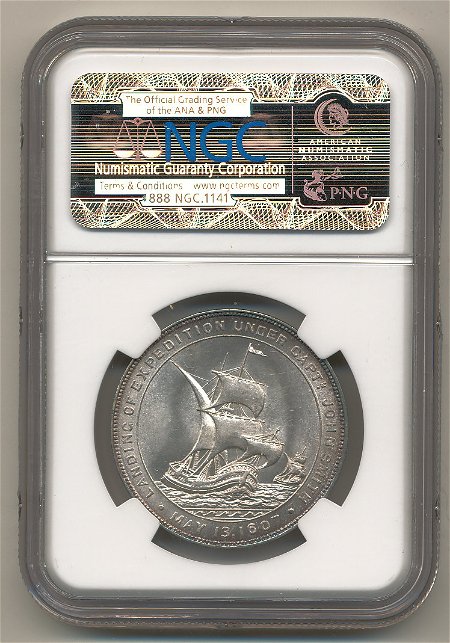
For close to three decades now, I've been aware that the US Mint struck commemorative medals for the 1907 Jamestown Exposition. I've even shown them here on CCF! Here's one from my collection for reference:
1907 Jamestown Exposition Commemorative Medal - HK-344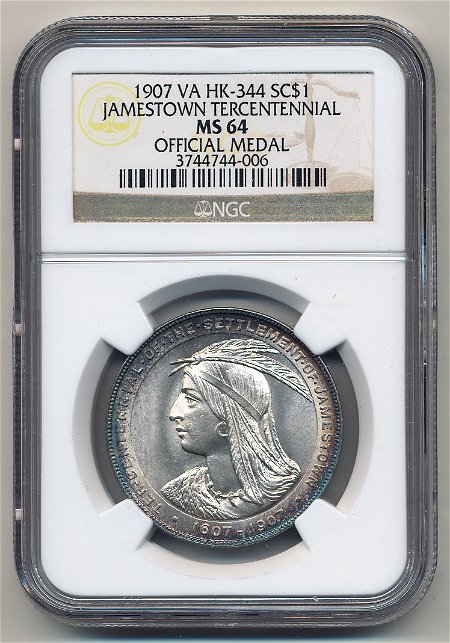
Surprisingly, I recently learned - relearned? - that the Mint might also have been tasked with the requirement of striking an unusual commemorative coin for the Exposition as well.
In January and April, 1906, bills were introduced in the House and Senate, respectively, that sought to "authorize the United States Government to participate in the Jamestown Tercentennial Exposition on the shores of Hampton Roads, in Norfolk County, Virginia, in the year nineteen hundred and seven."
The House bill was introduced by Representative Harry Lee Maynard (D-VA) and immediately referred to the Select Committee on Industrial Arts and Expositions. The bill
did not get referred to the Committee on Coinage, Weights, and Measures as the vast majority of the bill dealt with the details of the Government's participation in the Exposition and corresponding appropriations for such participation. Section 7 of the lengthy bill, however, stated "the Secretary of the Treasury shall...cause to be struck at the mints of the United States one million
two-dollar silver pieces of the same fineness and of twice the weight of the present one-dollar piece." Imagine either an over-sized or double-thickness
Morgan dollar! (I was recently re-alerted to the coin provision via the transcript of the Hearing for the bill (see following discussion ) - I've had the transcript in my files for nearly nine years but the proposed coin reference was originally overlooked by me - I had a different focus at the time!)
The proposed coin would have been the first, and ultimately, the only $2.00 denomination coin in the US commemorative series (or regular circulation series).
The Select Committee called a Hearing for the bill in February 1906, and Henry St. George Tucker, President of the Jamestown Exposition Company and former US Representative from Virginia, was the primary speaker on behalf of the bill - the entire bill, not just the coin section.
Regarding the coin, Tucker imagined that the $2.00 silver piece would provide a clean profit for the Company and preclude it from asking for an appropriation of the same amount. The Government would be paid for the value of silver in the coins (i.e., an amount less than their face value) and the Company would earn its profit by using the coins at their full face-value. The example used in the Hearing presented a case where the coin might contain $1.20 in silver value. The Company would pay the Government $1.20 for each coin (i.e., less than face-value) and then use them as $2.00 coins, thus netting a profit of $0.80 on each coin.
When the subject of the requested coin came up for discussion, however, Tucker was almost immediately put "on the defensive." Multiple Committee members questioned Tucker on the distribution plan for the coin. His answers made it very clear that the Company had not yet worked out a solid plan. Tucker stated that the coins would be distributed in one of three ways or in some combination of them: given to Exposition workers as part of their pay, distributed through banks across the country and/or sold at a premium into the numismatic hobby. The contradictions of such a distribution model were immediately seized upon by the Committee. The Big Question: How would the Company expect to sell some of the coins at a premium when others were to be distributed at face value? (Who would pay a premium?)
When the Committee's Report on the bill was released, it recommended an amendment via substitution for the entire bill and deleted the coinage section. It continued to include, however, the provision for the Mint to strike commemorative souvenir medals and award medals for the Exposition Company (see above).
The Senate version of the bill, introduced in April 1906, was cognizant of the House actions that preceded it, and did not include any reference to a $2.00 commemorative coin; it did, however, include provisions for medals.
Neither of the standalone bills was authorized in Congress, but its provisions were included in the Civil Sundry Expenses Act for the Fiscal Year, which was passed by Congress and signed into law by President Theodore Roosevelt, Jr. The Act enabled the US Government to be an active, and prominent, participant in the Jamestown Tercentennial Exposition. The Act also provided for medals to be struck by the US Mint but did not include authorization for a commemorative coin - $2.00 denomination or otherwise!
For other of my posts about commemorative coins and medals, including more What If? stories, see:
Commems Collection.






 Posted 07/11/2022 1:26 pm





