Wrapping up my look at classic US commemorative coins that feature a Coat-of-Arms or Seal...12. 1936 US-Philippines Commonwealth InaugurationThe US gained possession of the Philippine Islands in 1898 as a result of its victory over Spain in the Spanish-American War.
The US' plan for the Philippine Islands was to support and guide its development to the point at which it could become a self-supporting independent nation. The Philippine Islands, under US administration, was originally a Territory of the US, which meant the US exerted a high degree of control over the island's internal and external affairs.
A Coat-of-Arms was developed for the Philippines Territory based on the Coat-of-Arms granted to Manila in 1596 by King Philip II of Spain; it reflected some of the colonial history of the islands as well as their new status. The Arms consisted of a US Shield with a blue chief (top section) and 13 alternating red and white stripes in its field. At the center of the shield is found an escutcheon which features a modified version of the original Coat-of-Arms of Manila which includes a castle (symbolic of Spain) and a mythical sea lion with sword (symbolic of the local government).
An American Bald Eagle surmounts the Arms, it represents the US' oversight of the Philippine Islands. A scroll with the text "Philippine Islands" is seen below the shield.
Coat-of-Arms of the US Territory of the Philippines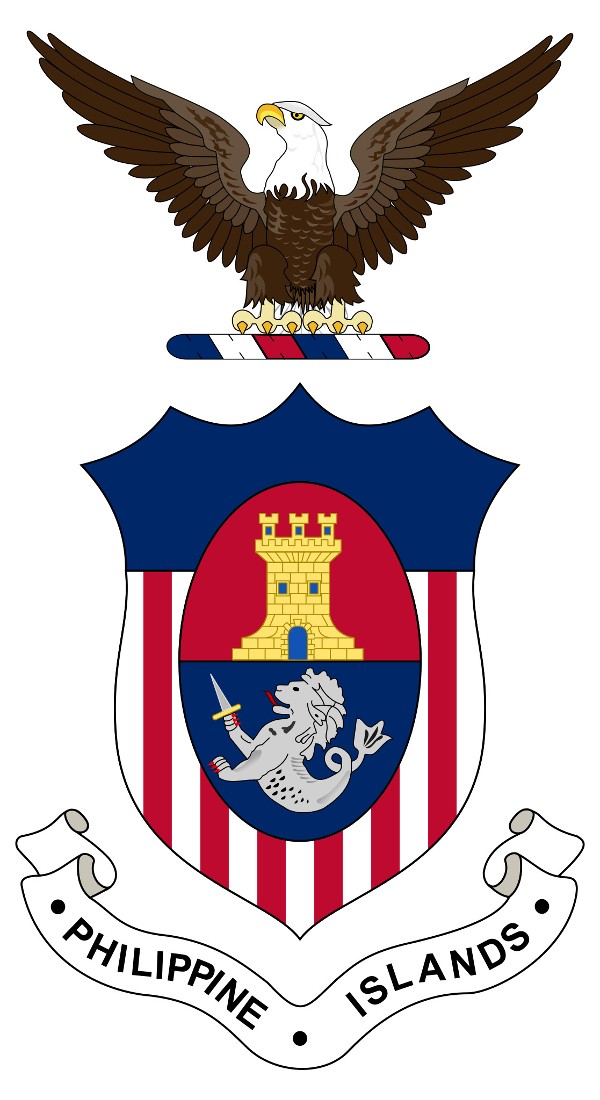 (Image Credit: Government of the Philippines, Public domain, via Wikimedia Commons.)
The C-of-A was not used, however, on the Territory's circulating coinage (1903 to 1936). The coins depicted a Bald Eagle perched atop a US Shield with 13 stars and stripes. Here's my 1904 Five Centavos coin:
1904 - US Territory of the Philippines 5 Centavos - Obverse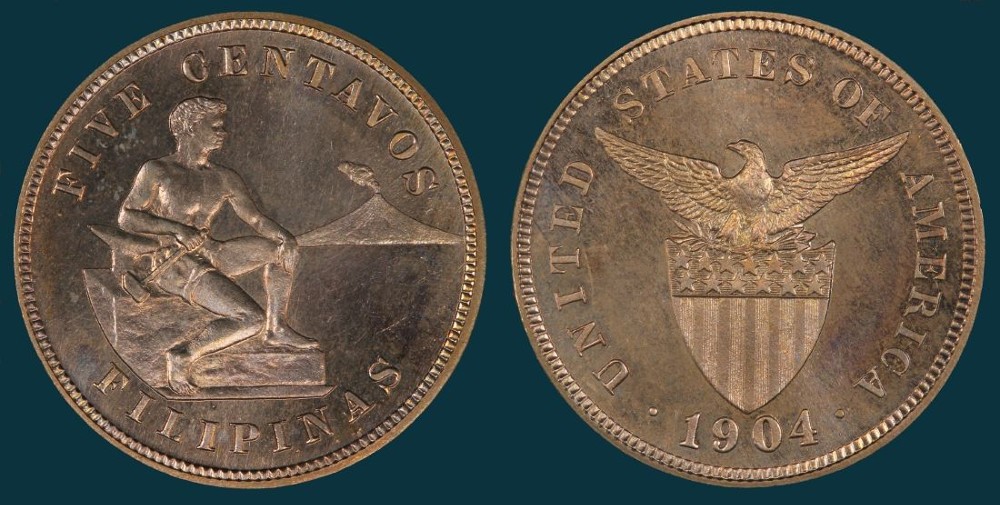
The formal transition from a US Territory to an independent Philippines Republic began in 1934 with the passage by the 73rd US Congress of The Philippines Independence Act (aka, the Tydings-McDuffie Act). The Act provided a framework for the Philippines to achieve independence within 10 years and established the Commonwealth of the Philippines as an interim step; World War II and the Japanese occupation of the Philippines extended the transition timeline by one year to July 1946. As a Commonwealth, the Philippines became largely self-governing and responsible for its internal affairs; it also drafted its own constitution.
The new form of government for the Philippines initiated the development of a modified Coat-of-Arms for the Commonwealth. The Arms continued to feature a US Shield, but with a white chief (vs. blue), and the 13 red and white stripes in the field below the chief were changed to a field halved vertically with the left section blue and the right section red. Also, the chief was updated to include three five-pointed stars that represent the three main island groups of the Philippines: Luzon, the Visayas and Mindanao.
The same Arms design seen on the Territorial Arms is superimposed on the shield - though with different coloring. included are a castle in the top half (continuing to represent Spain's legacy in the islands) and the same sword-toting, mythological sea lion in the bottom half representing the authority of the local (Philippines) government.
An American Bald Eagle, representing the continuing United States-Philippines relationship along with the US' continued oversight. A scroll with the text "Commonwealth of the Philippines" is seen below the shield.
Coat-of-Arms of the Commonwealth of the Philippines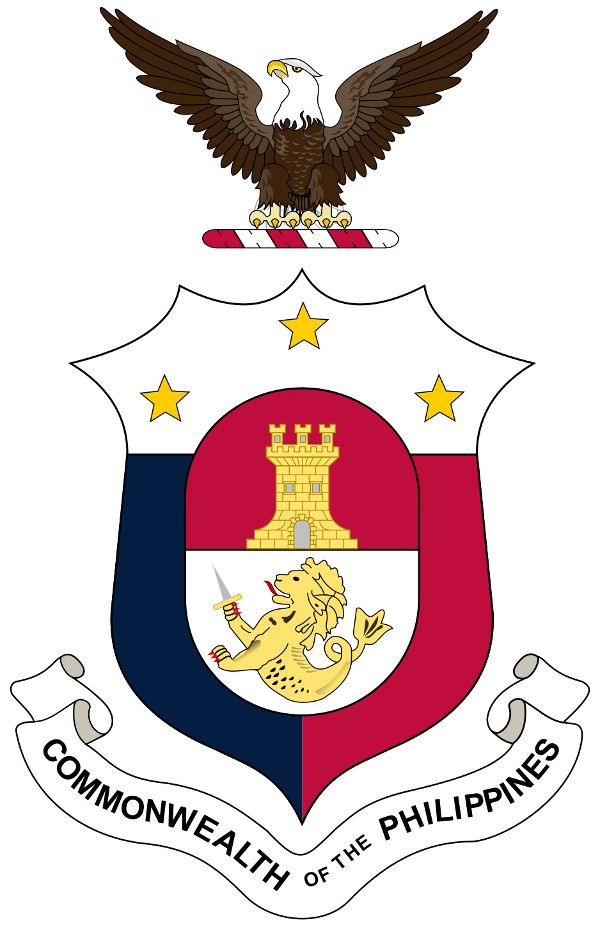 (Image Credit: Government of the Philippines, Public domain, via Wikimedia Commons.)
The new Arms were incorporated on the obverse of the three commemorative coins struck to mark the November 15, 1935 inauguration of the Philippines' Commonwealth status - a pair of One Peso coins and a single 50 Centavos piece. All three were minted at the reconstructed Manila Mint which had been striking coins for the Philippines since 1920.
The coins are the work of Amrosio Morales, a Filipino artist/sculptor/engraver and college art instructor.
1936 Philippines Commonwealth - 50 Centavos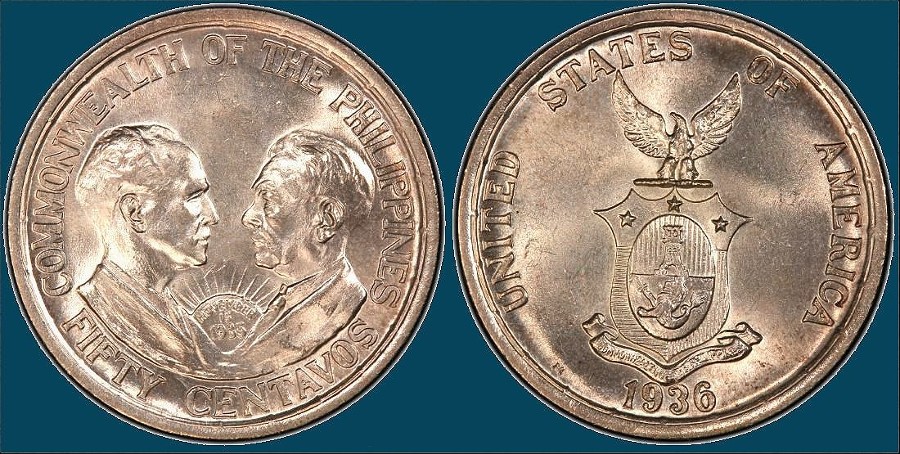 1936 Philippines Commonwealth - One Peso / Murphy-Quezon
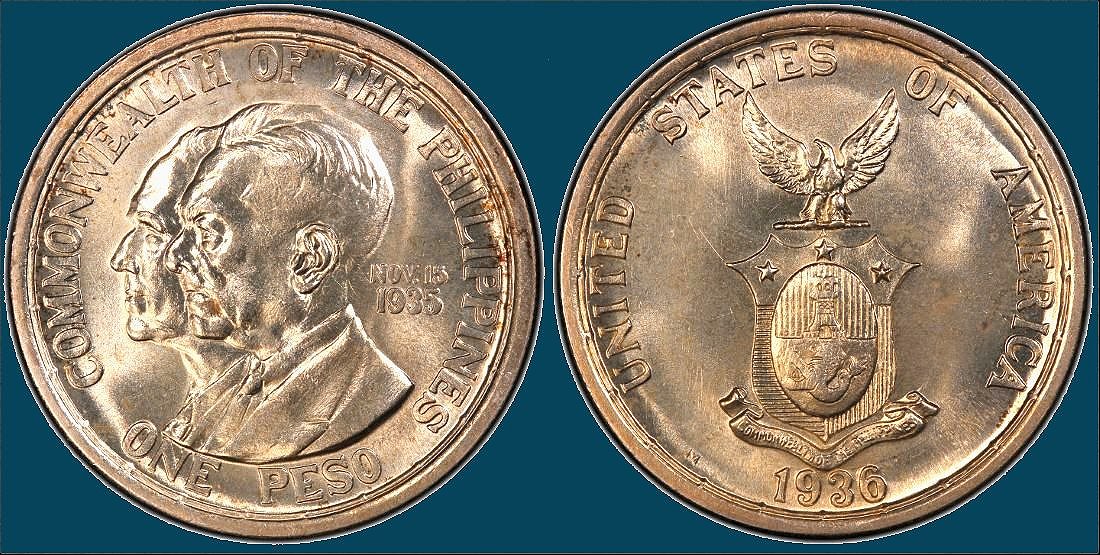 1936 Philippines Commonwealth - One Peso / Roosevelt-Quezon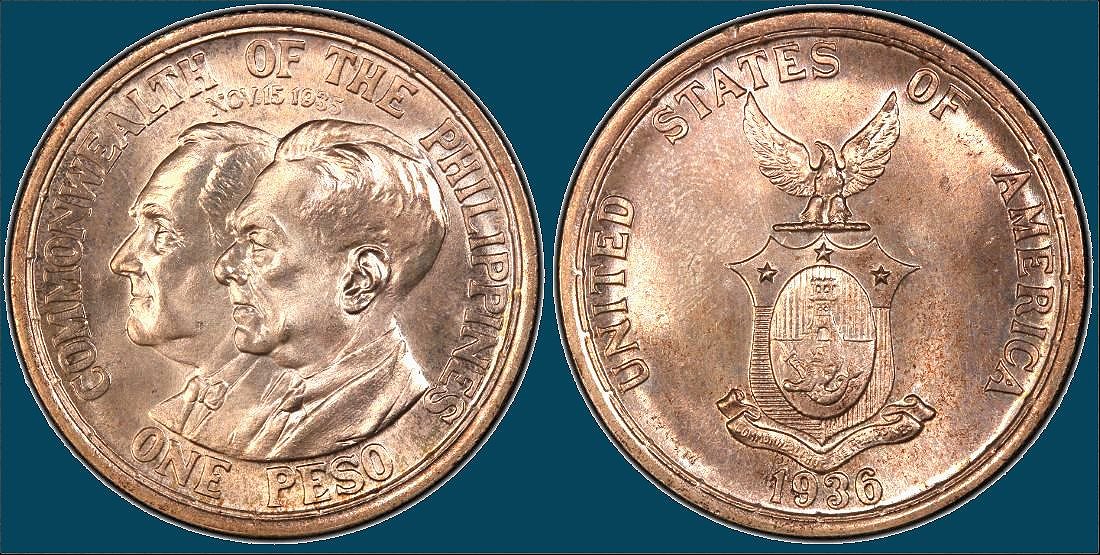
I've previously posted about the US-PI commemorative coins here:
-
1936 US-PI Commonwealth Inauguration-
Quick Bits #11 - Conjoined Portraits-
Quick Bits #49 - Territorial Commemorative CoinsFor other of my commemorative-themed posts about coins and medals, check out:
Commems Collection. 




 Posted 07/18/2022 7:40 pm





