The 1930s saw many sponsor/coin dealer misdeeds that led to the exploitation of collectors, so it's nice to relay a story about a sponsor that "got it right" and implemented a well-planned, fair and equitable distribution plan for its commemorative coin. Let's talk about the 1946 Iowa Statehood Centennial half dollar...
Iowa joined the Union on December 28, 1846 as the 29th State. Prior to Statehood, present-day Iowa was a part of the Iowa Territory which included portions of present-day North and South Dakota, parts of present-day Minnesota and all of present-day Iowa. The Iowa Territory, as described, existed from July 4, 1838 until December 28, 1846.
The Iowa Centennial Committee was created to oversee the State's centennial celebration. The Committee formed a sub-committee to address the desire to have a commemorative coin and a commemorative stamp be part of its planned celebration - it was successful on both counts.
1946 Iowa Statehood Centennial Stamp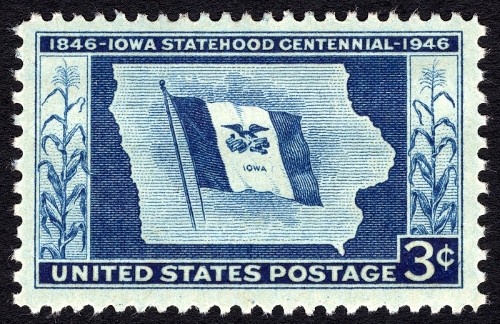 (Image Credit: Smithsonian National Postal Museum. Fair use.)
The Public Law authorizing the Iowa coin was signed by US President Harry S. Truman on August 7, 1946. It and the Booker T. Washington Birthplace Memorial half dollar - signed on the same day - were the first US commemorative coins to be authorized since the 1936 Norfolk, VA Anniversary coin, authorized on June 28, 1937 and struck in late 1937 (but back-dated to 1936).
A key objective of the Iowa Centennial Committee was to keep its commemorative half dollar out of the hands of speculators. To do so, it enlisted the Iowa Bankers Association (IBA) to manage the sale and distribution of its coin. The IBA agreed to do so without charge, except for some minor out-of-pocket expenses. 650 of the IBA's 658 member banks across the state agreed to participate in the "no charge" coin sale program.
The Act authorizing the Iowa half dollar specified a mintage of up to 100,000 coins. The Committee decided that 90,000 of the coins would be designated for Iowa residents, 5,000 would be for out-of-state orders and that it would hold 5,000 coins in reserve.
The Committee, along with an Iowa accounting firm, devised a distribution model that allocated coins to each of the State's 99 counties at a rate of ~28.2 coins per person in the county. It was a population-based model based on county populations as reported by the 1940 US census. (The Illinois Statehood Centennial half dollar used a similar model back in 1918. Read about it here:
1918 Illinois Statehood Centennial: Quick Bits #32 - 1918 Illinois Sales.) The Iowa coins would be assigned to the banks in each county based on private deposits held by each bank - no "big city" government/company accounts were included to prevent the allocations from being unfairly skewed.
Participating banks ordered their coins at a cost of $2.50 per coin - payable in advance only - giving the Centennial Committee an immediate gross profit of ~$2.00 per coin (~$180,000 total for the bank-distributed coins). As the IBA was handling sales without cost to the Committee, the same $2.50 price was charged to residents. Purchase limits were set at one coin per person.
Residents did not immediately purchase the coins from their local bank, however. The banks were instructed to take written applications from residents for the first week of the program (December 16 through December 21); the Committee made a reservation form available for the banks to use. After the initial ordering period was complete, if the order could be filled from the bank's allocated coins, the resident was able to make the physical purchase of the coin beginning on Monday, December 23, 1946.
If a bank took more applications than it had coins, it was instructed by the IBA to use either a random drawing or first-come-first-served approach (based on receipt of applications) to select those who would receive their coin. IMO, the fairest approach would be the random drawing model. Though I haven't read any specifics, it seems likely that whatever method an oversubscribed bank chose, some Iowa residents faced disappointment after having their coin application denied.
Banks within each country were instructed by the IBA to communicate regarding surpluses and shortages during the week of December 23 through December 28. In January, the IBA reported on the surpluses/shortages within the banking network and helped coordinate exchanges among banks. This enabled some Iowa residents who previously had their application denied "bonus" access to a coin.
In January 1947, the one-coin-per-person limit was lifted and banks were free to sell multiple coins to their customers/Iowa residents.
A brief news piece in the American Numismatic Association's
The Numismatist magazine (February 1947) announced that the Iowa half dollar was then available for $3.00 ($2.50 for coin, $0.50 for postage and handling) to all those desiring on; orders were to be placed with the Iowa Treasurer's office which handled sales and distribution. Out-of-state buyers did not have limits. It's fair to say that out-of-state buyers had an easier time of it vs. the multi-step process imposed on Iowa residents.
The
Numismatic Scrapbook Magazine announced the availability in January 1947. So,
Scrapbook readers in early 1947 had a head start on purchases vs. those who only read
The Numismatist.
In the end, the sales period for the Iowa Statehood Centennial half dollar lasted 100 days and resulted in a near sellout (excluding the coins held in reserve). Most importantly, the distribution was completely above board and eminently fair. It would have been a great model for other US commemorative coins had it taken place earlier in the series!
1946 Iowa Statehood Centennial Half Dollar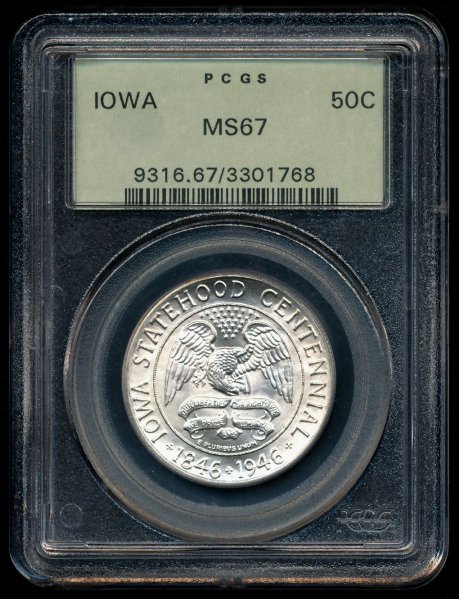
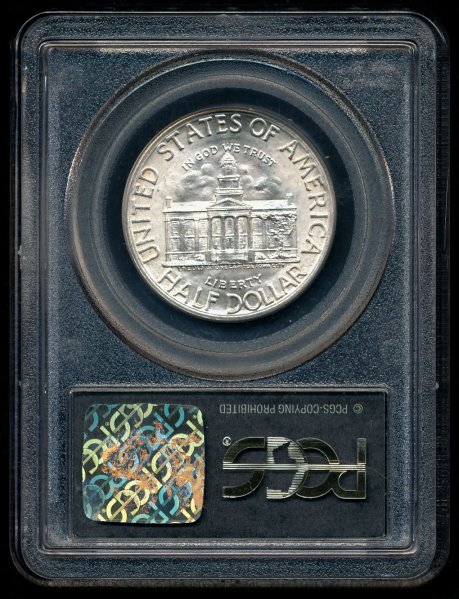
For other of my posts about commemorative coins and medals, including more on the history of the Iowa Statehood half dollar, see:
Commems Collection.










 Posted 07/30/2022 5:14 pm


