I've previously written about the silver half dollar that was struck as part of the five-coin set struck to support the Panama-Pacific International Exposition that was held in San Francisco, California in 1915 (see Commems Collection link below) - now it's time to turn my attention to the gold coins of the set. First up, the gold dollar.
The bill calling for commemorative coins for the 1915 Panama-Pacific International Exposition ("Pan-Pac Expo") was introduced in the Senate in July 1914. The bill was introduced by Senator James Edgar Martine (D-NJ) and was immediately referred to the Committee on Industrial Expositions (
not the Committee on Banking and Currency).
The bill called for, among the other coins of the set, the minting of up to 25,000 gold dollars at the San Francisco Branch Mint on behalf of the Panama-Pacific International Exposition Company.
The Industrial Expositions Committee reported the bill back to the Senate without amendment. A question was raised on the Senate floor as to why the bill was not referred to the Committee on Banking and Currency or to the Committee on Finance, but was quickly addressed and resolved with Senator Martine assuring the Senate that the Secretary of the Treasury had reviewed the bill and supported it. The bill passed without further debate and was sent to the House.
Once received in the House, the bill was referred to the Committee on Coinage, Weights, and Measures. After its review of the bill, the Committee reported the bill favorably but with a few minor edits/amendments. One of the recommended changes changed the initial delivery date for the coins to "the day of the opening of the Exposition" vs. the original December 1, 1914 date. Another change was addition of language to ensure the Treasury would be reimbursed for any funds expended for securing the needed coin designs.
The amendments were agreed to in the House and the amended version of the bill was sent back to the Senate. The Senate concurred in the House amendments without debate, clearing the way for the bill to be sent to the President for final approval. The bill was signed into law by US President Woodrow Wilson on January 16, 1915.
Charles Keck was selected to design the gold dollar; it was the first coin to be designed by Keck, who would later be called upon to design the 1927 Battle of Bennington-Vermont Independence Sesquicentennial commemorative half dollar (and official medal) and the 1936 Lynchburg, VA Sesquicentennial half dollar.
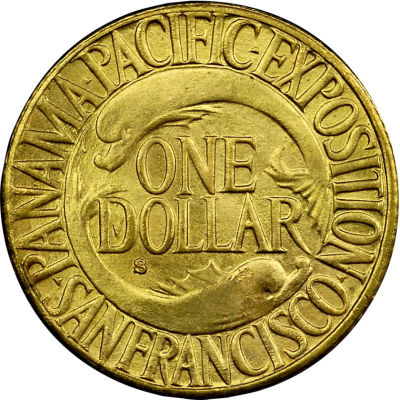
The obverse of the coin presents an unnamed, left-facing Panama canal worker wearing a short-brimmed cap (one of many different styles of hat worn by canal laborers); the design was meant to be representative of a typical canal worker. The reverse design of the coin features a pair of dolphins. The dolphins are meant to symbolize the connection that was created between the Atlantic and Pacific Oceans when the Panama Canal was completed - two oceans, two dolphins. The coin includes the "S" mint mark within the reverse design.
The Mint struck the authorized maximum of 25,000 coins in May (4,000), June (1,500) and July (19,534 - 34 coins for assay purposes), 1915. Sales, however, did not fully meet expectations and more than 10,000 coins remained unsold when the Exposition wrapped up - 10,000 coins were returned to the Mint and melted leaving a net distribution of 15,000 coins (many others were held by Farran Zerbe the Manager of the Exposition's Coin and Medal Department).
(Note: Zerbe initially claimed that no gold dollars remained or needed to be returned to be melted - personal motives?)I find the designs to be artistic and attractive and believe they work well on the small coin. I also like the font used for the inscriptions - I believe it works well on the coin.
The coins were initially sold at the Exposition for $2.00 each (the price was later raised to $2.25); a package price of six for $10.00 was also offered.
Panama-Pacific International Exposition Gold Dollar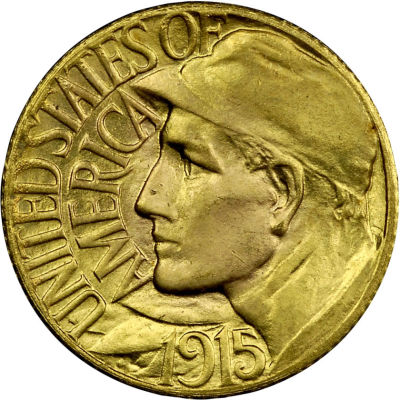
For other of my posts about commemorative coins and medals, including more on the other coins of the Pan-Pac Expo set, see:
Commems Collection.







 Posted 08/04/2022 10:20 am





