For the history of the path the bill that authorized the Panama-Pacific International Exposition ("Pan-Pac Expo") coins took in Congress, see:
1915 Panama-Pacific International Exposition - Gold Dollar.) This post focuses specifically on the Quarter Eagle coin and its design.
The artists behind the Pan-Pac Expo coins are
Charles Barber, sixth Chief Engraver of the US Mint, and Assistant Engraver George Morgan. As was typical for most coins/medals when a joint design project, Barber, as Chief Engraver, took on the responsibility for the coin's obverse design and assigned the reverse to Morgan, his assistant.
Barber's obverse design presents an allegorical figure of
Columbia - the personification of the United States - seated on a hippocampus - a fictitious animal that dates to the times of Greek mythology; a hippocampus was said to be an animal that combined the front quarters of a horse with the body and tail of a fish.
Columbia is also shown holding a caduceus in her left hand which is meant to represent the medical triumph achieved over yellow fever that enabled the Panama Canal to be be built/completed.
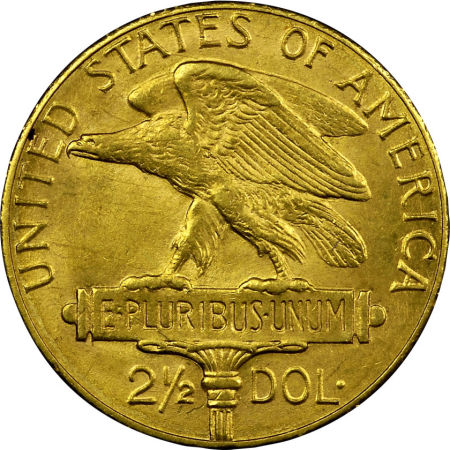
Morgan's reverse design depicts an eagle, striding to the left, on a pedestal with its wings elevated but not fully extended. The motto "E PLURIBUS UNUM" presented on the pedestal's plaque was making its co-debut on US commemorative coinage (it simultaneously appeared for the first time on the Pan-Pac Expo $50 gold coins).
These classically-influenced designs, however, were replacements for those that had been under development by the artist recommended for the Pan-Pac Expo coins by the Commission of Fine Arts - Evelyn Beatrice Longman.
Ms. Longman, of New York, was the artist originally selected to design the Panama-Pacific Gold Quarter Eagle coin. She had prepared initial sketches for her designs and was said to be in Washington, DC to discuss them (presumably with the Treasury Department). She took seriously ill during the trip, however, and had to withdraw from the project; the Barber/Morgan team took over the assignment and created the designs with which we are familiar. (See
What If? 1915 Panama-Pacific International Exposition Gold $2.50 for more details.)
The Public Law that authorized the coin called for up to 10,000 of the gold Quarter Eagles. The Mint struck 10,017 (17 for assay purposes) of the coins at the San Francisco Branch Mint in June 1915; the coin includes the "S" mint mark within its obverse design. As with the Pan-Pac Expo gold dollar coins, sales did not reach the level of "sell out" and the Mint has reported melting 3,251 returned coins.
The designs on the Pan-Pac Expo Quarter Eagle have never given me the same sense of artistic achievement as the program's gold dollar and $50 gold coins, they seem rather pedestrian in comparison (especially the reverse) - at least to my eyes.
The coins were initially sold at the Exposition for $4.00 each; less than the double-face charged for the gold dollar coin, but still a difficult "sell" at the time.
Panama-Pacific International Exposion Gold Quarter Eagle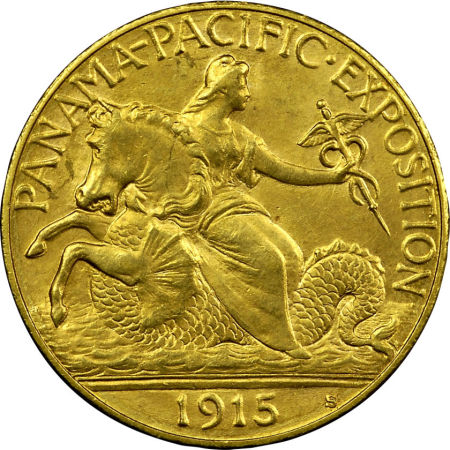
For other of my posts about commemorative coins and medals, including more on the other coins of the Pan-Pac Expo set, see:
Commems Collection.







 Posted 08/05/2022 10:28 am





