The US 1991 Silver Dollar that was struck "in commemoration of the thirty-eighth anniversary of the ending of the Korean War and in honor of those who served" is one of the US commemorative coins whose anniversary date is often questioned. "Why the 38th anniversary of the ending of the Korean War?" "Why not wait for the 50th anniversary?"
The 38th anniversary is, no doubt, an unusual milestone to recognize with a commemorative coin, but there is a historical reason for it.
Near the end of World War II, at the US Army's suggestion, the 38th Parallel North was set as a dividing line that served to indicate which country was to accept/recognize Japan's surrender in the area - the USSR north of the line, the US south of it. The line was meant to be a temporary division of the Korean peninsula, with the expectation of one Korea after the War was officially concluded. Due to Cold War tensions between the USSR and US, however, the unification of the segments did not happen and the US and USSR each took a more "vested interest" in its region of the Korean peninsula. Between 1945 and 1948, a Soviet-backed government and military presence was established in North Korea and an American-backed government and presence established in South Korea.
The Korean War broke out on June 25, 1950 along the 38th parallel when North Korean forces attacked at several locations. These actions resulted in the US and United Nations sending troops to the area to stop North Korea's advances and restore peace and order to the peninsula. Three years later, after more than two years of discussions/negotiations, the hostilities were ended with the signing of the Korean Armistice. More than 2.5 million villagers and soldiers died during the conflict. The Armistice was an agreement to end military actions, it was not a formal peace treaty that officially ended the war between the two sides.
During the negotiations, the official border area between North and South was an obvious topic of debate. It was decided to form a demilitarized (though heavily guarded) zone (DMZ) along the border between the two countries. The DMZ does not bracket the 38th parallel precisely, it follows the agreed to borders of the countries with South Korea territory extending above the parallel in the east and North Korea territory extending below it in the west.
The Korean Armistice Silver Dollar was a one-coin program issued to benefit the Korean War Veterans Memorial Fund. The sales prices of each silver dollar included a surcharge of $7.00 for the Memorial Fund; approximately $5.8 million was paid to the Memorial Fund from sales of 831,537 coins (618,488 Proof / 213,049 Uncirculated).
Soldiers on Patrol - A Part of the Korean War Veterans Memorial, Washington, DC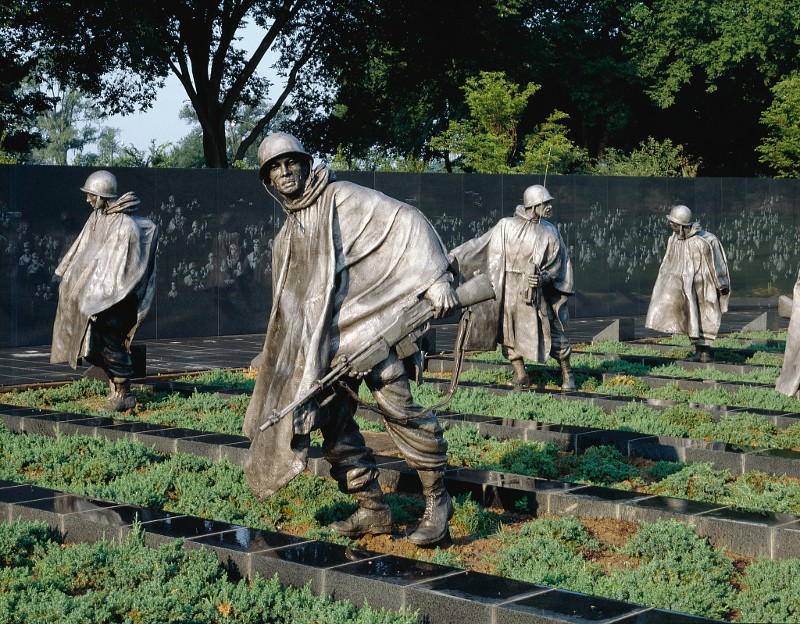 (Image Credit: Library of Congress, Prints and Photographs Division. Public Domain.)
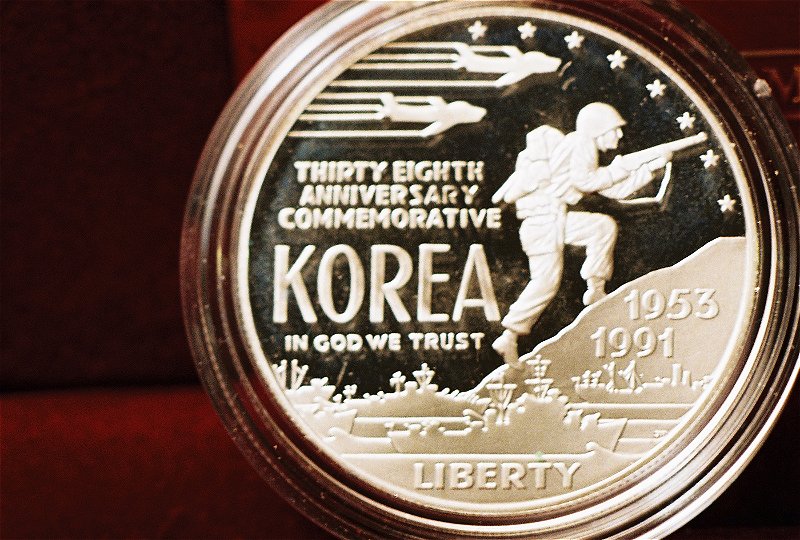
The coin's obverse design includes a soldier, gun at the ready, making his way up a hill as a pair of F-86 fighter jets fly overhead and a variety of US Navy ships, presented as silhouettes, fill the sea in the foreground. The dual anniversary dates of "1953" and "1991" are seen within the hill. US Mint Sculptor-Engraver (and future Chief Engraver)
John Mercanti was responsible for the design.
US Mint Sculptor-Engraver
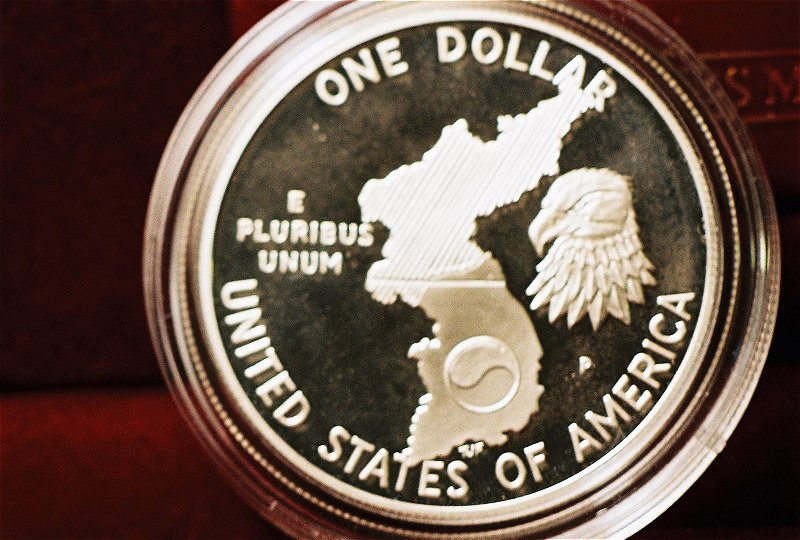
T. James Ferrell created the coin's reverse design. The design presents a map of the Korean peninsula with a straight, horizontal line representing the 38th parallel dividing north from south. It also shows the actual border between the two countries, with areas above and below the 38th Parallel North. An attentive Bald Eagle (symbolic of the US) is shown keeping a watchful eye on things to the right of the map. On the South Korea portion of the map is found a
Taegeuck which is symbolic of peace and harmony. When shown in color, it is a combination of red (top segment) and blue; it can be found on the South Korean National Flag and multiple official government emblems.
South Korea National Flag with Taegeuck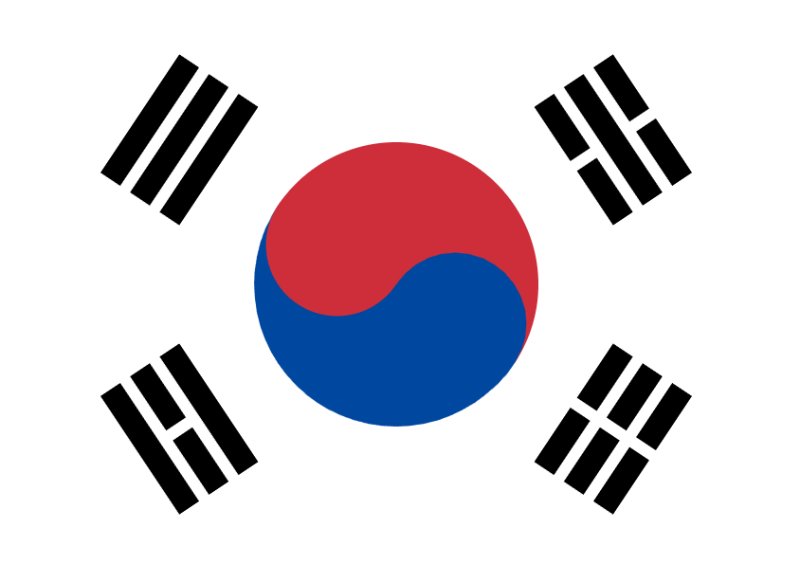
The Regular Issue prices of the coin were $31.00 for the Proof version and $26.00 for the Uncirculated. As was/is my preference, I purchased an Uncirculated coin from the Mint.
1991 Korean War Armistice Silver Dollar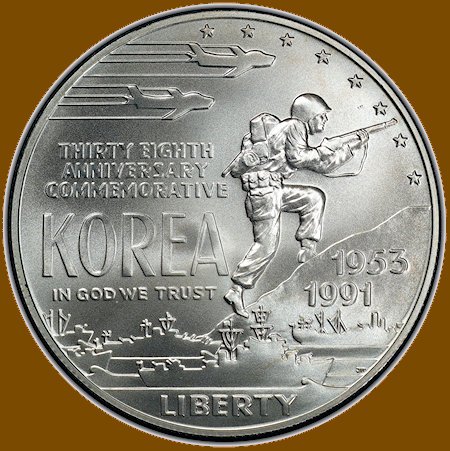
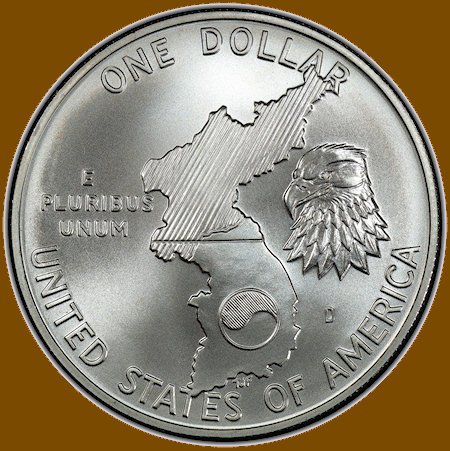
For more of my posts about commemorative coins and medals, including others about Modern US Commemorative Coins, see:
Commems Collection.
For more design discussions specific to the 1991 Korean Armistice Silver Dollar, check out:
-
1991 Korean Armistice 38th Anniversary - Coins with Stars Thread-
1991 Korean Armistice 38th Anniversary - Coins by John Mercanti Thread







 Posted 09/01/2022 09:36 am