Senator Carter Glass was the recipient of the first Lynchburg, VA Sesquicentennial half dollar struck; his portrait, of course, appears on the obverse side of the coin. Glass was given the coin at a brief ceremony by long-time friend and Secretary of the Senate Edwin A. Halsey on October 14, 1936 as part of Lynchburg's 150th Anniversary celebrations; Glass and Halsey each trace their roots to Lynchburg, VA.
As part of the coin presentation, Halsey stated:
Lynchburg, in searching for one to forcefully symbolize the salient features of our city, has chosen you, Senator Glass. Through your endeavors for the establishment of the Federal Reserve System and your initiative and cooperation in the enactment of banking laws, stabilized currency has become universal. Your governmental services have been a credit to your State and country.Secretary of the Senate Colonel Edwin A. Halsey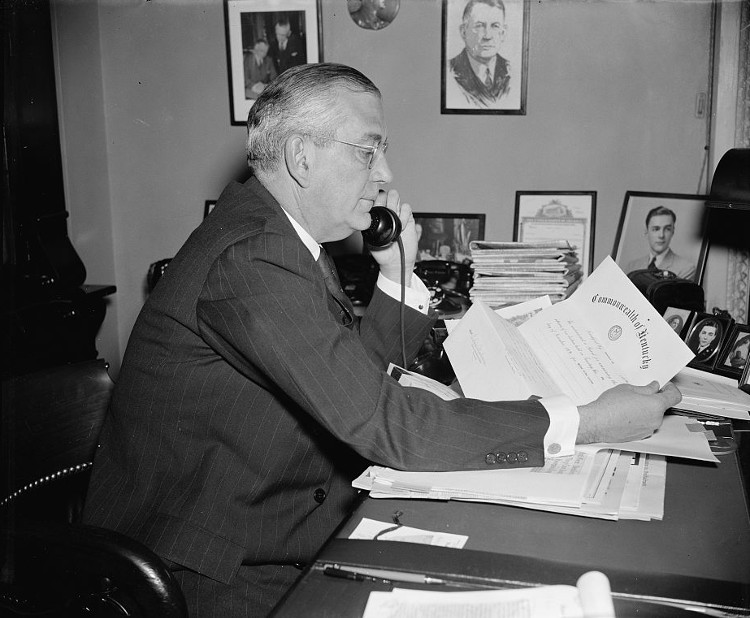 (Image Credit: Library of Congress, Prints and Photographs Division. 1938. Public Domain.)
Halsey began a long career of working (in non-elected positions) in the Senate in 1897 when he started as a page at the age of 16 in the Senate Press Gallery. He progressed to being a supervisor of pages in the Gallery as well as on the Senate Floor. He eventually became the Democratic Party Secretary (a post created for him) and ultimately Secretary of the Senate (1933-1945).
Senator Carter Glass at Occasion of 80th Birthday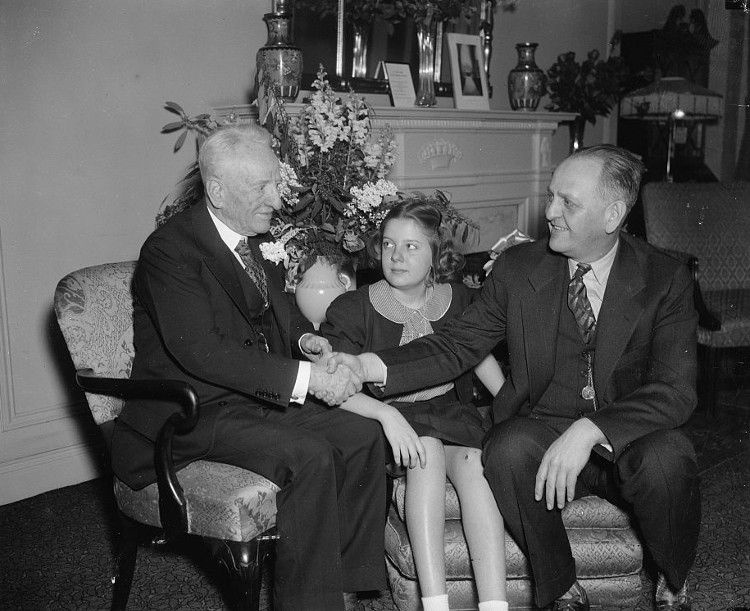 (Image Credit: Library of Congress, Prints and Photographs Division. 1938. Public Domain.)
Senator Glass is shown with his son, Carter Glass, Jr. and granddaughter Nancy Carter Boatwright, in January 1938.
Glass had a long and illustrious history in the US Federal Government. He was elected to the US House of Representatives in 1902 and served until 1918 (after eight consecutive re-elections), he resigned in 1918 to become the Secretary of the Treasury (1918-1920) within the Woodrow Wilson administration. He resigned as Secretary to be appointed a Senator from Virginia to fill the vacancy caused by the death of Thomas Martin. Glass was re-elected to four consecutive six-year terms, and ultimately served in Washington, DC from February 2, 1902 until his death on May 28, 1946.
For other of my topics on commemorative coins and medals, including more on the history and design of the Lynchburg half dollar, see:
Commems Collection.










 Posted 09/22/2022 2:26 pm


