The California Midwinter Exposition (aka Midwinter Fair) was held in San Francisco, California between January 27 and July 4, 1894 at Golden Gate Park. It was the first international exposition held in the western United States (i.e., west of Chicago). Over the course of its five and-one-half month run, the Exposition drew ~2.5 million attendees, and was a financial success.
It was the brainchild of Michael H. de Young, the publisher of the
San Francisco Chronicle, and Commissioner of California Exhibits at the Columbian World's Exposition. While in Chicago at the Exposition, de Young gathered together other prominent California businessmen who were also in Chicago and pitched the idea of following the Columbian Exposition with a Fair in San Francisco. It would be designed to boost San Francisco and its economy, and present California's riches in an attempt to attract industry and new residents.
de Young's proposal was supported by those attending the meeting, and soon arrangements were being made to construct the Exposition grounds at Golden Gate Park and transport many of the exhibits presented at the Chicago Exposition to California for the Midwinter Exposition. Staging a Fair in 1894 was a risky proposition, considering the Panic of 1893 (an economic depression that gripped the US between 1893 and 1897), but de Long's drive and enthusiasm for the Fair drove it forward and on to success.
The California Midwinter Exposition was held at a time when the US regularly hosted Expositions/World's Fairs (1870s-1930s). The US Mint often struck souvenir commemorative medals (and/or coins) for these Expositions; the medals were available for purchase at the Expositions. Sometimes the Mint had an Exhibit Booth and struck the medals on-site, other times, whether it had a booth or not, medals were struck in Philadelphia and brought to the Exposition.
Presented here is an example of the Type I medal from the 1894 California Midwinter Exposition. The dies for the piece were created by
Charles Barber at the US Mint in Philadelphia but the medals were struck on-site at the Exposition. The US Mint did not have an exhibit booth at the Exposition, but medals were struck on a press installed in the Mechanical Arts Building. The large hall also included mineral/mining exhibits, various commercial machinery exhibits and a relief map of California - among other exhibits. The Mechanical Arts Building was one of the Exposition's five primary buildings/halls, and was part of the Grand Court of Honor.
Mechanical Arts Building with Great Fountain - 1894 California Minwinter Exposition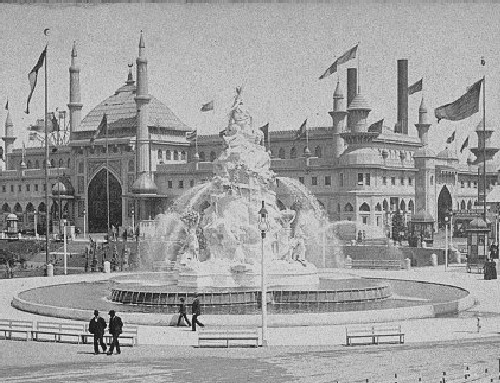 (Image Credit: Library of Congress, Prints and Photographs Division. Public Domain.)
The medal presents a version of the California State Seal on its obverse. Per the California Secretary of State: The Constitutional Convention of 1849 adopted a "Great Seal of the State of California." Two main features of the seal are the seated figure of the Goddess
Minerva and the California Grizzly Bear crouching at her feet. Other design elements include a gold miner, ships upon a mountain-rimmed bay, and the motto "Eureka," which means "I have found it."
California State Seal - 1849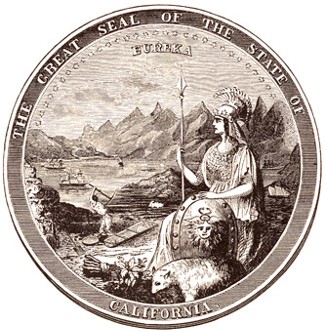 (Image Credit: State of California, Department of Parks and Recreation. Public Domain.)
The reverse of the medal is an "inscriptions only" design indicating the souvenir nature of the medal and its connection to the "CALIFORNIA MIDWINTER EXPOSITION." The "promotional" inscription near the rim reads, "THE LAND OF SUNSHINE FRUIT AND FLOWERS".
Most of the medals were struck on regular brass planchets - quick tarnishing was the norm. On the first day of the Exposition, however, gold-plated versions of the brass medal were struck; the medal shown here is one of the gold-plated pieces.
1894 California Midwinter Exposition Commemorative Souvenir Medal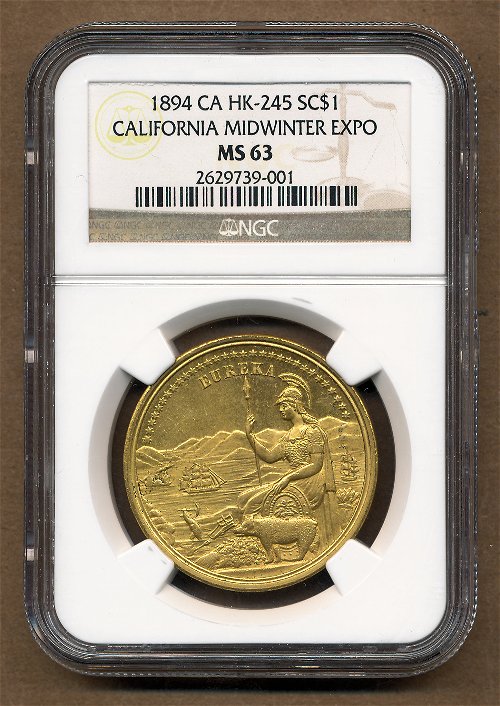
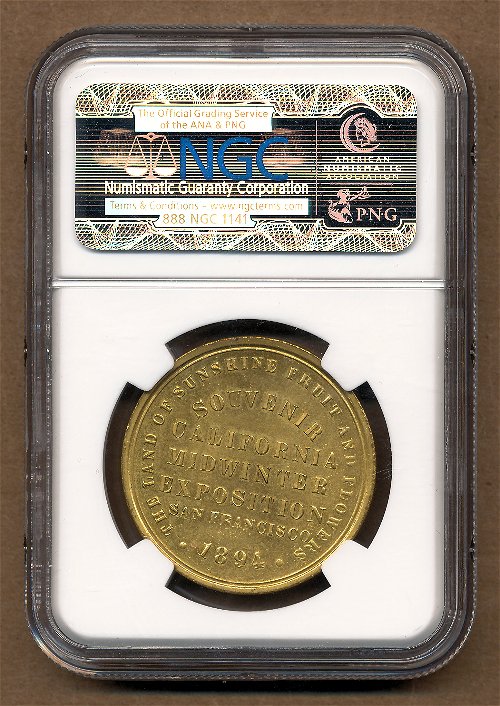
I have to mention...I am a bit surprised by the grade - it appears to be nicer to my eyes. In fact, it's the nicest example I've had the opportunity to buy! Oh, well!
For more of my posts about commemorative coins and medals, see:
Commems Collection.










 Posted 10/02/2022 07:22 am


