The 1998 Black Revolutionary War Patriots commemorative Silver Dollar was authorized to recognize "Black Revolutionary War patriots and the 275th anniversary of the birth of the first Black Revolutionary War patriot, Crispus Attucks, who was the first American colonist killed by British troops during the Revolutionary period..."
Surcharges collected from sales of the coin were to be given to the Black Revolutionary War Patriots Foundation for the "purpose of establishing an endowment to support the construction of a Black Revolutionary War Patriots Memorial" in Washington, DC. (Public Law 104-329) Unfortunately, the Memorial was never built and the Foundation disbanded after receiving (and spending) ~$1 million in surcharge funds. (See the link below for a discussion.)
The Memorial's construction had a seond chance, however. A new effort was initiated by Congress in 2012 when it authorized the National Liberty Memorial and designated the National Mall Liberty Fund D.C. as the group in charge of making it happen. Unfortunately, the new Memorial effort did not raise the needed funds by its Congressionally-mandated deadline (Congress even extended it) and its reservation for a spot on the National Mall has been canceled. At this point, It's unclear when, or even if, a Black Patriots memorial will be built in Washington, DC.
Bills calling for a 1998 commemorative Black Patriots Silver Dollar were introduced in the House of Representatives and Senate in June 1995; by Nancy Lee (R-CT) in the House and by John Hubbard Chafee (R-RI) in the Senate. The bill was later amended by substitution (1996) to be a multi-coin bill that included several commemorative coin programs: Black Patriots, Dolley Madison Death Anniversary, Geroge Washington Death Anniversary, National Law Enforcement Memorial, Franklin Delano Roosevelt Memorial, Yellowstone National Park and Jackie Robinson Color Barrier Anniversary. The multi-coin bill ultimately was passed and became Public Law 104-329 in October 1996.
The coin's obverse presents a three-quarters, right-facing portrait of Crispus Attucks; it was designed by
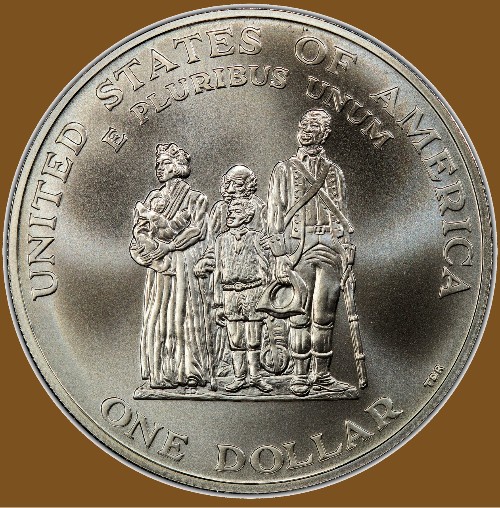
John Mercanti. His "JM" initials are found at the 7:30 clock position, incused on Attucks' right shoulder. Its reverse depicts the original, planned Memorial statue (in a similar vein to the US 1936 Elgin, IL Centennial half dollar); the reverse design is the work of Ed Dwight, the sculptor of the statue. The Mint's
Thomas D. Rogers was responsible for the reverse's modeling.
Side Note: Ed Dwight was the first African-American to be trained as a US astronaut - a very different "First Act" for someone who went on to be a sculptor who has created many dozens of public and private sculptures to recognize and honor noteworthy African-Americans.Idealized Portrait of Crispus Attucks (Potential Reference Source for Coin, presented as Mirror Image of Original)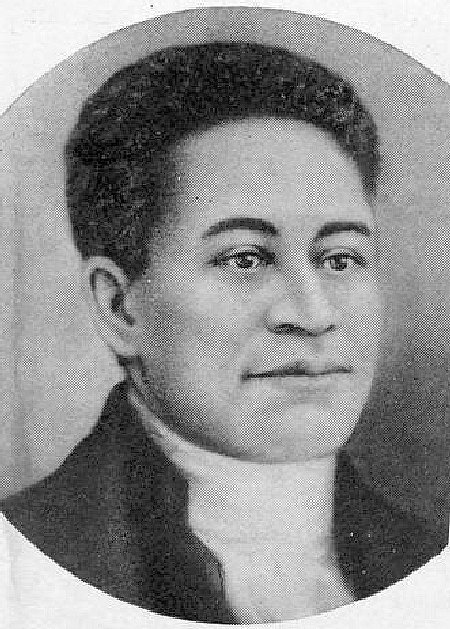 (Image Credit: The New York Public Library, Digital Collections, https://digitalcollections.nypl.org...00a18064a99. Public Domain.)1998 Black Revolutionary War Patriots Silver Dollar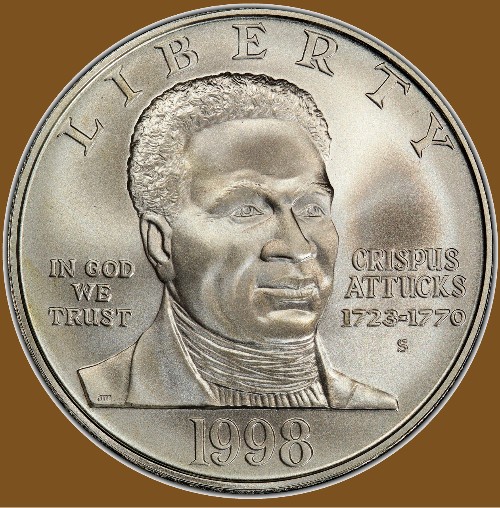
Attucks was a man of mixed African American (father) and Native American (mother) ancestry who was born into slavery in 1723, but escaped at around the age of 27. He made his way to Boston, where he found work as a sailor on whaling ships. When not at sea, it is believed that Attucks was employed as a rope maker.
On March 5, 1770, Attucks was among a group of colonists who were fired upon by British soldiers after the colonists had harassed and antagonized them; he was ~47 years old at the time.
Accounts of the event, historically called the "Boston Massacre," vary in their specific details, but all (or nearly all) accounts agree that Attucks was the first of the group to be shot/killed by the British. In all, five colonists were killed; the others who died were: Samuel Gray, Samuel Maverick, James Caldwell and Patrick Car - Attucks was the only black man among those who were killed.
It is estimated that over 5,000 African American men fought with the colonists against the British during the Revolutionary War as either soldiers or sailors; many of the enslaved who signed on did so with the understanding that they would be freed after the War. These Black Patriots took part in every major battle of the Revolution, including the War's last major battle at Yorktown. Though the stories of most of these patriots have been lost to time, several distinguished themselves enough to be individually remembered by history. These include Salem Poor, Colonel Tye, Peter Salem, James Armistead and the First Rhode Island Regiment (an integrated unit in the Continental Army). To learn more about Crispus Attucks and these other fighting patriots, check out this informative article on History.com:
7 Black Heroes of the American Revolution.
Interesting Side Note: Some historians estimate that up to 20,000 African-Americans joined the fight on the British side, believing they had a better chance at freedom with such an allegiance.The Silver Dollar was available in standalone Proof and Uncirculated versions, as well as in a Young Collector's Set (Uncirculated) and Coin & Stamp Set (Proof). Pricing for the coins was as follows:
Proof, Individual: $33.00 (Pre-Issue); $37.00 (Regular)
Uncirculated, Individual: $30.00 (Pre-Issue); $32.00 (Regular)
Proof & Uncirculated, Two-Coin Set: $59.95 (Pre-Issue); $64.95 (Regular)
Young Collector's Set: $37.00 (Pre-Issue); $40.00 (Regular)
Coin & Stamp Set: $79.00 (Pre-Issue); $84.00 (Regular)
The final sales totals for each option:
- Proof, Individual: 51,252
- Uncirculated, Individual: 10,987
- Proof & Uncirculated, Two-Coin Set: 17, 170
- Young Collector's Set: $37.00 (Pre-Issue); 9,062 (Uncirculated Dollar)
- Coin & Stamp Set: $79.00 (Pre-Issue); 6,645 (Proof Dollar)
- Total Proof: 75,070
- Total Unirculated: 37,210
- Total Combined: 112,280
For more about the Black Patriots Memorial failure, see:
-
Quick Bits #10 - Two Surcharge StoriesFor more of my posts about commemorative coins and medals, see:
Commems Collection.









 Posted 09/30/2022 12:31 pm


