As did most US commemorative coin designs, the 1936 Wisconsin Territorial Centennial Half Dollar design experienced revisions during its development based on feedback received from the US Mint and/or the Commission of Fine Arts (CFA). In the case of the Wisconsin coin, the "revision" was actually a rejection of the original models developed by David Parsons, a University of Wisconsin art student, and the hiring of Benjamin Hawkins, a professional artist in New York, to create new ones. The Mint considered Parsons' designs "unworkable" and enlisted the CFA to help it convince the Wisconsin group that its coin designs would be best served by re-assignment to a different artist.
The Wisconsin Territorial Centennial Coin Committee (Committee) went along with change-of-artist recommendation, but wanted to continue with the design elements it had previously approved and recommended - the Territorial Seal and badger.
(Note: The Mint considers the Seal side to be the reverse, and the badger side to be the obverse, the date placement not withstanding)Shown here are preliminary models prepared by Parsons but rejected by the Mint and CFA.
1936 Wisconsin Territorial Centennial - Rejected Models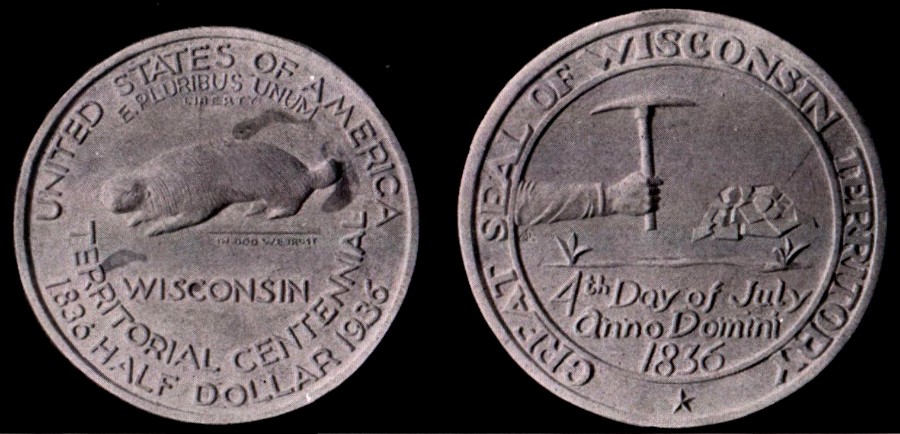 (Image Credit: Wisconsin Territorial Coin Committee via the American Numismatic Association, The Numismatist, June 1936. Fair use.)
Based on the Committee's request to maintain the original design elements, it would be fair to say that Hawkins' designs were more of a refinement of those prepared by Parsons vs. a new design direction. So, though he doesn't often get credit for designing the coin, I think Parsons deserves at least
partial credit for his efforts.
1936 Wisconsin Territorial Centennial Half Dollar - Struck Coin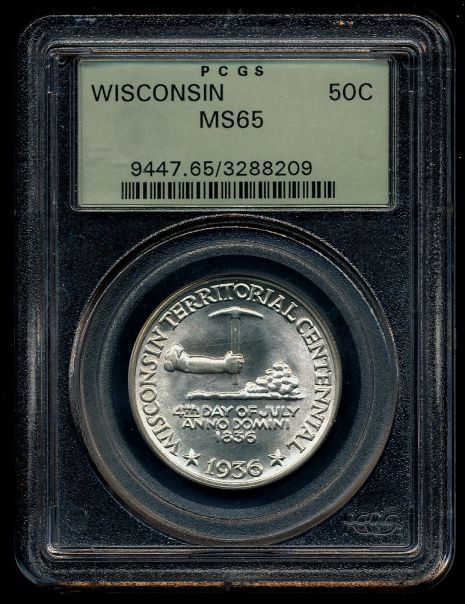
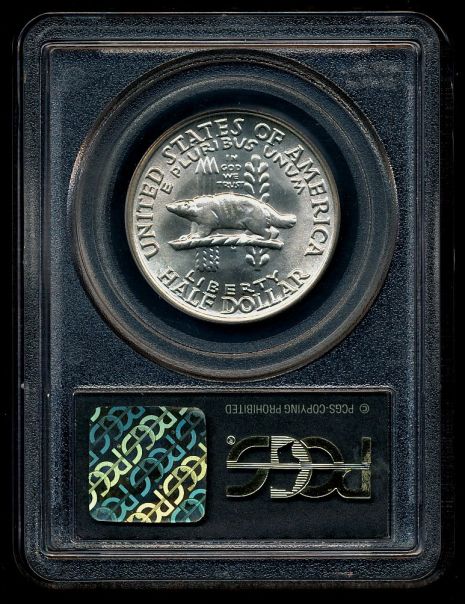
A few things are immediately seen when comparing the early designs to those used for the struck coin:

The badger is smaller and less prominent on the coin.
The number of inscriptions on the badger side has been reduced to provide the design with additional open space; for example, "WISCONSIN TERRITORIAL CENTENNIAL" has been moved to the reverse (where it replaced "GREAT SEAL OF WISCONSIN TERRITORY" near the rim).
"LIBERTY" was enlarged/made more prominent, and moved from a 12 o'clock position to a 6 o'clock position.
The coin's dates were modified, and were used only on the coin's reverse vs. both sides.
The font used for the "4th DAY OF JULY" inscription is smaller and non-italicized on the coin.
The arm depicted in the Seal is depicted wearing a long-sleeve shirt on the draft models vs. a short-sleeve shirt on the coin.
A variety of other differences are also seen with additional study.
Interesting note, per the report published in the June 1936 issue of the American Numismatic Association's (ANA's)
The Numismatist magazine, the coin's original models were prepared before the its bill was approved - the Committee had high confidence that its bill would be enacted and desired to get "a jump" on its coin's design.
IMO, Hawkins' more refined designs do make for a better coin, but I don't think Parsons' original designs merited his outright replacement. A bit of fine-tuning under the direction of a more experienced, professional sculptor would likely have enabled him to develop acceptable models.
For more of my topics on commemorative coins and medals, including more on the history and design of the Wisconsin half dollar, see:
Commems Collection.







 Posted 11/15/2022 3:13 pm





