The first bill to call for "the coinage of certain gold and silver coins in commemoration of the Panama-Pacific International Exposition" was introduced in the House of Representatives by Julius Kahn (R-CA) in May 1914. The bill was immediately referred to the House Committee on Coinage, Weights and Measures.
1915 Panama-Pacific International Exposition - Promotional Post Card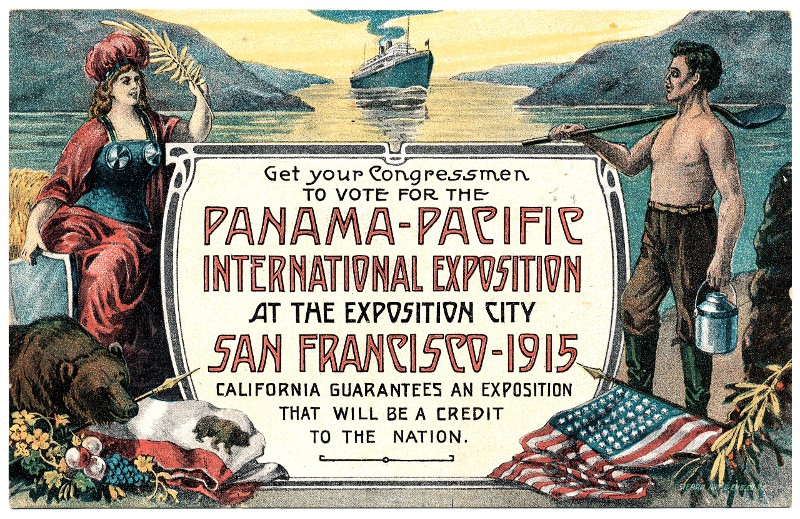
No further action was taken on the bill, but it was joined by a bill introduced in the Senate in July 1914. The bill was introduced by Senator James Edgar Martine (D-NJ); it was referred to the Senate Committee on Industrial Expositions (
not the more typical Committee on Banking and Currency).
The bill called for the largest, by denominations included (4), US commemorative coin program of the classic era. It included provisions for a silver half dollar, a gold dollar, a gold quarter eagle and a gold $50 coin (quintuple eagle) in two shapes (round and octagonal). The bill specified that the coins were to be struck "at the United States mint at San Francisco"- a first for the series. The bill also included a special provision for the half dollars: "for the purpose of maintaining the exhibit as an educative working exhibit at all times the coins so minted may be remelted and reminted." (Typically, Mint equipment in its Exposition exhibit was used to strike souvenir medals vs. coins.) Only the silver half dollars were included in this "on-site" provision.
The Industrial Expositions Committee reported the bill back to the Senate without amendment and with a recommendation to pass. When brought up for consideration, a question was raised on the Senate floor by Reed Smoot (R-UT) as to why the bill was not referred to the Committee on Banking and Currency or to the Committee on Finance, but was quickly addressed and resolved with Senator Martine assuring the Senate that the Secretary of the Treasury had reviewed the bill and supported it. The bill passed without further debate and was sent to the House for its consideration.
In the House, the bill was referred to the Committee on Coinage, Weights, and Measures. The Committee reported the bill favorably but recommended several minor edits/amendments:
- the maximum mintage for $50 gold coins be increased to 3,000 from 2,000
- the initial delivery date for the coins be changed from December 1, 1914 to "the day of the opening of the Exposition"
- the Exposition Company was to reimburse the Treasury for its expenses - up to $5.000 - related to securing designs for the coins vs. not being charged.
The amendments were agreed to in the House without objection and the amended version of the bill was sent back to the Senate for concurrence. Once received in the Senate, the House amendments were quickly agreed to without debate. With approval gained in each chamber, the bills was examined, signed and sent on to the President for final approval. The bill was signed into law by US President Woodrow Wilson on January 16, 1915.
With such approval, the Panama-Pacific International Exposition commemorative coin program was born! It was a bold step forward for the US commemorative coin series, but one that did not serve as a foundation for additional "big" commemorative programs. The commemorative coin proposals that followed were generally of the one-denomination-per program variety, though one did call for a silver half dollar along with a gold dollar (1922 Grant Centenary) and another for a silver half dollar and a gold quarter eagle (American Independence Sesquicentennial).
Of course, some sponsors went down the path of multiple annual issues of the same denomination (e.g., Oregon Trail Memorial, Daniel Boone Birth Bicentennial) vs. multiple denominations. IMO, these multi-year programs blazed a different trail vs. the multi-denomination path launched by the "Pan-Pac" program. The Panama-Pacific International Exposition program, IMO, is a more direct predecessor of the three-coin CuNi clad half dollar, silver dollar and gold half eagle programs of the modern series than the multi-year programs of the classic era.
For other of my posts about commemorative coins and medals, including more on the individual Pan-Pac coins, see:
Commems Collection.






 Posted 05/30/2023 12:24 pm





