St. Louis, Missouri is a city with a long and noteworthy history. It was founded on the banks of the Mississippi River on February 14, 1764 by an expedition led by Pierre Laclede Liquest, Gilbert Antoine de St. Maxent and Auguste Chouteau; The New Orleans-based explorers named their settlement after the French King - Louis IX.
St. Louis became an "American City" as part of the US' 1803 Louisiana Territory purchase from France. It was a busy trading post from its start and enjoyed steady growth. St. Louis was the Mississippi River outpost that was the starting point for the Lewis and Clark Expedition of 1804-06 and, later, the Fremont Expedition in 1842 - two overland expeditions, that helped to open the Louisiana Territory and the Far West to American exploration and settlement."
In 1964, its bicentennial year, St. Louis had a population of ~750,000 making it the 10th largest US city.
To help mark the 200th anniversary of the city's founding, Leonor Kretzer Sullivan (D-MO) introduced a national medal bill in the House of Representatives in November 1963. The bill was referred to the House Committee on Banking and Currency, then further referred to its Subcommittee on Consumer Affairs - the Committee that handled proposed commemorative medals. Representative Sullivan was the Chairwoman of the Subcommittee.
The bill called for the striking of up to 100,000 medals for the benefit of the Saint Louis Bicentennial Corporation, with the Corporation to determine the size(s), material(s) and designs. The minimum order size was specified as 2,000 medals and they could only be struck through December 31, 1965.
The bill was reported by the Committee without amendment and with a recommendation to pass. When it was brought up for consideration, the bill passed the House without objection. Representative Sullivan offered the following remarks:
"The medals authorized by [the bill] would serve two important purposes: to provide a tangible memento in the form of a national medal demonstrating the vital role played by St. Louis in the expansion of the United States from coast to coast; in addition, sale of the medals by the sponsoring organization will help us raise some of the necessary funds to finance our bicentennial events.
She continued, "As chairman of the subcommittee which handles this type of legislation in the Committee on Banking and Currency, I can assure the Members, Mr. Speaker, that my subcommittee has thoroughly investigated the merits of commemorative national medals, particularly as compared to proposals for authorizing commemorative coins. We have not approved any coin bills for limited distribution and for fundraising purposes. We have, on the other hand, approved a series of commemorative medals bills. They do not interfere with coin operations."
This was a clear and explicit indication of how the tide had turned against commemorative coins in favor of commemorative medals.
After passage in the House, the bill was then sent to the Senate for its consideration. Upon receipt, the bill was referred to the Senate Committee on Banking and Currency. The Committee reported the bill without amendment and with a recommendation to pass.
Prior to its third reading and passage, Senator William Stuart Symington (D-MO) rose to state his support for the bill and to note,
"As many of my colleagues know, February 14, 1964, will mark the beginning of the St. Louis bicentennial, a 3-year series of events to commemorate the beginning of St. Louis' third century.
During this celebration a series of memorable events will take place in our great city, including a visit by the President of the United States, and also the dedication of the Jefferson National Expansion Memorial." (The Expansion Memorial is home to St. Louis' famed Gateway Arch.)
Gateway Arch, St. Louis Missouri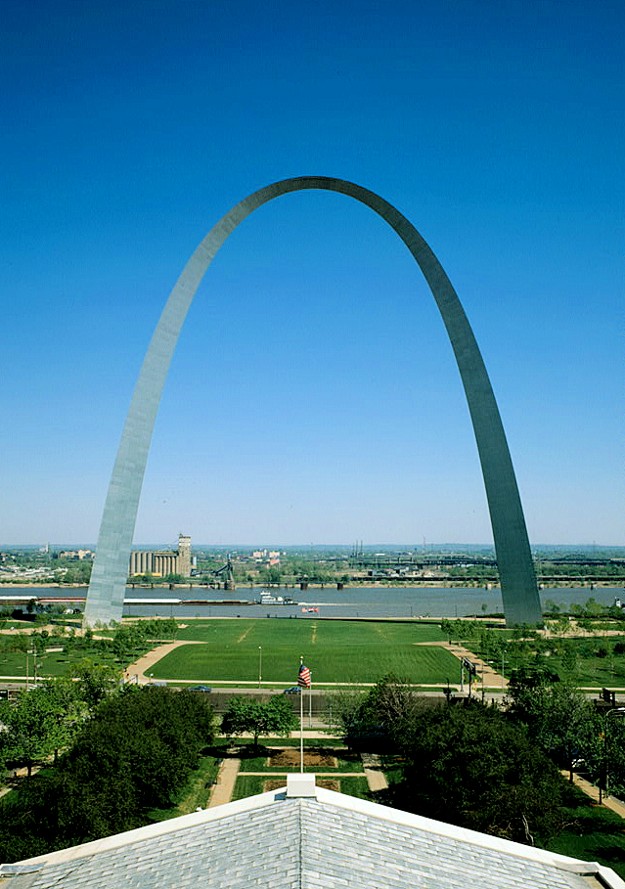 (Image Credit: Library of Congress, Prints and Photographs Division. Public Domain.)
The bill was then examined and signed in each chamber before being sent to the President for final approval. President Lyndon Baines Johnnson signed the bill into law on Februay 11, 1964.
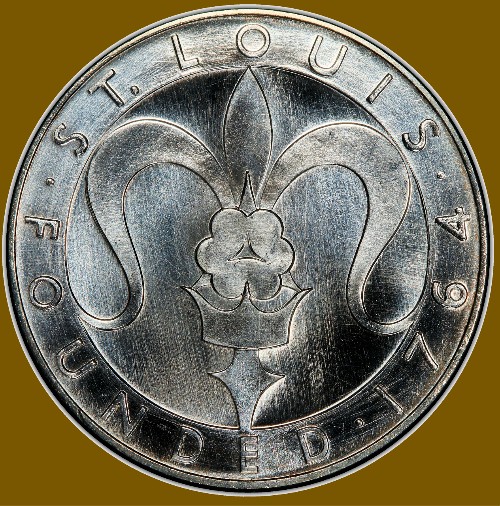
The medals were struck in silver (0.900 fine) and bronze - they share a simple, modern design.
1964 St. Louis Bicentennial Medal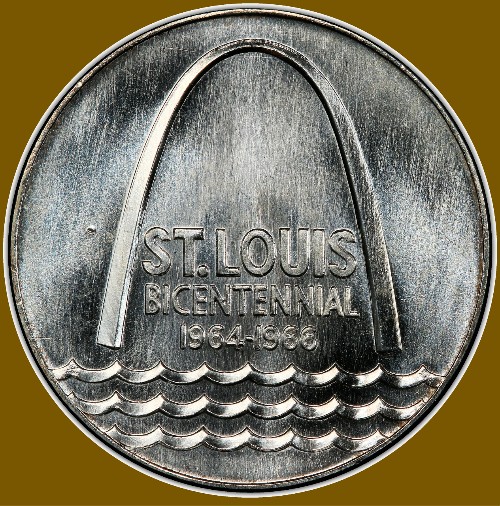
The obverse of the medal presents a stylized view of the Gateway Arch with the waters of The Mississippi River in the foreground. Within the Arch is the inscription "ST. LOUIS / BICENTENNIAL / 1764-1964".
The medal's reverse is dominated by a Fleur-de-Lis, recalling the city's French heritage. In a ring around the Fleur-de-Lis is the inscription "ST. LOUIS FOUNDED 1764".
For other of my posts about commemorative coins and medals, see:
Commems Collection.








 Posted 07/07/2023 11:41 am


