Continuing the 1982 George Washington Half Dollar story...Click for
Part IAnthony Swiatek was next to testify. His support of US commemorative coins was very clear in his comments and written statement:
"I just feel so thrilled right now, because prior to this time, our Nation, aside from France, was the only major nation in the world that has not produced a commemorative coin since the Washington-Carver issue of 1954."In his prepared statement, Swiatek offered:
"Isn't it time that we begin remembering our heroes? Let us revive the custom of striking "commemoratives," the most colorful coinage of the United States of America."He also brought up world commemorative coin programs in his statement:
"Research into the silver commemorative coinages of many nations shows that the procedure of manufacture and distribution most profitable and beneficial to the issuing government involves these essential points:
1) A large number of the coins should be minted;
2) The coins should be made of silver;
3) As an economy, they should be issued through banks like other currency;
4) Coins should be available at or close to face value."Swiatek concluded his statement with:
"The Mint has about 3.5 million customers in the numismatic service who, for the most part, would welcome a 90% silver commemorative half dollar. As noted by Congressman Doug Barnard, "this coin will provide Americans with an inexpensive way to own silver and will help reduce both the budget deficit and trade deficit."After Swiatek's testimony, the Hearing adjourned.
Barnard and Annunzio immediately introduced a new version of their bill that addressed the recommendations of the US Treasury. The Subcommittee began the process of marking up the original bill in order to report on it, but was discharged from further consideration of it and the new bill was substituted for the original and was passed by the House and referred to the Senate.
The follow-up bill extended the authority for the coin to December 31, 19
83 (vs. 1982) and deleted the provision in Public Law 91-607 that restricted use of the silver purchased for the silver Collector Version of the
Eisenhower dollar. The original law stated:
"Such silver shall be used exclusively to coin one-dollar pieces authorized in section 101(d) of the Coinage Act of 1965, as amended by this Act. "
With that provision removed from the books, the millions of unused ounces of the silver stockpile already held by the Treasury could be used for new Washington half dollar. (And it was!)
The day after the new House bill was referred to the Senate, James McClure (R-ID) introduced a near-identical bill in the Senate - it appears he may not have been aware of the House's action at the time. McClure's bill was referred to the Senate Committee on Banking, but was not acted upon. The House bill was reported out of the Senate Committee without amendment in lieu of it and was passed by the Senate.
With approval in both chambers, the House bill was examined by each, signed and sent to the President for final approval. US President Ronald Reagan signed the bill into law (Public Law 97- 104) on December 23, 1981.
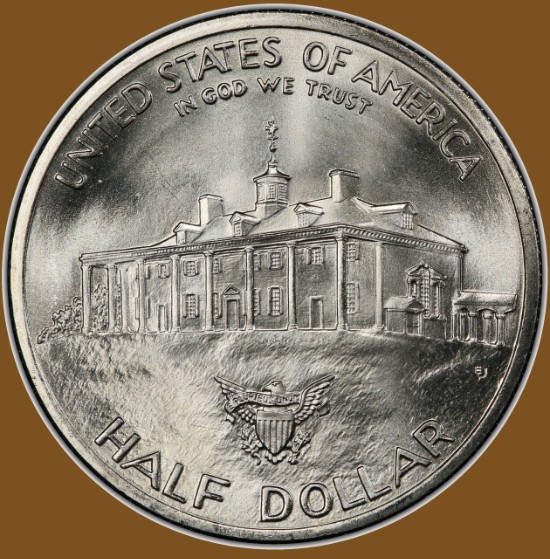
The coin's designs were created by Elizabeth Jones, the recently-promoted Chief Sculptor-Engraver of the US Mint. The obverse presents George Washington on horseback, with both Washington and his horse facing forward toward the viewer (Washington looks slightly to his right). The coin's reverse depicts Washington's Mount Vernon home.
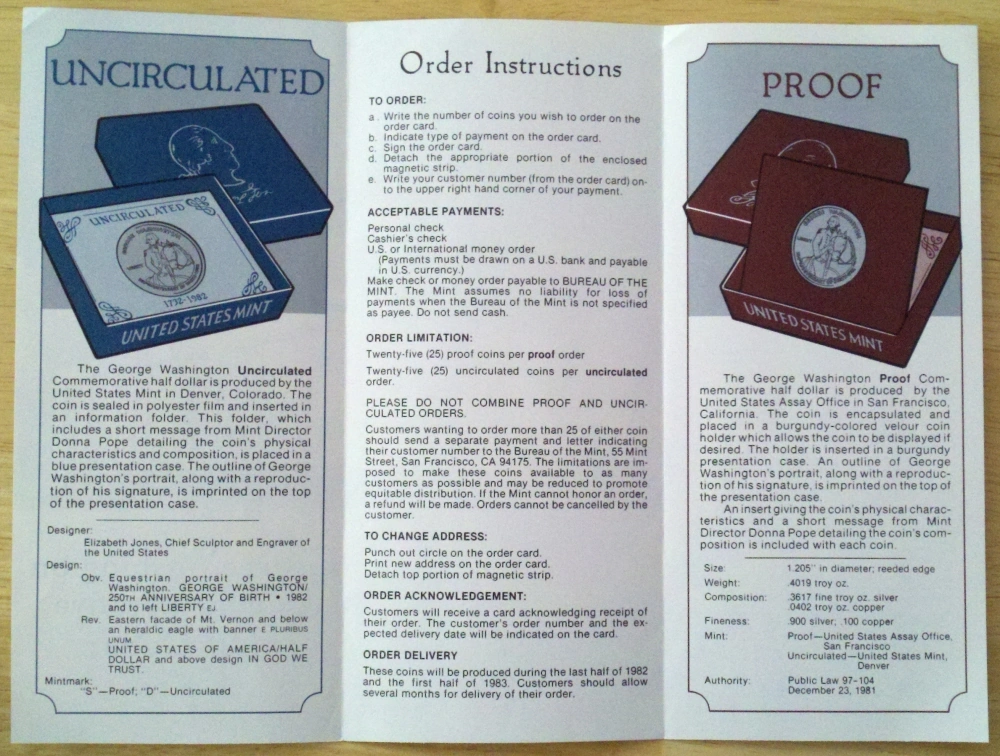
The 0.900 fine silver coin was produced in Uncirculated and Proof versions. The issue price for each were $10.00 / $12.50 (Pre-Issue / Regular Issue) for the Proof and $8.50 / $10.00 for the Uncirculated. The George Washington half dollar is one of only two
silver half dollars in the modern US series - the other is the 1993 Bill of Rights / James Madison coin.
Mint records indicate that 7,104,502 coins were sold - 4,894,044 Proof and 2,210,458 Uncirculated.
All of the coins were struck in 1982, but the US Mint continued to sell them through December 31, 1985 - three full years after production stopped. When sales were halted, the Mint had an inventory of more than 1.34 million coins - 868,326 Proof and 478,716 Uncirculated - which were melted. Combining the sold and melted totals reveal that the Mint struck 8,451,544 coins - ~84.5% of the 10 million authorized. It was prepared for large-scale sales!
This is one of the few modern commemorative coins for which I purchased a Proof version to go along with my standard Uncirculated coin.
1982 George Washington Silver Half Dollar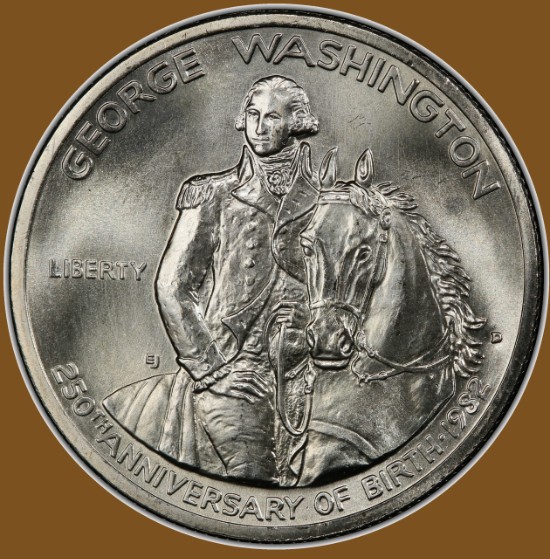
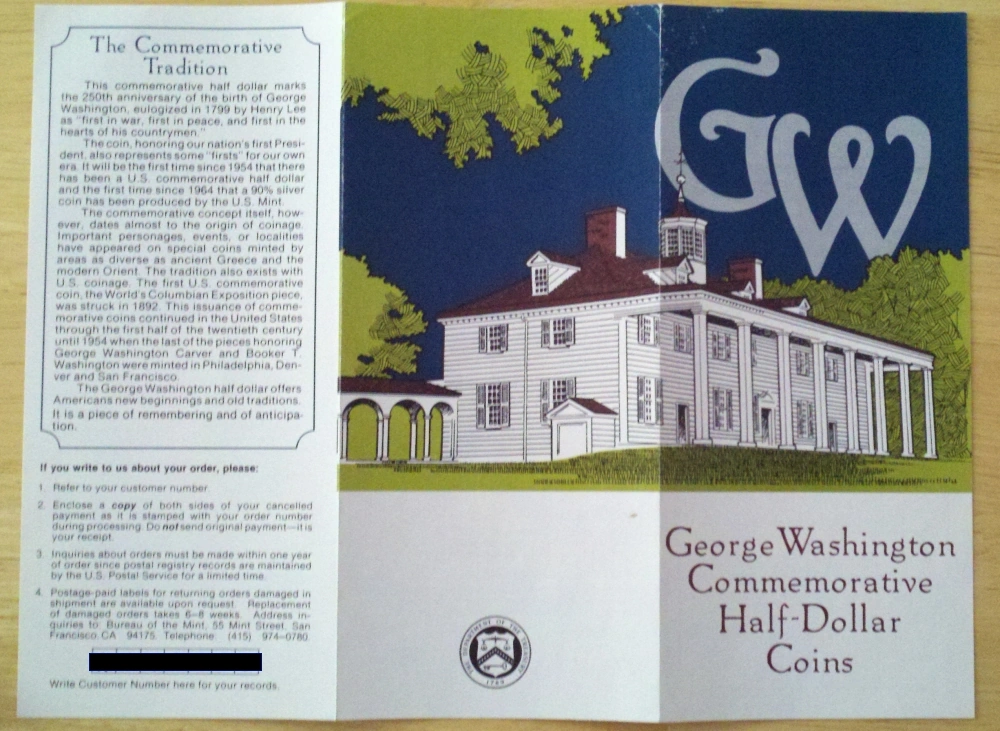
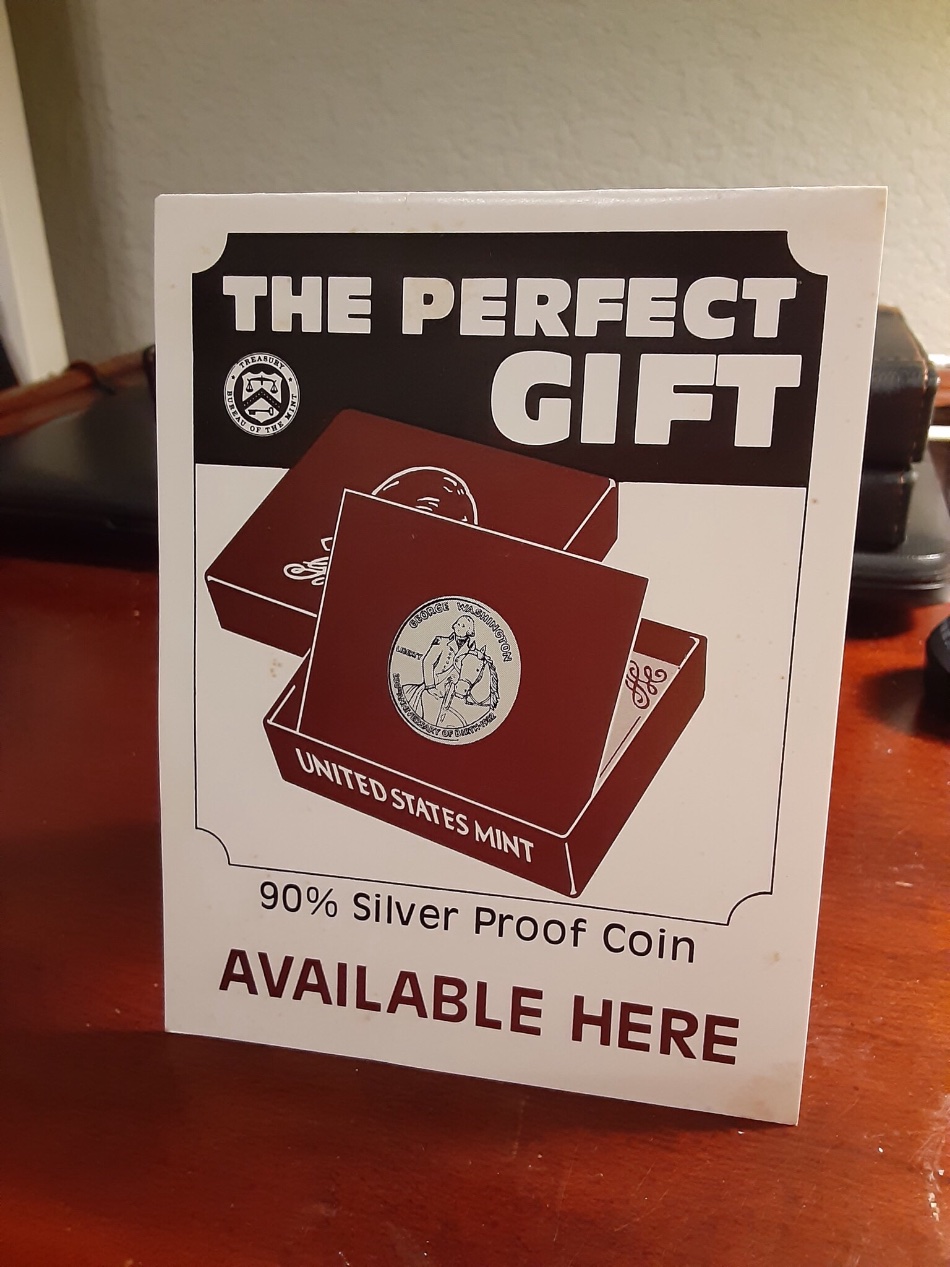
Hopefully, jbuck will be along to post his original brochures for the coins.
For other of my posts about commemorative coins and medals, including other modern US commemorative coin stories, see:
Commems Collection.









 Posted 10/11/2023 09:03 am