I've written before about the US Congress' role in bringing about the half dollar collectors fondly refer to as the "Columbian." (You can read my previous posts
[Here and
Here.)
But things could have gone differently...
If Senator George Graham Vest (D-MO) could have had his way, the World's Columbian Exposition Half Dollar may never have seen the light of day. On August 5, 1892, as the US Senate considered the bill introduced by James Bernard Reilly (D-PA) in the House of Representatives (and passed), Senator Vest rose and stated "Mr. President, if I could defeat this measure by any sort of parliamentary tactics whatever, I should do so very cheerfully. It is very evident to me, however, that this bill will pass, and all I could hope to do under existing circumstances would be to delay action upon it for a number of days only . It is entirely useless now to go back to the inception of this "
Note 1: The Reilly bill proposed the coining of up to five million pieces of a "Columbian half dollar" that were to be given to the World's Columbian Exposition Company, the managers of the Exposition, as an appropriation without a requirement for repayment.Note 2: The "President" referred to by Senator Vest was the Senate President, i.e., US Vice President Levi Parsons Morton not US President Benjamin Harrison.Senator Vest continued:
"I have not been disappointed in the history of this Exposition. When debate was had here upon it at the time the bill was originally presented to us for our action, I expressed the opinion that after the Government of the United States had given its indorsement to the enterprise, the city of Chicago would come to the Congress of the United States and demand, in the name of the national honor, appropriations in order to carry on this enterprise. It was indignantly denied at the time that such would be the case, and we were told when Chicago sought the location of the World's Fair in that city that her people were amply able to make good every guaranty, and that an appropriation simply for the governmental exhibit would be required from the people of the United States. It is hardly necessary to remark that, without the gift of prophecy, I did not foretell one-half of what has occurred in regard to the demands made upon the Treasury.of the United States in ·behalf of this Exposition.
"Against my opposition and that of.other Senators a bill was passed appropriating $5,000,000 in these souvenir half-dollars, to be coined out of the uncurrent silver in the Treasury. Under that bill the people of the United States had some prospect of recovering back or receiving back a portion of the money.
...
"Under the bill which comes back to us now from the House of Representatives here is a pure, naked donation of $2,500,000 of the tax money of' the people of the United States, from which they will never receive one cent. It is a donation of $2,500,000 to the stockholders of this corporation. It is simply giving them so much to increase their dividends, and the Government of the United States, instead of standing like other stockholders, is made to furnish the money to put dividends into their pockets.
"Mr. President, I know of no language in which I can convey my opposition to a measure like this. I repeat now simply if I could by any sort of parliamentary means defeat this bill, I should resort to them."
Multiple Senators followed Vest, voicing their opposition to the coin bill.
For example, Senator Edward Douglas White (D-LA) added, "Here we are to give by this bill $2,500,000 to do what? Two million five hundred thousand dollars, as was aptly said by the Senator from Missouri, to create a fund. If we have the Constitutional power, because it is a public purpose, to create an asset by the use of public money, I ask how are we going to justify, either in a constitutional way or in a business way, the absolute gift of money without any provision for the return to the Government of her share of that which her own money will have obtained?
"I can not vote for this bill."
Other Senators rose to defend the bill's appropriation and history informs us that the "Pro" side of the argument won out as the souvenir coins were ultimately authorized, struck by the Mint and given to the Exposition Company for their use in raising funds to stage the Exposition. But, the US' first authorized souvenir/commemorative coin did not result from a simple "rubber stamp" approval by Congress (as was the case with many later commemorative coin issues).
And now you know
the rest more of the story.
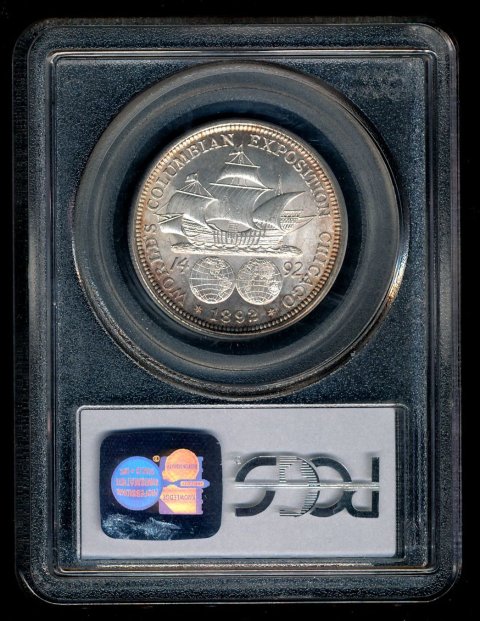
1892 World's Columbian Exposition Half Dollar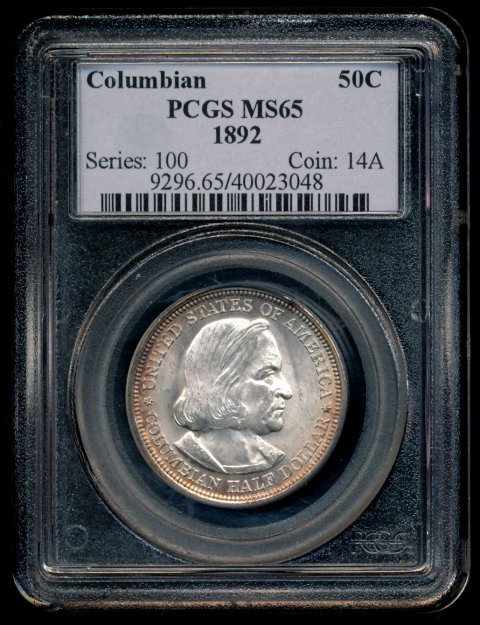
For more of my stories about commemorative coins and medals, including more on the Columbian half dollar, see:
Commems Collection.










 Posted 06/12/2024 12:05 pm


