Howard Weinman, son of Adolf Weinman, was selected to design the 1936 Long Island Tercentenary Half Dollar by the Long Island Tercentenary Committee. In his own words, Howard's original obverse design presented "two heads, one particularly imposed upon the other, of an Indian and a Netherlander, in which I shall try to infer by the harmonius balance of the heads the peaceful settlement of the island by the Dutch." For the reverse, Weinman noted the design "is to have as central motif a Dutch vessel of the period."
In these designs, the motto "IN GOD WE TRUST" was to be included below the conjoined portraits on the obverse (with "LIBERTY" above). The motto "E PLURIBUS UNUM" was to appear on the coin's reverse, above the Dutch sailing ship, along with "UNITED STATES OF AMERICA" and "HALF DOLLAR". The inscription "LONG ISLAND TERCENTENARY" was to appear below the ship.
The Commission of Fine Arts (CFA) suggested that the "E PLURIBUS UNUM" motto be removed from the reverse and that "HALF DOLLAR" be moved to below the ship. The CFA also recommended that Howard review his designs and the Commission's suggested changes with his father Adolph (designer of the
Walking Liberty half dollar and Winged Liberty/Mercury Head dime) to guide creation of the final models. The CFA believed in the value of the elder Weinman's experience with coin design.
Howard did meet with his father to discuss the designs and developed the changes seen on the struck coin. Namely, "E PLURIBUS UNUM" is on the obverse (below the portraits, with "LIBERTY" above them) vs. the reverse. The motto "IN GOD WE TRUST" was moved to the reverse, added in small, incuse letters on the rolling sea under the ship. As per Weinman's original design, "UNITED STATES OF AMERICA" and "HALF DOLLAR" continue to be found above the ship on the reverse, with "LONG ISLAND TERCENTENARY" below the ship in two lines ("1936" is seen above the anniversary inscription).
All-in-all, the design changes suggested by the CFA were relatively minor and were directed to the included mottoes/inscriptions vs. the design's graphic elements. Howard Weinman did "real good work" - per Lee Lawrie of the CFA - and while the designs might not rise to the "beloved classic" level attained by those of his father's
Walking Liberty half dollar and/or Winged Liberty/Mercury Head dime, they certainly make for an attractive commemorative coin with good historical symbolism. (IMO)
1936 Long Island Tercentenary Half Dollar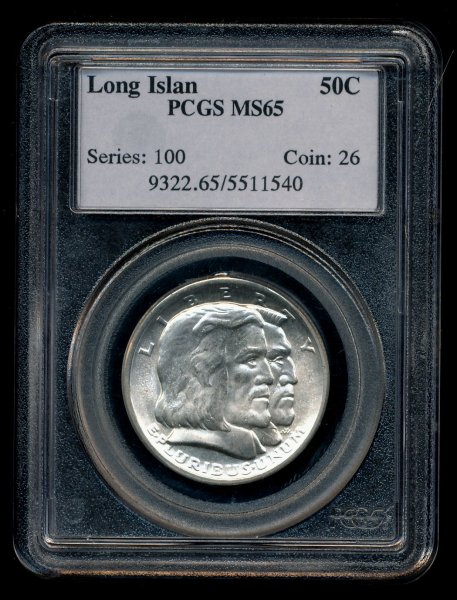
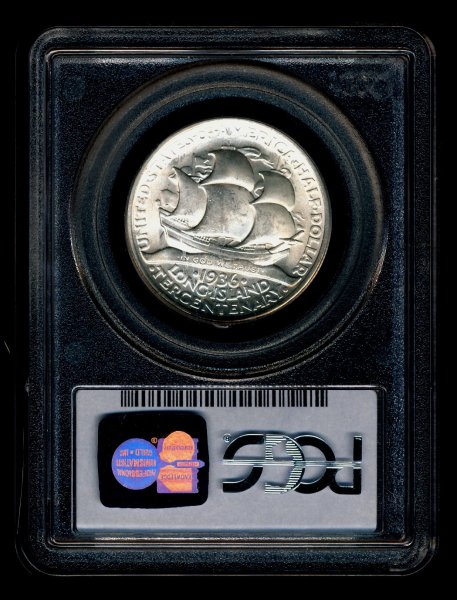
For other of my posts about commemorative coins and medals, including other stories about the Long Island half dollar, see:
Commems Collection follow the "Classic US Commemoratives" link.










 Posted 06/17/2024 11:40 pm


 Uncirculated American Silver Eagles


