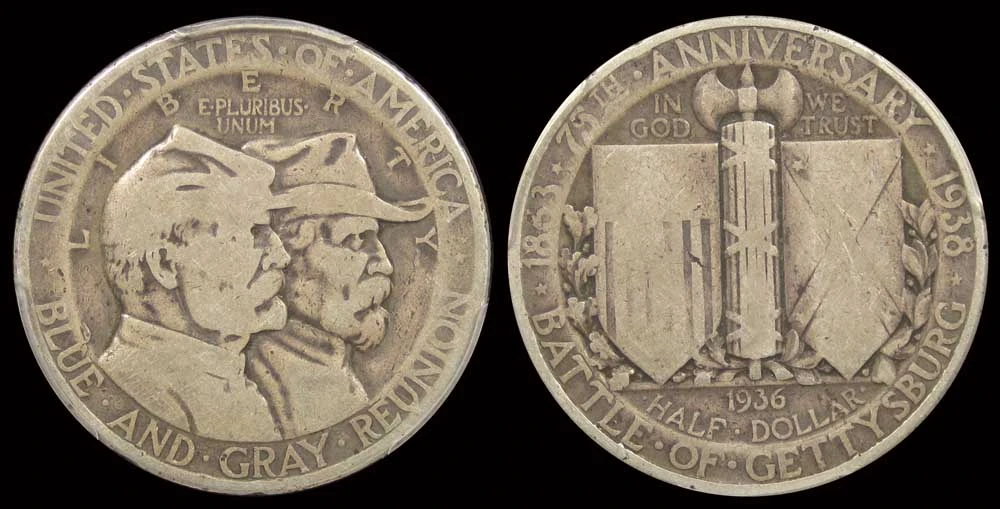
If you've ever visited the Gettysburg National Military Park, you've likely visited (or at least viewed) the Eternal Light Peace Memorial ("Memorial") while there - it is among the most impressive and imposing monuments in the Park. It is located on Oak Hill and overlooks the battlefields of Little Round Top and Big Round Top.
Eternal Light Peace Memorial - Gettysburg, PA Battlefield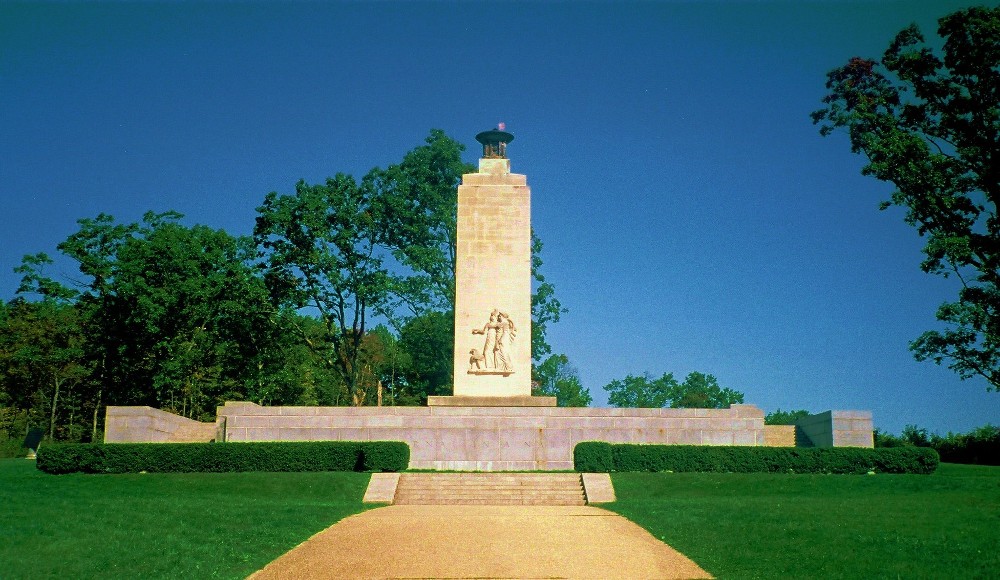 (Image Credit: National Park Service. Public Domain.)
The Memorial incorporates multiple components: 1) a rectangular platform/base (42' x 80'; height of 11') of Maine granite, 2) a shaft (~40' tall) of Alabama limestone, 3) a bronze urn at the top of the shaft that houses the eternal flame (gas-lit), and 4) a sculpture by Lew Lawrie that is symbolic of the "peace and good will existing between the North and South today."
Lawrie's "Peace and Good Will" Sculpture on Eternal Light Peace Memorial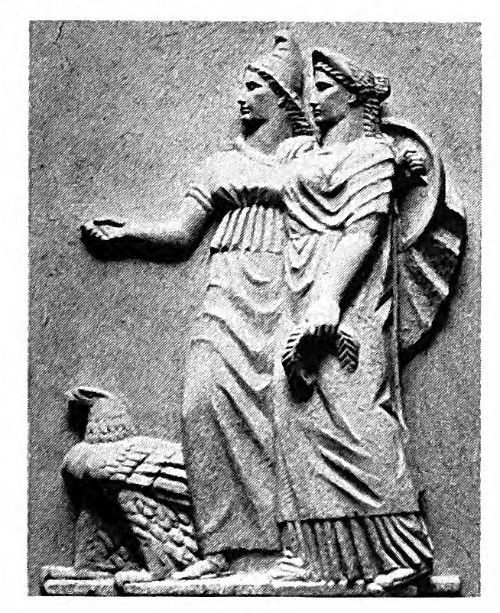 (Image Credit: Report of the Pennsylvania State Commission. Public Domain.
French-born Paul Phillipe Cret (b. 1876; d. 1945) was the architect for the Memorial. Cret moved to the United States in 1903. He began his stateside career as an instructor at the University of Pennsylvania and continued to teach there as a member of the University's Department of Architecture for 30 years. During this time, he won many commissions for buildings and war memorials.
Cret collaborated with Artist-Sculptor Lee Lawrie (b. 1897; d. 1963) on the Eternal Light Peace Memorial. Lawrie's sculpted the statue seen at bottom, front of the Memorial's shaft (see above). The Memorial's design was selected from a group of submitted concepts in mid-/late-1937.
Paul Phillipe Cret (Circa 1937)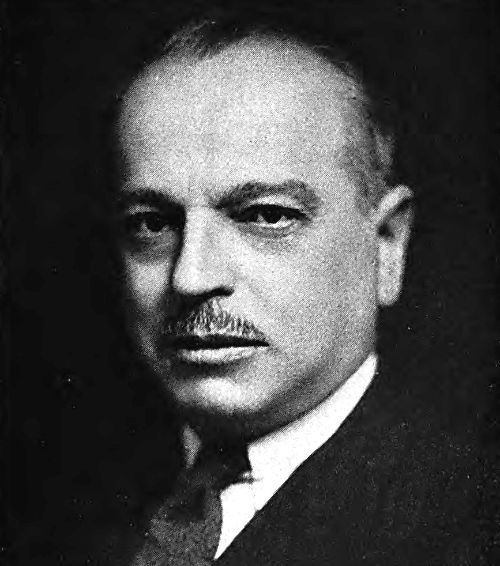 (Image Credit: Report of the Pennsylvania State Commission. Public Domain.Lew Lawrie (Circa 1937)
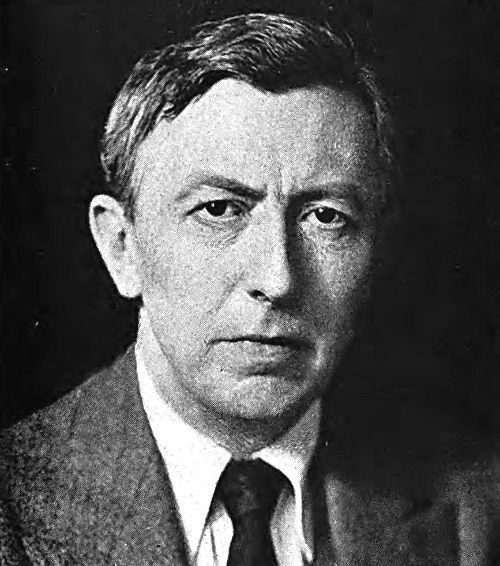 (Image Credit: Report of the Pennsylvania State Commission. Public Domain.Note 1: Lawrie served two stints on the Commission of Fine Arts, 1933-1937 and 1945-1950; he reviewed many US commemorative coin designs during his tenure. Note 2: The Memorial was originally proposed to coincide with the Battle of Gettysburg's 50th anniversary in 1913, but funding proved to be elusive and no monument was constructed.
Pennsylvania State Senator John S. Rice introduced a bill in the Pennsylvania Legislature to create the Gettysburg Peace Memorial Fund. The bill was approved and signed by Governor George H. Earle on February 24, 1937. With the bill's approval, the State Commission, especially its Executive Secretary, Paul L. Roy, was empowered to raise funds for the Memorial and move its design and construction forward.
Memorial construction took place in the first half of 1938, with its dedication on July 3, 1938 during the Gettysburg Blue and Gray Reunion.
An estimated 250,000 people attended the dedication, with ~100,000 others believed to have turned away due to road congestion. US President Franklin D. Roosevelt attended the ceremony, addressed the crowd and unveiled the Memorial.
From Roosevelt's address:
"Immortal deeds and immortal words have created here at Gettysburg a shrine of American patriotism. We are encompassed by "The last full measure of devotion" of many men and by the words in which Abraham Lincoln expressed the simple faith for which they died."Funding for the Memorial came from multiple sources. Virginia, New York, Indiana, Tennessee, Wisconsin, Illinois and Pennsylvania each appropriated at least $5,000 toward the Memorial - other States were contacted about appropriations, but, in the end, did not provide funds. The Commonwealth of Pennsylvania made the largest appropriation, with the Pennsylvania State Commission contributing money from its "coin fund."
To my knowledge, the Pennsylvania State Commission did not issue an official souvenir medal for the Memorial or its dedication. It did, however, prepare a number of different hanging badges that were used as awards to select individuals and groups (e.g., it produced one for the Boy Scouts who assisted during the Reunion). These badges are avidly sought by Civil War/Gettysburg collectors and can command strong prices. The medal presented here is an unofficial, privately-struck piece.
I added one of these medals to my collection because of the connection between the Commission's Coin Fund and its Memorial Fund. The Commission reports moving money from the former to the latter on more than one occasion. The exact extent of coin sale revenue being used for the Memorial is unclear (the records are a bit "murky").
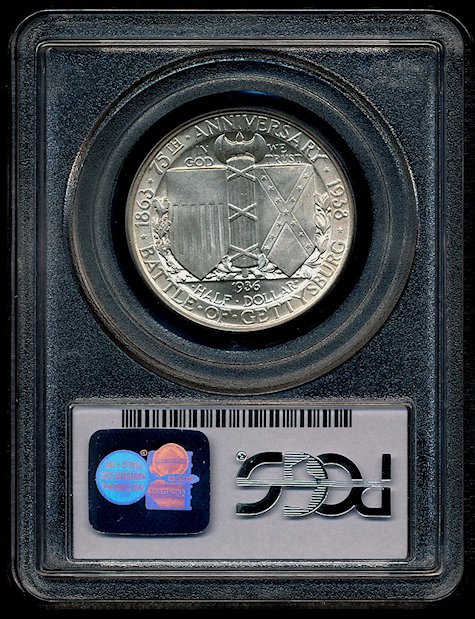
The coin's authorizing Act stated that "net proceeds shall be used by it [the Commission] in defraying the expenses incidental and appropriate to the commemoration of such event [75th Anniversary Commemoration]." The Eternal Light Peace Memorial was created for such a purpose, and so using coin funds for the Memorial was perfectly appropriate.
Eternal Light Peace Memorial Souvenir Medal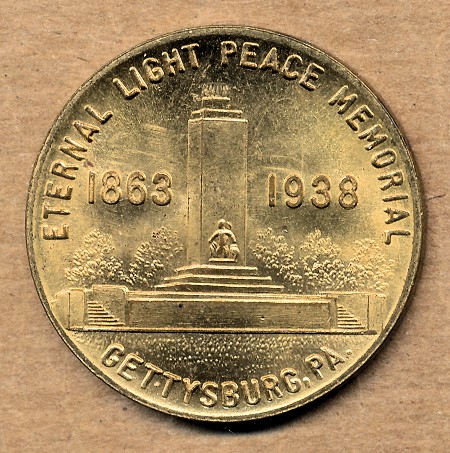
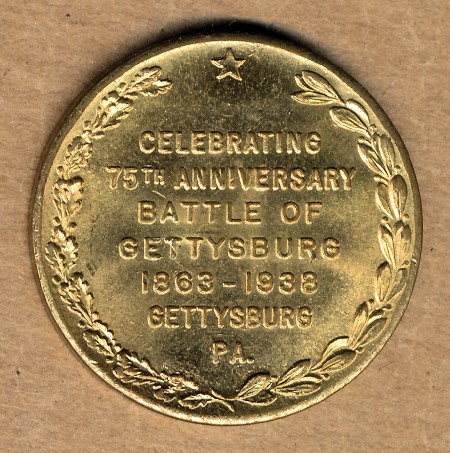 1936 Battle of Gettysburg 75th Anniversary Half Dollar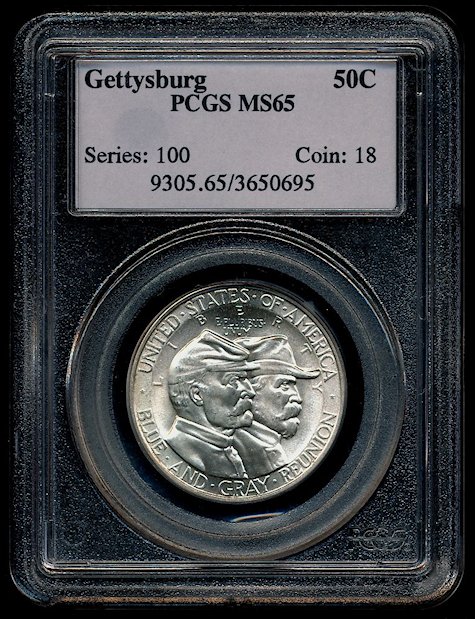
For more of my stories about commemorative coins and medals, including more about the Gettysburg half dollar and its related ephemera, see:
Commems Collection.







 Posted 07/03/2024 11:49 am