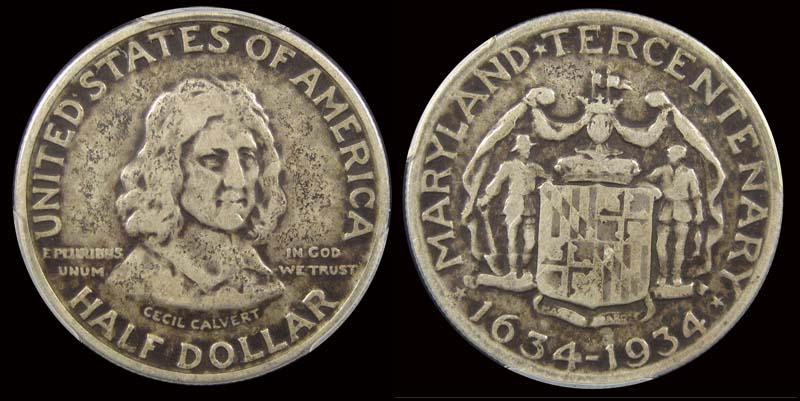
As I've discussed before, the 1934 Founding of the Maryland Province Tercentenary Half Dollar was first proposed in the Senate via a bill that called for 10,000 coins to be struck.
As introduced, the bill passed the Senate and was sent to the House of Representatives for its consideration. Once received by the House, the bill was referred to the House Committee on Coinage, Weights, and Measures. The Committee reported the bill favorably and recommended that it pass, though with several amendments. The Committee's amendments generated some discussion in the House.
The bill was brought up for consideration in the House by Andrew Lawrence Somers (D-NY) - Chairman of the Coinage Committee - with a request for unanimous consent. After the Clerk read the bill as originally written, he read the recommended Committee amendments:
"Page 1, line 5, strike out the word "ten" and insert in lieu thereof the word "twenty-five"; after the word "thousand" in line 5, insert "silver"; in line 6, after the word "and" strike out "silver"; and in line 9, after the word "Treasury", strike out "to be legal tender in all payments at face value", and insert "but the United States shall not be subject to the expense of making the models for master dies or other preparations for this coinage."After hearing the amendments, Thomas Lindsay Blanton (D-TX) rose to object and initiate a discussion.
"Mr. BLANTON. Mr. Speaker, I rise in opposition to the committee amendment for the purpose of asking some questions. While we are striking out "10,000" and inserting "25,000 ", why not insert " 100,000 '', and get that much more silver in circulation?
"Mr. SOMERS of New York. Of course, that might be a good argument to get more silver in circulation if more than 25,000 of these coins were in the habit of going into circulation. The committee took this up with the department and decided that 25,000 was about the proper number.
"Mr. BLANTON. The gentleman knows from his experience with respect to such matters that most of these coins are immediately taken out of circulation. They are sold at a premium and they are put into somebody's memento box. I am willing for that to be done, but in order to get about 75,000 in actual circulation, so that the people will have a 50-cent piece in their pockets once in a while, why not increase it to 100,000?
"Mr SOMERS of New York. Unfortunately, the history of these coins has been that they never go into circulation.
"Mr. BLANTON. I know, but I want to put some of them in circulation.
"Mr. SOMERS of New York. I do not know of any method compelling that. If I did, I would be glad to amend the bill.
"Mr. BLANTON. I withdraw the pro forma amendment, Mr. Speaker.
Upon Blanton's "defeat" and withdrawal of his objection, the House passed the amended bill and returned it to the Senate for its concurrence. The Senate did so and the bill went on to receive Presidential approval and enactment into law.
I've always found it interesting that Representative Blanton, a silver advocate, argued for increasing the coin's mintage four-fold over the increase already recommended by the House Committee. The Committee was acting to prevent creation of an artificially small mintage (10,000) and to support collectors, but Blanton clearly had other motivations (though not fully thought out IMO).
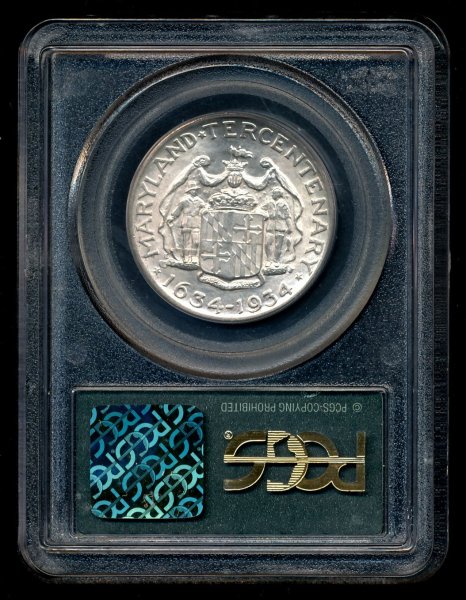
1934 Founding of Maryland Province tercentary Half Dollar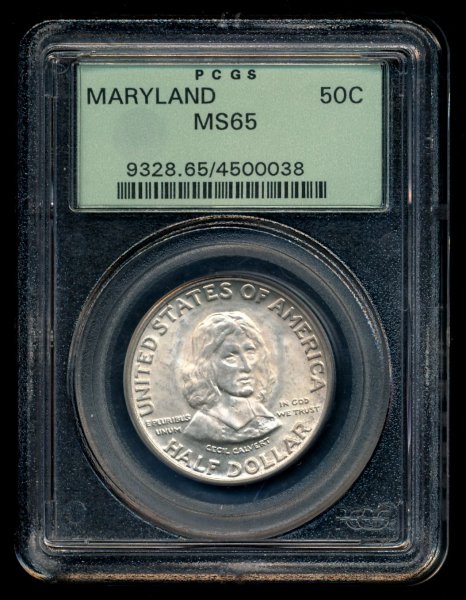
For more of my stories about commemorative coins and medals, including many other stories about the Maryland half dollar, see:
Commems Collection.







 Posted 09/25/2024 12:36 pm