|
This page may contain links that result in small commissions to keep this free site up and running.

Welcome Guest! Registering and/or logging in will remove the anchor (bottom) ads. It's Free!
To participate in the forum you must log in or register. | Author |
 Replies: 15 / Views: 1,111 Replies: 15 / Views: 1,111 |
|
|
New Member
Belgium
8 Posts |
Hi all,
I am currently thinking of how to organize my collection of cardboard coinholders, containing exclusively Roman coins.
Of course the denomination should be included.
Typically, the name of the emperor is written, but then what emperor? The one depicted on the coin or the one issueing/authorizing the coin? Two different things.. Especially in the tetrachy period, and later onwards with eastern and western emperors, I noticed that one emperor authorized coins depicting the other emperor.
Or, that the depicted emperor was deceased and authorized by his successor.
Then, the dates. The exact date the coin was issued? Or the reign period of the emperor? Or the birth and death years of the emperor?
I realize that I can write whatever I want, but I want to know what experienced (roman) coin collectors do, what is most common and also most helpful for you.
Once I choose a certain format/layout, I don't want to change it afterwards, that's why I want to think this over before I start writing on the coinholders.
Thanks!
Tom
|
|
|
|
Pillar of the Community
United Kingdom
2135 Posts |
I don't know what other people write, and now I'm curious to find out.
On the obverse side, I write issuing emperor and other emperor/persona, denomination; and on the reverse side, I write the type, mint, issue or date and a reference number either to Roman Imperial Coinage or Byzantine Coin Values.
|
|
Moderator
 Australia
16898 Posts |
Quote:
Typically, the name of the emperor is written, but then what emperor? The one depicted on the coin or the one issueing/authorizing the coin? Cataloguers have tended to historically place coins under the reign in which they were issued, irrespective of the actual name appearing on the coin. This is well and good for an archaeologist wanting to use the coins as dating evidence for their digs, but rather confusing for a coin collector, especially since there isn't usually any indication on the actual coin that this is the case. Personally, I've always placed coins under the name that appears on the coin. If it's a posthumous issue, or the issue of a family member or colleague under a senior emperor, make a note of that on the 2x2. Quote:
Then, the dates. The exact date the coin was issued? Or the reign period of the emperor? Or the birth and death years of the emperor? I've noticed most coin dealers usually put the reign-dates on the 2x2. Personally, if I found myself needing to know what the reign-dates or birth-and-death dates of a Roman emperor were, I'd look up Wikipedia rather than my coin album. The information on the 2x2 ought to be restricted to information actually relevant to the actual coin sitting in that 2x2 - which for dates means the year of issue if known, or a time-period of issue if the precise date is not known. If the date of issue is known from other contexts (eg. archaeological evidence) but isn't specifically stated on the coin itself, I would put the date of issue in brackets. As for other information, I've found it helpful to include a brief description of the reverse. That way, if at some future point I've removed a bunch of coins from their 2x2s, I don't have to sit down and figure out which coin "belongs" in which 2x2. Here's a typical Roman coin 2x2 description from my collection:
ROME - Empire Denarius (AD 70) Vespasian Rev: JVDAEA CAPTA {purchase price}
And on the back:
S 2296 09889 {provenance and purchase date}
"S2296" is the Sear catalogue reference. "09889" is my personal coin database catalogue number for this specific coin. Don't say "infinitely" when you mean "very"; otherwise, you'll have no word left when you want to talk about something really infinite. - C. S. Lewis
|
|
Pillar of the Community
 Sweden
2124 Posts |
Different collectors have different views on what is important, of course, but here is my list.
Essential info, should definitely be included:
- Issuing emperor
- Denomination
- Date of issue
- Mint (and officina)
Optional, but still important info:
- Depicted emperor or persona
- Type
- Issue, if there are several
- Catalogue number, such as Roman Imperial Coinage
Other info, possibly of interest:
- Inscriptions (since they can be hard to read on the coin itself)
- Weight
Info like reign of emperor and such can be catalogued separately if one wants it accessible, otherwise that can easily be looked up when needed.
|
|
Moderator
United States
34467 Posts |
Quote:
The information on the 2x2 ought to be restricted to information actually relevant to the actual coin sitting in that 2x2 100% agree with this. For me, I include on the front: 1. Name of Kingdom or Empire 2. Denomination 3. Year or year range of issue 4. Unique inventory number 5. Reference(s) 6. Weight 7. Diameter 8. Price paid 9. Grade 10. Date purchased 11. Mint (if known) I sometimes also include the inscription and the name of the person pictured. On the rev, I include: 1. Provenance going back as far as I can determine I sometime also include the inscription. "If you climb a good tree, you get a push."
-----Ghanaian proverb
"The danger we all now face is distinguishing between what is authentic and what is performed."
-----King Adz
|
|
Bedrock of the Community
United States
94367 Posts |
 to the CCF! |
|
Pillar of the Community
United States
917 Posts |
You start by taking the coins out of 2x2 cardboard holders and put them in flips. Now you have a better way to store them that allows you to actually hold the coin.
You can also include a lot of information on flip inserts, printing on the front and back.
This is how most of my inserts look--
Maximianus
A.D. 301-303
#1236; follis 26x28mm 9.7g
IMP MAXIMIANVS AVG; Laureate and cuirassed bust left, holding club over his right shoulder and wearing lion skin over left.
GENIO POPVLI ROMANI; Genius standing left, modius on head, naked except for chlamys over left shoulder, holding patera and sacrificing over lit altar, cornucopiae in left; In right field A.
In ex. PLG
RIC VI Lugdunum 120; Bastien 155 (2 ex.)
|
|
Bedrock of the Community
United States
12057 Posts |
I use Kraft paper envelopes when I need more space for describing and want to still be able to hold the coin.
Otherwise if using a 2x2 holder I will include the following:
Front side
- Ruler/emperor
- Mint of issue / mint mark / privy
- Approximate date of issue
- Denomination
- Approximate grade, if applicable
- Notes to any major flaws (scratched, holed, clipped, porous)
- Composition (AV, AR, AE, Orichalcum, Potin, etc.)
- Weight in grams
- Diameter in mm
- Reference number, e.g. Sear, RIC, Mitchiner, Album, RSC, BMC, Varbanov, Duplessy, et al.
- If there is room for it, the obverse legend and description
Reverse side:
- My initials (AB)
- Date purchased (month/year) without any separator, e.g. 1224
- Purchase price without any separator, e.g. 1500 = $15.00 paid
- If provenanced, the name of the collection/collector/Sammlung/auction house/etc. e.g. CGB, Album, CNG, Heritage, and so on
- If room for it, the issuing authority
- Reverse legend and description
Example from a recent addition to my collection:
(obverse side)
Lucilla (161-183). Denarius
Rome. RIC III 762 (var.), RSC 14.
LVCILLAE AVG ANTONINI AVG F
Draped bust rt w/diadem & braid
AR 2.9g / 17.0 mm
(reverse side)
AB1224799 (purchased 12/24 for $7.99)
DIAN-A LVCIFERA
Diana stg. l. holding torch
Auth. M. Aurelius / L. Verus
Member ANA - EAC - TNA - SSDC - CCT #890 "Most of the things worth doing in the world had been declared impossible before they were done." -- Louis D. Brandeis Edited by paralyse
12/20/2024 2:33 pm
|
|
Moderator
United States
34467 Posts |
I gotta say that I'm really enjoying this thread. So nice to see how we all have converged on so many of the same pieces of information.
"If you climb a good tree, you get a push."
-----Ghanaian proverb
"The danger we all now face is distinguishing between what is authentic and what is performed."
-----King Adz
|
|
Bedrock of the Community
Australia
21789 Posts |
1. Obv: emperor, approx date, where minted, legend, brief description
2. Rev. brief description, legend, catalog reference numbers. price and date when purchased, sellers grade, my grade if different.
Same for all other ancient coins; Greek, Celtic, Roman Colonial, Byzantine, Parthian, Sassanian, ancient Indian, ancient Chinese, Islamic, medieval European, etc. etc.
Only use Mylar / cardboard flips
because they are the by far the most practical way to fully ascribe all of the information that pertains to the coin
Some of the more valuable coins may have acrylic sheet inserts inside the flip to help protect the coin
3. All coins in date order in album.
------------------------------------------------------------------------------------------------------------------------------
For those collectors who collect modern coins, far less info needed.
(for American coins), where most of the information can be self evident:
1. Obv: price paid and date when purchased
2. Rev: sellers grade, my grade if different,
None of my American coins are slabbed, all in flips as above, although some of the more valuable coins ($ thousands), have extra flip insertions, as described above.
I am also an active collector of modern commemorative coins that have been issued into circulation, and have been acquired at face value. All of these coins are in flips in an album as well. This part of the collection numbers about 500 items.
None of these coins have any description written on the flip, because all of their information is considered to be self evident.
Modern packaged bright 'n shiny coins are irrelevant to the way my collection is presented.
|
|
Pillar of the Community
United States
917 Posts |
I store my coins in trays with my 2x2 cards and also keep any dealer or collector tags. 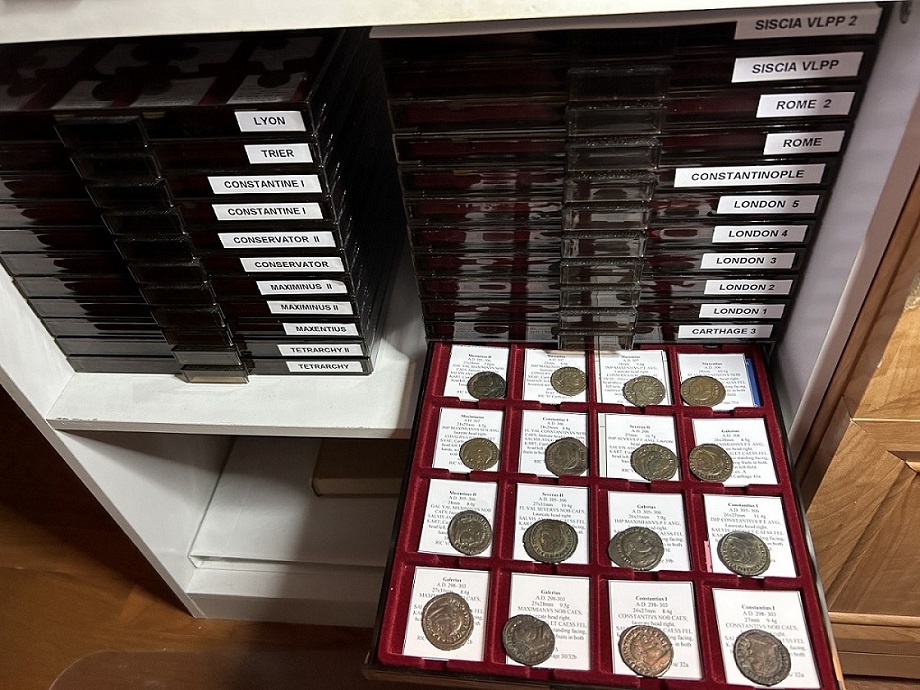 |
|
Bedrock of the Community
United States
12057 Posts |
Victor, that's an amazing collection, and an amazing set of trays.
I could probably spend a couple of days just staring at those coins...
Member ANA - EAC - TNA - SSDC - CCT #890 "Most of the things worth doing in the world had been declared impossible before they were done." -- Louis D. Brandeis |
|
Pillar of the Community
United States
917 Posts |
Quote:
Victor, that's an amazing collection, and an amazing set of trays. There's more  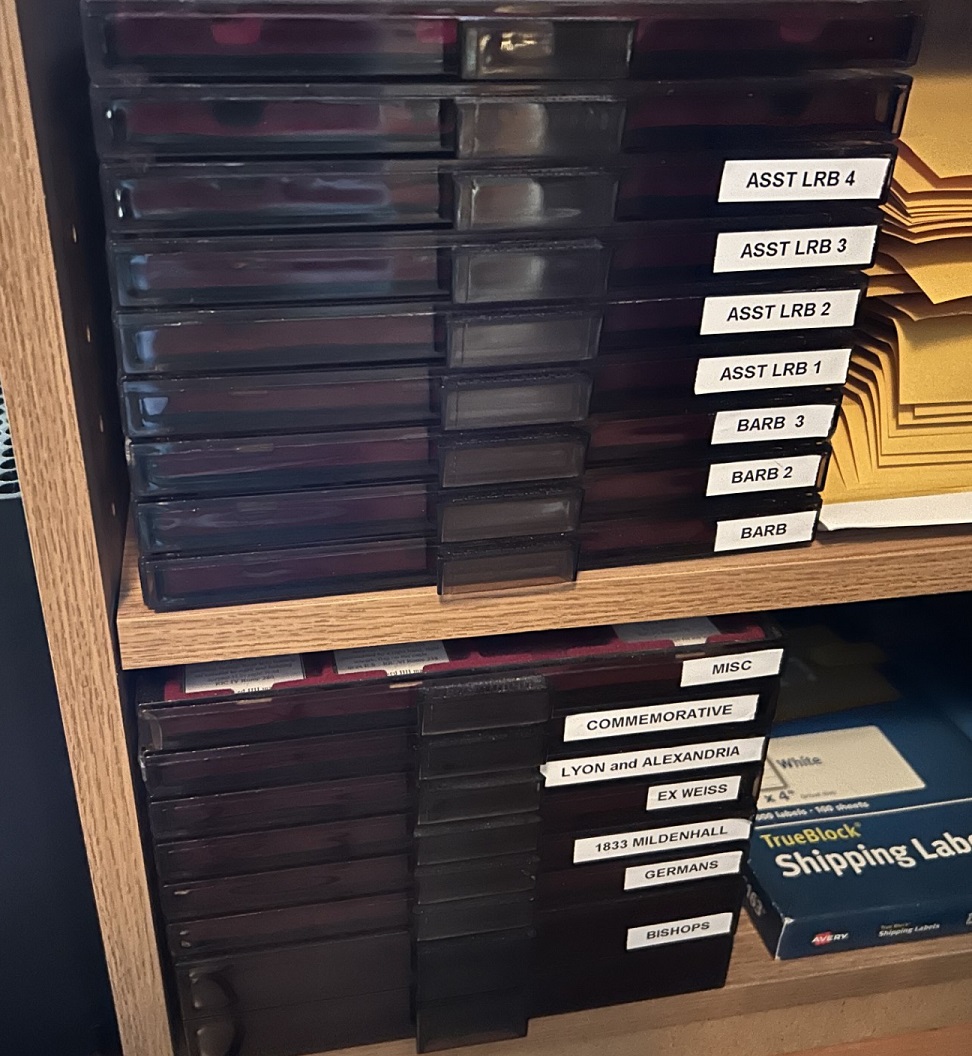 I have added several trays since taking those photos. I also have hundreds of unofficial issues in albums. |
|
Pillar of the Community
United States
2284 Posts |
Victor, very nice way to keep your ancients!
|
|
Bedrock of the Community
United States
12057 Posts |
My partner has gotten used to the madness.. somewhat
"Honey, what did you do today?"
"Spent 6 hours looking at ancient coins"
"Oh, okay!"
Member ANA - EAC - TNA - SSDC - CCT #890 "Most of the things worth doing in the world had been declared impossible before they were done." -- Louis D. Brandeis |
|
New Member
 Belgium
8 Posts |
Thanks guys, cool suggestions so far!
|
| |
Replies: 15 / Views: 1,111 |
|
To participate in the forum you must log in or register.
Disclaimer: While a tremendous amount of effort goes into ensuring the accuracy of the information contained in this site, Coin Community assumes no liability for errors. Copyright 2005 - 2026 Coin Community Family- all rights reserved worldwide. Use of any images or content on this website without prior written permission of Coin Community or the original lender is strictly prohibited.
Contact Us | Advertise Here | Privacy Policy / Terms of Use
|
| Coin Community Forum |
© 2005 - 2026 Coin Community Forums |
| It took 0.45 seconds to rattle this change. |
 |
|
| |
| |







 Posted 12/20/2024 05:55 am


