If you need to catch up on the previous installments:
-
1993 World War II 50th Anniversary Coins - Part I-
1993 World War II 50th Anniversary Coins - Part IIIn August 1992, during the Second Session of the 102nd Congress, John Herschel Glenn, Jr. (Yes, that "John Glenn") introduced a bill in the Senate that called for coins "in commemoration of the 50th anniversary of the United States' involvement in World War II." It followed in the footsteps of the Marcy Kaptur (D-OH) bill, being introduced approximately one month after Kaptur's bill had been passed by the House and sent to the Senate (where it stalled).
Glenn's bill was essentially a companion bill to the Kaptur bill, incorporating just minor technical changes (e.g., adding the phrase "(hereafter referred to as the "Commission")" after the first reference to the American Battle Monuments Commission - such abbreviation language was inadvertently omitted in the Kaptur bill, though the ABMC was referred to as the "Commission" after its first reference as if the abbreviation note had been included.)
Glenn's bill duplicated the "Findings," "Sense of Congress," coin specifications, design requirements, marketing provisions, surcharge model and use of the Coinage Profit Fund as a holding place for surcharges collected pending distribution. Glenn basically made a couple of minor technical changes to Kaptur's bill and introduced it in the Senate.
The bill was passed in the Senate without amendment and sent to the House of Representatives for its review and concurrence. In the House, Larry LaRocco (D-ID) moved to suspend the rules and pass the Senate bill without it first being sent to Committee. LaRocco referenced the Kaptur bill, stating that the Senate bill was almost identical to the Kaptur bill that the House had previously passed, and urged that Glenn's Senate version be passed.
Representatives James Albert Smith Leach (R-IA) and Henry B. Gonzalez (D-TX) rose in support of the bill, and followed LaRocco in urging their colleagues to pass it. With no objections raised, the bill passed the House via voice vote, and was sent back to the Senate. It was examined and signed in both chambers and sent on to the President. US President George Herbert Walker Bush signed the bill into Public Law on October 14, 1992. Let the design processes begin!
1993 World War II 50th Anniversary Gold Half Eagle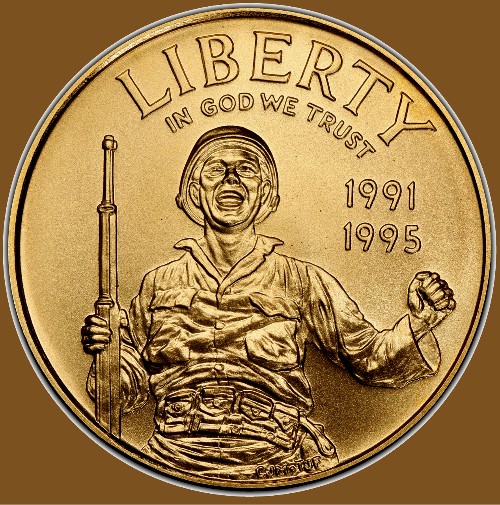
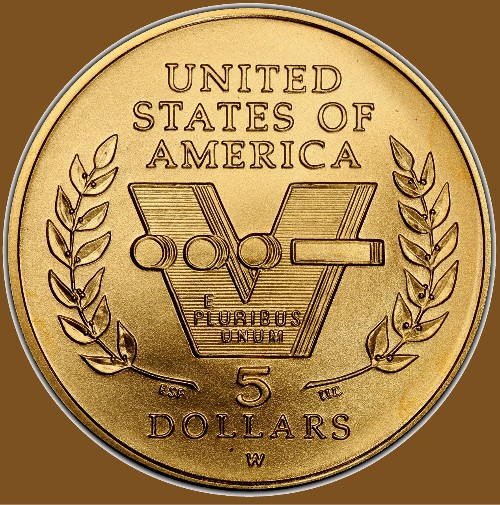
The Gold Half Eagle was designed by Charles J. Madison. It depicts a US soldier celebrating victory with his left arm and clenched fist raised, along with his rifle (in his right hand). The dual "1991-1995" date specified in the legislation is seen to the soldier's left (at right from viewer's perspective).
Edward Southworth Fisher was the designer of the coin's reverse. At center is seen a large "V" (for "Victory") with the Morse code for "V" presented in front of the large letter (dot-dot-dot-dash). Flanking the "V" are two olive branches.
The Pre-Issue prices for the Half Eagle were $185 and $170 (Proof and Uncirculated, respectively). The Regular prices were $220 and $200 (Proof and Uncirculated, respectively).
Proof mintage totaled 67,026; with Uncirculated version sales reaching 23,672 units. (The maximum authorized mintage for the Gold Half Eagle was 300,000, so the coin's total of 90,698 units sold represents ~30.2% of the maximum allowed.)
1993 World War II 50th Anniversary Silver Dollar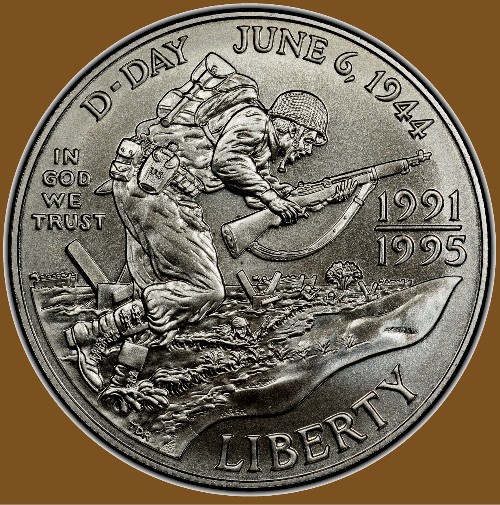
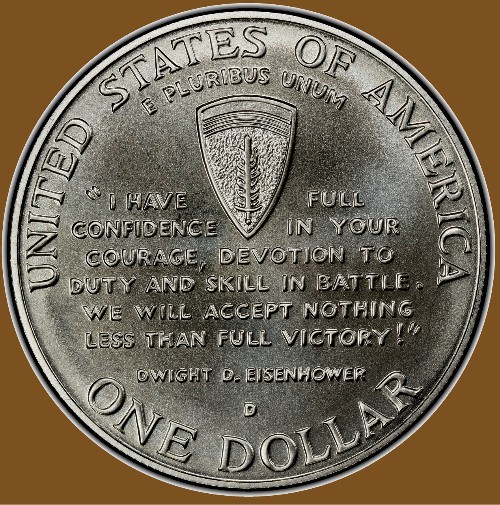
The WWII Silver Dollar presents a D-Day theme. The obverse depicts an American soldier on the beach at Normandy during the D-Day landing. The "1991-1995" dual date specified in the legislation is seen to the right of the soldier (viewer's perspective). The legislatively optional "D-Day" and "June 6, 1944" inscriptions are found above the solder at the coin's rim.
On the reverse is found a quote from General Dwight David Eisenhower, the US General of the Army and overall Allied Supreme Commander: "I HAVE FULL CONFIDENCE IN YOUR COURAGE, DEVOTION TO DUTY AND SKILL IN BATTLE. WE WILL ACCEPT NOTHING LESS THAN FULL VICTORY.". The quote was included in Eisenhower's Order of the Day message to Allied troops on June 5, 1944. Seen at the top of the quote is the insignia of the Supreme Headquarters Allied Expeditionary Force it was part of the letterhead on the stationery used by Eisenhower at the Supreme Headquarters of the Allied Expeditionary Force.).
Thomas D. Rogers, Sr. was the designer for each of the coin's sides.
The Pre-Issue prices for the Silver Dollar were $27 and $23 (Proof and Uncirculated, respectively). The Regular prices were $31 and $28 (Proof and Uncirculated, respectively).
Proof mintage totaled 342,041; with the Uncirculated version selling 107,240 units. (The maximum authorized mintage was 1 million, so the coin's total of 449,281 units sold represents ~44.9% of the maximum allowed.)
1993 World War II 50th Anniversary Half Dollar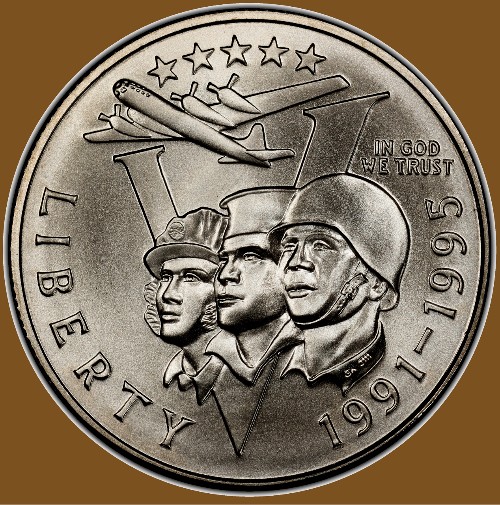
The obverse design of the Half Dollar is by George Klauba. It depicts the faces of three members of the US military (two men, one woman), superimposed over a large "V" for "Victory." Above the figures is seen a World War II era bomber surmounted by five stars. The bomber appears to be a Boeing B-29 Superfortress used by the US Army Air Force, though it is not specifically identified by the Mint. The five stars above the bomber appear to be a reference to the highest US military rank of five stars; the rank was created during WWII, in 1944, (Eisenhower achieved the rank in 1944); it is generally a war time rank. The rank was retired in 1981 with the death of Omar Bradley.
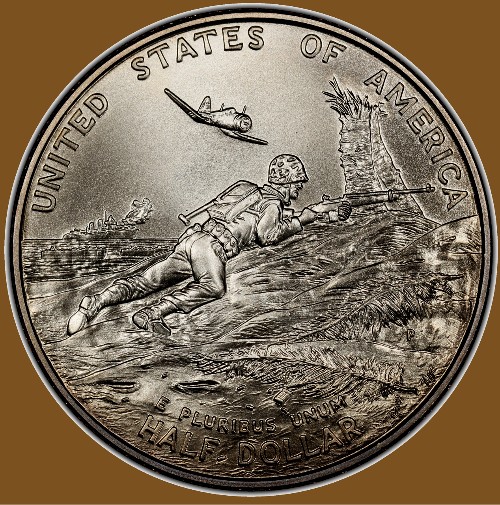
Bill J. Leftwich was the designer of the coin's reverse. It presents a US serviceman (Army or Marine Corps) crawling with his gun at the ready on the beach of a Pacific Ocean island. In the background is seen a pair of landing craft bringing more soldiers to the beach and a Navy warship (it appears to be a light cruiser); overhead is a fighter plane (its wings suggest that it is a carrier-based Vought F4U Corsair).
The Pre-Issue prices for the Clad Half Dollar were $9 and $8 (Proof and Uncirculated, respectively). The Regular prices were $10 and $9 (Proof and Uncirculated, respectively) - prices sure have gone up!
Proof mintage totaled 317,396; with the Uncirculated version selling 197,072 units. (The maximum authorized mintage was 2 million, so the coin's total of 449,281 units sold represents ~25.7% of the maximum allowed.)
The Clad Half Dollar was sold in a variety of packaging options, in addition to individually. I've posted before about three of these options:
-
1993 World War II Young Collectors Set-
1993 World War II Coin And Victory Medal Set-
1993 World War II Half Dollar PaperweightIMO, the overall sales of the program are disappointing. Coins marking such a seminal event in 20th Century US history should have fared better. Could the program's sales been an early sign of the "collector fatigue" that would befall the modern US commemorative coin series by the mid-1990s?
If you've made it this far in my three-part series on the US' 1993 World War II 50th Anniversary coin program - Thanks! I hope you learned a thing or two about the coins - that's always my goal.
For other of my posts about commemorative coins and medals, including other World War II stories, see:
Commems Collection.








 Posted 06/12/2025 06:15 am


