While preparing my recent post about the legal standing of the Norfolk Bicentennial/Tricententennial commemorative medal bill - You can read it here: -
1936 Norfolk, VA Bicentennial/Tricentennial - Summer Of The Medal) - I came across a number of interesting tidbits that I thought I'd share:
Tidbit #1: An Appeal to President Roosevelt?Regarding whether it would make sense to make a direct appeal to President Franklin Delano Roosevelt regarding the Norfolk commemorative coins...
The August 5, 1936 edition of
The Virginia Pilot made it clear that it did not believe appeals to Secretary of the Treasury or the President would have helped matters: "There is no reason to believe that an appeal to Secretary Morgenthau himself or to President Roosevelt as a last resort would alter the Treasury's attitude. On the contrary, both Mr. Morgenthau and Mr. Roosevelt, in official letters to the banking and currency committee of the Senate, have urged that medals and not coins be authorized for such commemorative purposes."
I've previously discussed the Treasury Department's opposition to the growing list of US commemorative coins in the 1920s and 1930s before, as well as its preference for the striking of commemorative medals and how its opposition influenced multiple US Presidents, including Roosevelt. So, such positions by Morgenthau and Roosevelt should not have been a surprise.
Tidbit #2: The FDR Conspiracy Theory!The August 5, 1936 edition of the
Norfolk Ledger-Dispatch blamed President Roosevelt for the Norfolk medal vs. coin snafu. Francis E. Turin, head of the Norfolk Advertising Board (the sponsor of the commemorative legislation) was quoted as stating "One man--and one man alone--is responsible for the fact that the Norfolk Commemorative coin bill passed by the House, was changed in the Senate to provide for a medal. And that man is the President of the United States."
Turin also stated "We have a right to know why Norfolk has been discriminated against. It's time for the people of this area to rise up in righteous indignation at this insult to this cty."
Conspiracy Theory 101.

Turin appears to have ignored a few facts:
1) The passed Senate bill was amended based on a recommendation by the Senate Committee on Banking and Currency. In its Report on the bill, the Committee stated "This is in accord with the view of the committee that in the future medals instead of coins be authorized in cases similar to this bill and that a restrictive policy be adopted hereafter with respect to the issuance of commemorative coins."
Granted, the Committee did identify a June 1935 letter from President Roosevelt to the Committee as the driver behind its recommendation - Roosevelt was on record (along with the US Treasury Department) as favoring commemorative medals vs. special commemorative coins for historical events - but the letter was a proposal for a change vs. a mandate to change by the President. It appears Turin put his own self-serving spin on FDR's proposal.
Also, it should be noted, that in 1935 - prior to the introduction of the commemorative bill for Norfolk - the Senate had passed a measure that called for commemorative medals vs. commemorative coins. (The measure stalled in the House of Representatives - you can read about it here:
Medals Vs. Coins So, the evidence is clear that the concept of medals vs. coins was not initiated because of the Norfolk commemorative proposal - it came before in response to other coin bills!
2) The Senate version of the Norfolk commemorative bill was amended to call for medals (vs. coins) before the House of Representatives considered the bill. True, it inadvertently considered and passed the bill as Senator Carter Glass originally proposed it, but this was done accidentally - the Clerk read the incorrect version of the bill when it was brought up for consideration in the House.
The Senate had asked the House to concur in its amendment (i.e., the medals for coins swap), but signals got crossed and the House passed the wrong version of the bill. No conspiracy, just clerical error.
3) The clerical error and resultant discrepancy between the bills should have been caught by Congress before President Roosevelt was presented with a bill to sign (the medal proposal version). The fact that the incorrect bill was sent to the President was a failure in administrative cross-checking, to promote the idea that FDR was the man to blame for the clerical error was inappropriate and reckless in IMO.
Tidbit #3: Norfolk Changes Anniversary Celebration PlansThe delay in getting its Norfolk coin bill approved - and the delay in proceeds from its sale - caused the Norfolk Advertising Board to dramatically revise its Norfolk Anniversary celebration plans. The plan went from a month-long observation (September - October 1936) to a year-long observation (September 1936 - September 1937) - renamed as the "Anniversaries Year" celebration. The revised schedule meant that the bulk of the anniversary events would take place in the year following the targeted anniversary year (1936). But let's not quibble over a "slight" change to the schedule!
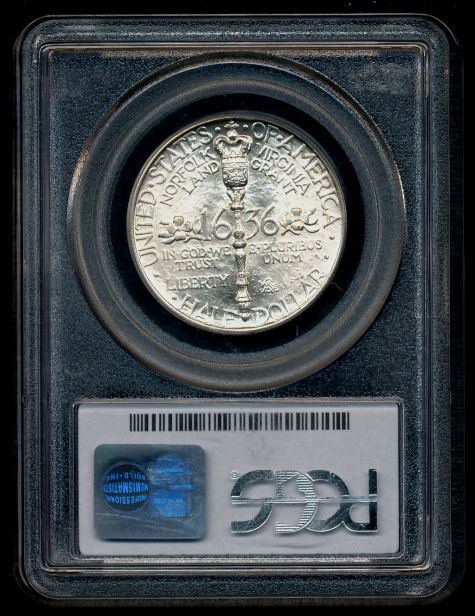
1936 Norfolk, VA Bicentennial/Tricentennial Half Dollar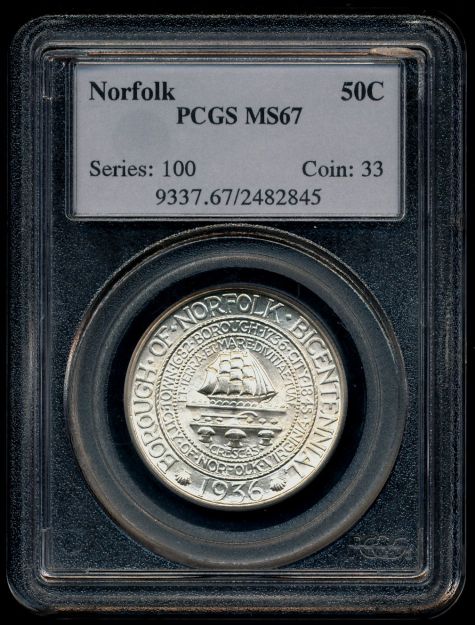
For other of my posts about commemorative coins and medals, including other Norfolk coin stories, see:
Commems Collection.






 Posted 07/06/2025 2:34 pm





