This is either the story of excellent US Mint efficiency or the story of slightly imprecise bookkeeping regarding the Mint's production schedule. The 1936 Battle of Gettysburg 75th Anniversary Half Dollar is known as one of the classic-era US commemorative coins that was dated 1936, struck by the US Mint in 1937 and celebrated a 1938 event (the last Blue & Gray Reunion). The 1936 Landing of the Swedes in Delaware 300th Anniversary Half Dollar is another example.
Mint reports indicate that the Gettysburg half dollars were struck at the Philadelphia Mint in June 1937; the coins were shipped to Gettysburg via train in 25 coin bags (2,000 coins each). The train carrying the coins arrived in Gettysburg at approximately 10:00am on Friday, June 4, 1937. (The train is reported to have gone from Philadelphia, PA to Baltimore. MD and then from Baltimore, MD to Gettysburg, PA.)
Assuming the train carrying the coins - along with its armed guard - left Philadelphia on Thursday, June 3rd, it would have been necessary for the coins to have been struck either on Tuesday (June 1) or Wednesday (June 2) - if the June Mint reports are to be accepted as accurate. This quick from-coin press-to-bag-to-train scenario is the "Efficient Mint" scenario.
Another possibility is that the coins were struck in late May (including Monday, May 31st. The Mint would have been "open" on May 31st as Memorial Day was celebrated on Sunday, May 30th in 1937 - the last-Monday-in-May policy was not adopted until 1968) and its production might have been included as part of June's production - the "Imprecise Bookkeeping" scenario. Maybe the May books closed the previous Friday (May 28th)?
Regardless of which scenario transpired, it is well-documented that the coins arrived in Gettysburg during the morning of June 4, 1937. Thirteen of the 55-1/2 pound coin bags were stored at the First National Bank of Gettysburg, with the other 12 bags stored at the Gettysburg National Bank.
The first coin taken from the delivered bags was to be presented to Pennsylvania Governor George Howard Earle III, with the second coin selected going to US President Franklin Delano Roosevelt. My cynical side suggests that two prime specimens were selected for presentation vs. strictly the first two coins pulled from the bags as the bags were somewhat randomly filled with coins at the Mint vs. the coins being placed in special containers marked for strike order and so "first coin" or "second coin" had little actual meaning.
Coins went on sale in Gettysburg that afternoon (Friday, June 4, 1937) from the Federal/State Commission offices in the Hotel Gettysburg; the issue prices was $1.65 per coin.
1936 Battle of Gettysburg Half Dollar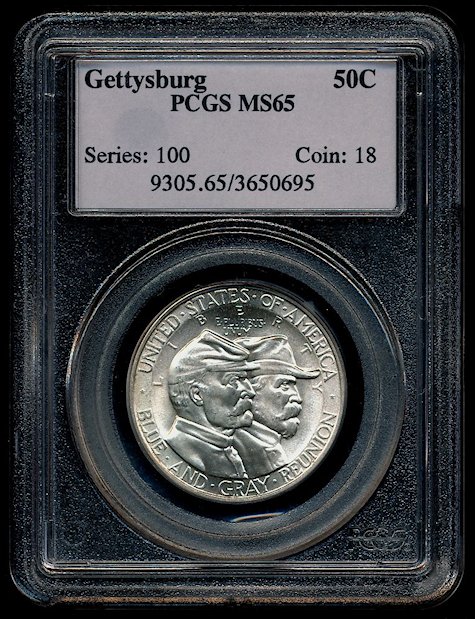
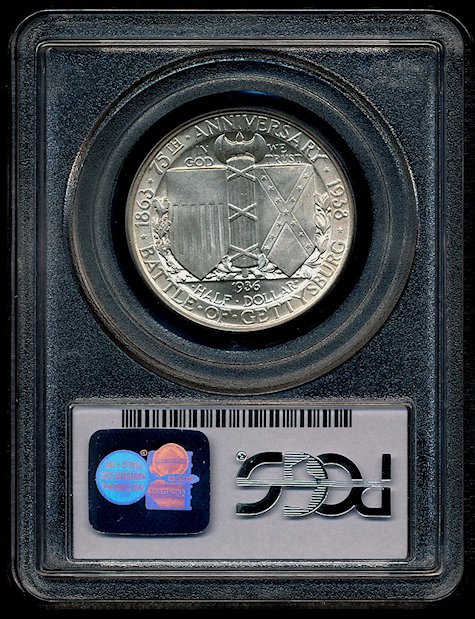
For more of my topics on commemorative coins and medals, including more on the history and design of the BTW half dollar presented here, see:
Commems Collection.







 Posted 07/17/2025 5:31 pm





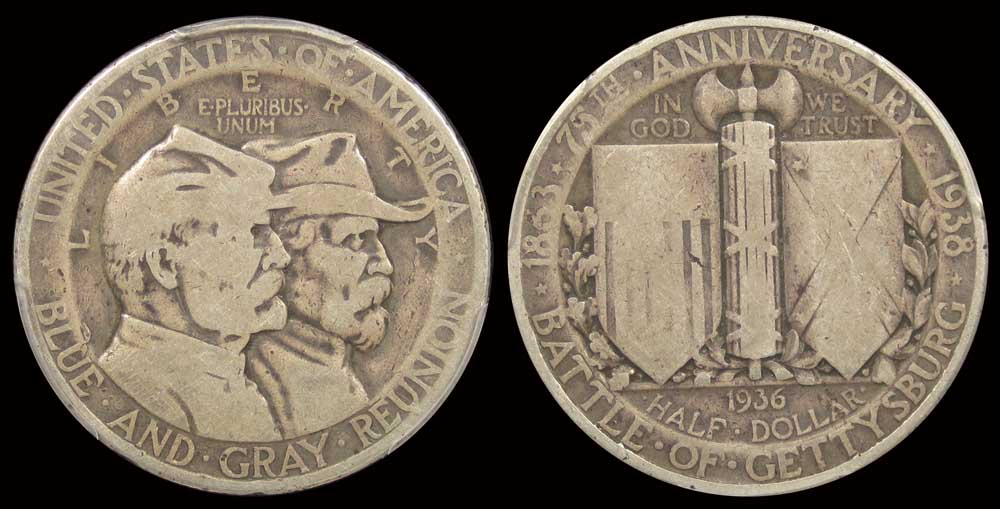


 That's a lovely circulated Gettysburg you have there!


