Continuing the story from Part I...The House Jamestown coin bill was referred to the House Committee on Financial Services, with a further referral to its Subcommittee on Domestic and International Monetary Policy, Trade, and Technology. The Subcommittee held a Hearing on multiple commemorative coin bills and a Congressional Gold Medal. Included on the Hearing's agenda was the two-coin Jamestown 400th Anniversary program.
The coin bill's House sponsor, Jo Ann Davis, attended to support her bill. She outlined the intended uses for the program's collected surcharges:
"The proceeds from the sale of these commemorative coins will go
a long way towards restoring the Jamestown settlement and preserving
and promoting educational programs."J. Steven Griles, Deputy Secretary, US Department of the Interior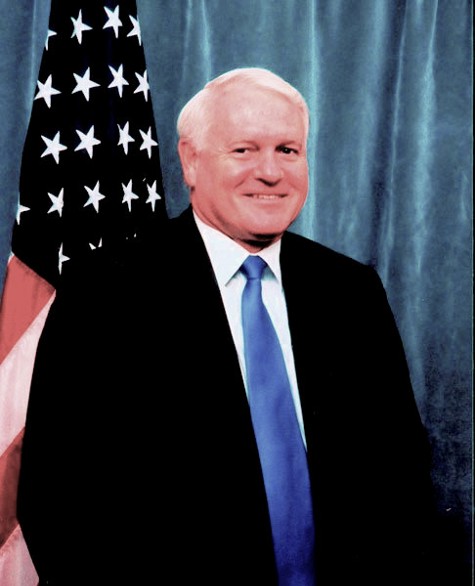
Representative Davis introduced the primary witness to support the Jamestown coin program, J. Steven Griles, Deputy Secretary, US Department of the Interior. Griles stated:
"...in 2007 the people of the United States and many of our friends from around the world will come together to commemorate the 400th anniversary of the first permanent English settlement in America in 1607 , the settlement of Jamestown in the Commonwealth of Virginia. More than just our nation's birthplace , Jamestown is a point of origin on this continent for many of the principles and the precepts that distinguished America , including our representative government , where the oldest legislative body in the new world first convened in Jamestown in 1619 ."The Subcommittee supported the Jamestown coin bill and recommended that it pass without any amendments. The Committee on Financial Services followed its Subcommittee's recommendation and reported the bill to the House with a recommendation for authorization.
The bill was then referred to the House Committee on Ways and Means due to its provisions outlining the collection and potential distribution of surcharges. The Committee on Ways and Means supported the bill, but with an amendment designed "to enforce the limitation established in the Commemorative Coin Reform Act of 1996 that commemorative coins from no more than two commemorative coin programs carrying surcharges be issued per year"
With such financial protections for the Federal Government in place, the amended bill was considered and passed by the House before being sent to the Senate for its consideration. The Senate passed the bill without objection or making further amendments.
Proof and Uncirculated versions of the coins were authorized, with the coins to be sold exclusively in Calendar Year 2007.
Next, the bill was examined and signed in each chamber, and then sent to the President for final approval. US President William Jefferson "Bill" Clinton signed the bill into Public Law on August 6, 2004.
To close the loop on the Senate Companion bill referenced above, John Warner's Senate bill was referred to the Senate Committee on Banking, Housing, and Urban Affairs. The Committee reported the bill favorably, but the Senate did not take further action on it - the House version of the bill was passed instead.
In another case of post-approval surcharge distribution modification,
In the bill that called for the Girl Scouts Centennial Silver Dollar, an amendment was made that altered the surcharge distribution model (not including the 50% of funds to be paid to the Jamestown-Yorktown Foundation of the Commonwealth of Virginia) as follows (compare with above):
- the equal shares provision of the Act was removed
- the Secretary of the Interior was cut out of surcharge distribution plan
- the Association for the Preservation of Virginia Antiquities was to receive two-thirds of available surcharge funds (up from one-third)
- the Jamestown-Yorktown Foundation of the Commonwealth of Virginia was to receive one-third of available surcharge funds (unchanged)
The amendment was included in the Act that authorized the Girl Scouts Silver Dollar in 2009 and thus helped ensure surcharge funds from coin sales would be directed toward Jamestown/Virginia and not, potentially, for other purposes as determined by the Secretary of the Interior.
To finish up the Jamestown coin story with a look at the coins, see:
Part III.
For other of my posts about commemorative coins and medals, including more about modern US commemorative coins, see:
Commems Collection 





 Posted 01/05/2026 11:09 am





