With its legislative journey behind it, the 1983-84 Los Angeles Olympic coin program moved into its implementation phase - it was not "smooth sailing"...A few key parameters (reminders) regarding the program:
1) The striking of up to 50 million Silver Dollars was authorized (25 million of a 1983 design and 25 million of a 1984 design). The striking of up to 2 million Gold Eagles was also authorized.
2) No restrictions were placed on which Mint facilities could be used to strike coins of the program. As a result, coins were struck at Philadelphia, Denver, San Francisco and West Point.
3) The authorizing legislation specified that the US Mint was to handle domestic marketing and distribution for all coins. Overseas marketing and distribution was to be handled, under contract, by a private organization.
Design ControversyThe coin design phase did not get off to a smooth start.
Due to time limitations, no open competition was held to develop the designs for the coins. A combination of in-house staff at the United States ("US") Mint and select independent artists was used for the designs of the program's coins. The process generated much controversy among the numismatic press, collectors and general program supporters.
There were such an outcry over the preliminary coin designs, in fact, that Frank Annunzio (D-IL) convened another Hearing of the Subcommittee on Consumer Affairs and Coinage (under the House Committee on Banking, Finance, and Urban Affairs), to review the designs and the possibilities for improvement of them. The 'Oversight on Olympic Commemorative Coin Designs' Hearing took place in December 1982.
Note: As a reminder, Annunzio was the Chairman of the Subcommittee referenced above.Annunzio came out firing:
"This morning the subcommittee meets to conduct oversight hearings into the designs of the 1984 Olympic commemorative coins. I truly wish that it were not necessary to hold these hearings. I must tell you quite candidly that it hurts me to hold these hearings. Many people in this room worked tirelessly to bring about the Olympic coin program which gave the control of the program to the Treasury Department rather than to private interests. Many of us fought long and hard for this program, and it is for that reason that these hearings give me problems." For background, at the time of the Hearing, the Mint had already conducted mailings for the coins, though the promotional materials sent indicated that the designs were preliminary and subject to change. The disclaimer was not enough to quiet the critics, however.
It should be noted, that the response to the Mint's initial mailing did generate a reasonable, if not spectacular, response, with pre-orders generating over $10 million in surcharge funds that were distributed - on a 50/50 basis - between the Los Angeles Olympic Organizing Committee ("LAOOC") and the United States Olympic Committee ("USOC").
Later in his opening remarks, while addressing those present to testify, Annunzio stated:
"We have the numismatic community, we have the Treasurer of the United States, we have the responsibility for the coin with the Secretary of the Treasury, but we will have to do something to get all of you together to get designs that we can agree on or that look good, and that are acceptable to the American public. If we do that, believe me, the Olympic athletes will have the finest teams we have ever had represented in Olympic games . We are going to turn over $600 million to both Olympic Committees."
I can't tell if Annunzio was speaking about the $600 million from a perspective of confidence or one of pure hope! He continued:
"When I first saw the proposed Olympic coin designs in late September [1982], I expressed deep concerns to the Treasury Department. On October 1, I wrote to Treasury Secretary Regan, who personally selected the designs, and expressed my concern. I asked him to reconsider the designs, or to at least consult with numismatic experts across the country to get their views on the designs. I have not had the courtesy of a reply to my letter from the Secretary, nor to my knowledge has there been any consultation with numismatic experts."Don't ignore the 'Bulldog', it only makes him more ornery! And quite possibly my favorite Annunzio quote:
"While some sides of the coin are at least of acceptable quality, my overall impression of the three coins is, in the words of today's teenagers, they are "groady to the max."The vivid image his description conveys! The unmistakable clarity! Criticism beyond measure!

The Hearing featured testimony from:
- Angela Buchanan, Treasurer of the United States
- Ken Gubin, Legal Counsel to the Bureau of the Mint
- Barry Frere, Assistant Director of the Mint
- J. Carter Brown, Chairman, Commission of Fine Arts
- Elvira Clain-Stefanelli, Curator, Numismatic Division, Smithsonian Institution;
- Larry Stevens, coin photographer with xyz photographs to his credit
- Anthony Swiatek, commemorative coin expert and author
- Robert A. Weiman, sculptor
- Adna Wilde, President, American Numismatic Association, and
- Karen Worth, sculptor and medalist.
Certainly a numismaticaly knowledgeable/experienced panel!
The general consensus among those who testified was that the designs/design drafts for the Silver 1984 Silver Dollar and 1985 Gold Eagle did not do justice to the Games or to the US athletes.
Angela Buchanan testified that though an open design competition was not held, more than 150 designs were proposed for review by the Secretary of the Treasury. In addition, the Treasury had been in close contact with the Commission of Fine Arts in order to refine the designs/concepts. The Secretary's selection was a considered one and not made in a vacuum.
At the time of the Hearing, the Commission of Fine Arts had endorsed the designs for the 1983 Silver Dollar; Buchanan noted that the final design was a multi-step refinement of its original version and expected the same iterative process on the design concepts for the other coins of the program. She believed that the criticism leveled against the preliminary designs was unjustified.
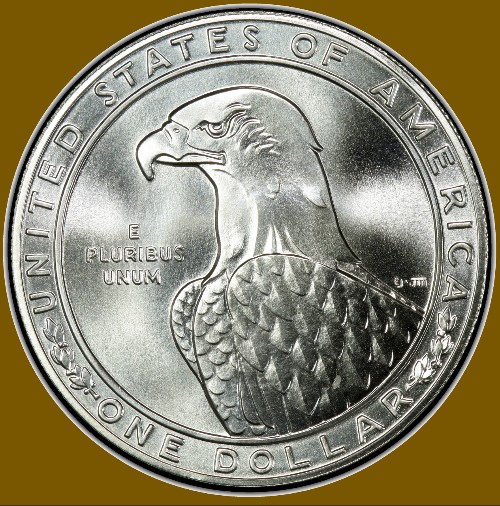
US Mint Chief Sculptor-Engraver Elizabeth Jones designed the 1983 Silver Dollar obverse and reverse; Mint Engraver
John Mercanti modeled Jones' reverse design.
1983 Los Angeles Olympic Games Silver Dollar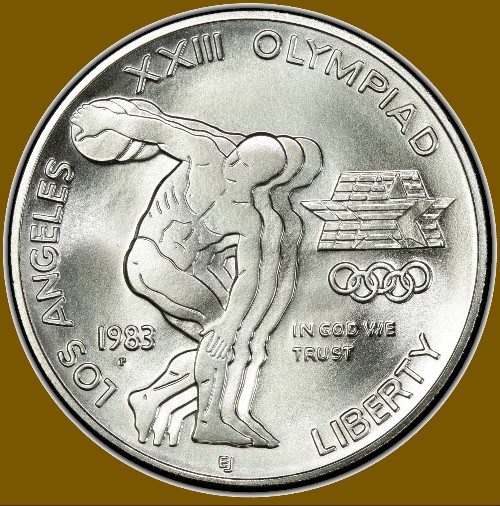
The coin's obverse presents a discus thrower, a classic Olympic athlete depicted on a variety of previous coins, medals, stamps, etc. Jones' design creates a sense of motion via a triple-layering of the depicted athlete in mid-throw. The included Los Angeles Olympics Organizing Committee logo also elicits a sense of motion via its layered stars and lines - it is referred to as the Committee's 'Stars in Motion' logo.
Los Angeles Olympic Organizing Committee Logo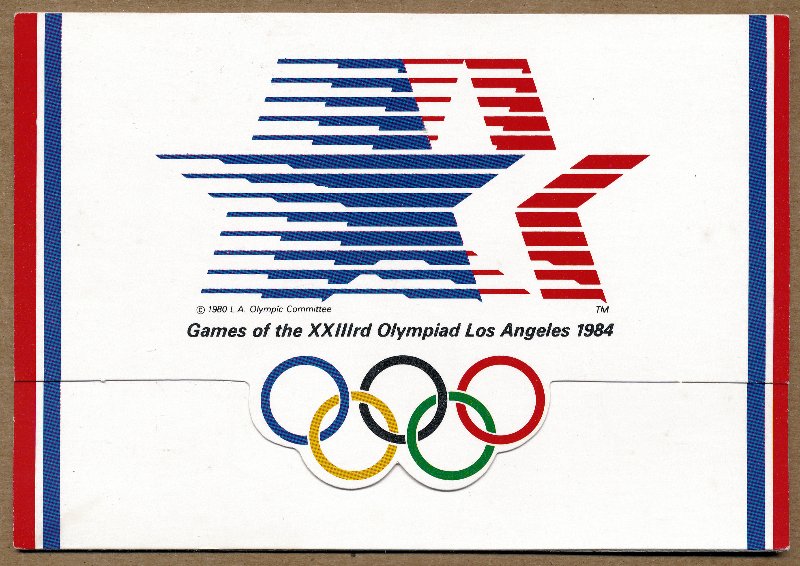
The discuss thrower design was suggested by the Secretary of the Treasury. I can't help but wonder if he was enamored by the 1978 Russia 150 Roubles Platinum coin struck as part of the 1980 Moscow Olympic coin program.
1978 Russia Moscow Olympics 150 Roubles Platinum Coin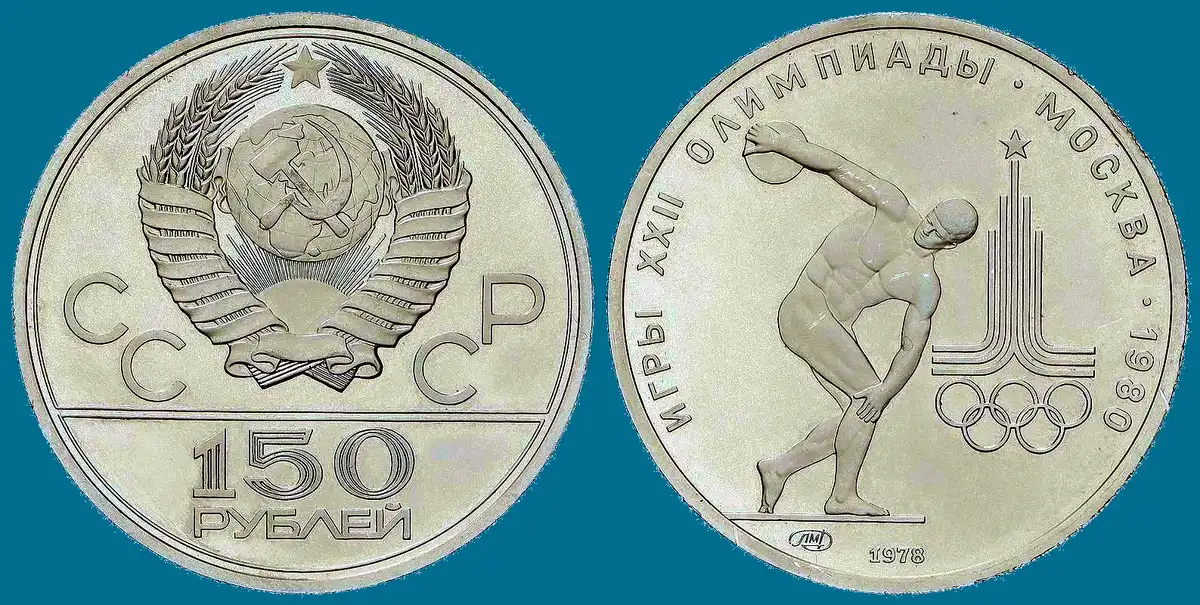 (Image Source: Soleer y Llach Auction, May 19, 2026. Lot 659.)
The US coin's reverse presents a bold, cropped view of a Bald Eagle facing left. It's a simple, uncluttered design that embodies strength of purpose for the US' Olympic athletes.
At the time of the Hearing,the Mint had received orders/pre-orders for approximately 600,000 coins. Buchanan also stated that >80% of orders were for coins that were still preliminary in design and would not be delivered until 1984 (i.e., the 1984 coins). It was a start, but there was still a long way to go if the program was to sell out its 52 million coin authorization!
Note: This initial sales volume drove the first $10 million surcharge distribution to the Olympic committees (referenced above). The Issue Price of the Silver Dollars included a $10 surcharge, the surcharge included in the Issue Price of the Gold Eagle was $50.In my next installment, I'll wrap up my discussion of the Subcommittee Design Hearing and discuss the designs of the 1984 Silver Dollar and 1984 Gold Eagle.
For other of my posts about commemorative coins and medals, including more modern commemorative stories, see:
Commems Collection 






 Posted 06/10/2026 10:56 pm


