Web Fed Dollars 1988A-1995From the first year of Federal paper money (1861) to the present numerous changes have been made to the way our money is printed. At first only four notes per sheet could be printed. Then in 1918 that number was doubled to eight to meet increased demands due to World War I. Then in 1929 there was a dramatic overhaul of US currency. Included in these changes was a standardization of size of bills, as well as note design. Because of this reduction in size note production was increased to twelve notes per sheet. Then in 1952 further breakthroughs that had been in the works since 1943 allowed eighteen notes to be printed per sheet. Finally in 1957 the Bureau of Engraving and Printing utilized dry intaglio printing to further increase notes per sheet to 32. Since 1968, all currency has been printed by means of the dry intaglio printing method, or has it?
Dry intaglio printing has a large number of steps that could make for an article all in of itself, but basically this is how it works. There are three different print phases. First everything on the back is printed. Then everything on the front is printed except the seals and the serial numbers. Finally the seals and numbers are stamped onto the bills. This is done by using the following method. First the plates used to make the bills are covered in ink. The ink is then wiped off the plates leaving it only in the recesses of the plate. Each sheet is the forced by extreme pressure, about 20 tons, into the recesses of the plate transferring the ink onto the sheets. This method is used for the first and second printing of the bills. After the second phase is done the seals and serial numbers are typographically overprinted onto the bills as needed.
Using this method about 8,000 sheets of money can be printed in about an hour. However in an effort to save money and increase printing speed the BEP in May 1992 tried an experimental method of printing ones. This method was the Alexander Hamilton Web Press. The web press can print 10,000 sheets in a 35 minute time span. As you can see it is about twice as fast as intaglio printing. The speed was achieved by printing the money similarly to printing a newspaper. The paper was all one huge roll that would be fed through the machine printing both sides of the bill simultaneously. A single sheet contained 96 notes. A huge difference when compared with intaglio printing: seemingly the ultimate way of printing.
Unfortunately problems arose with the web press. The main problem of the web press was its inability to sustain long continuous runs when compared with intaglio printing. Mechanical malfunctions plagued the web press from its institution. Paper jams were fairly commonplace. Also parts of the machine broke much more frequently than the intaglio printing press. Secondly, the quality of the prints was sub par when compared to the established method. Despite the best efforts of the BEP these problems could never be resolved in a satisfactory fashion. Sometime in July of 1996 the web press was discontinued.
The primary reason that web notes are rare is the BEP never notified the public as to their existence. They just printed them up and released them into circulation. The average life span for a dollar is between 18 and 21 months. So before most collectors were even aware of web note existence a large portion of them had already been destroyed. Another contributing cause is they look so similar to sheet fed notes unless you are looking for them they are easy to miss.
You may be asking yourself how someone tells the difference between regular and web notes. The differences are very subtle. So subtle that unless you know what you are looking for there is a very good chance you wouldn't notice any difference at all. The top note in each image is a web note; the bottom a regular sheet fed note.
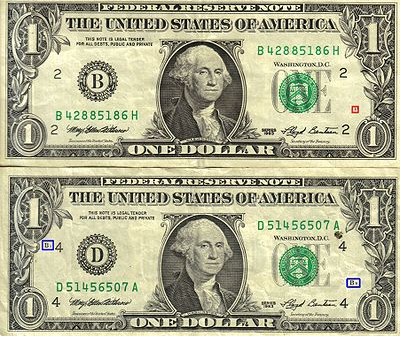
The red box indicates the face plate number on a web note which is located near the bottom right corner. The blue boxes indicate the face plate number in the bottom right corner and a position indicator number in the upper left corner on a sheet-fed note. Also, on sheet fed notes, the plate numbers are preceded by a letter; in some cases FW may precede the letter on the lower right corner; this indicates that the note was printed at the BEP facility at Fort Worth, Texas.
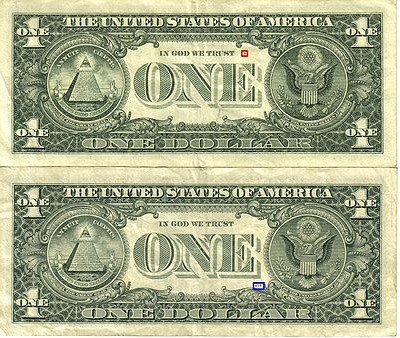
On the web note, the back plate number is just to the side of TRUST in the motto IN GOD WE TRUST (red box). On the sheet fed note, the back plate number is to the lower right corner of the central white space (blue box).
Web note collection is done by series, block, run, and finally plate combo. There were three series that web notes were released for 1988A, 1993, and 1995.
A "Block" is the letters before and after the serial number on any federal reserve note. These letters indicate what Federal Reserve Bank they were issued for. For example, look at any $1 bill ... if the serial number reads " A 23234587 C " then the block is "AC". The series of 1988A had 15 blocks released. 1993 had 2 blocks and 1995 had 5 blocks.
A "Run" is a unit of production consisting of 200,000 sheets or 6,400,000 notes unless is for a star note block: 100,000 sheets or 3.2 million notes being a star note block. There are 15 Runs to a block. Series 1988A had 38 runs. 1993 saw another 4 runs and 1995 saw an additional 8 more.
Lastly there is plate combos. The "Front and back Plate Numbers" are actual numbers printed on any web note or federal reserve note. Also referred to as a "Plate Combo". They represent actual mechanical pieces used in the printing process. There were plates numbered 1 through 10 for the front and back. There is rumored to be an 11th plate that was dropped and destroyed before it could be used. Additionally in 1995 there was a 12th back plate used in 4 different combos: however no matching 12th front plate is known. Series 1988A saw 188 different plate combos with 4 non-web combos. 1993 saw an additional 9 combos and 1995 had 43 more plus one more non web combo. New plate combos are still being discovered.
A "non-web" is a production of notes using stock from regular intaglio printing. Apparently, the BEP, either due to an error, or just because they didn't have enough web-fed notes to make a complete "stack" of 200,000 sheets used this stock of paper for the overprinting. This is a rare occurrence and only show up in Series 1988-a block B..L notes, 1988-a F Star notes, and again in series 1995 Block A..D. These notes are collectible due to their significance to the Web Press and strange mix up of the two processes.
The first run of web notes, Series 1988A block B..L run 6, had some normal sheet-fed notes mixed in. The web notes, actually making up less than a third of the run, are the last 60,000 of each 200,000 serial numbers in the run. The serial number range for this run is B 320 00001 L to B 384 00000 L. So serial numbers 320 00001 to 321 40000 are sheet-fed notes, 321 40001 to 322 00000 are web press notes, 322 00001 to 323 40000 are sheet-fed notes, 323 40001 to 324 00000 are web press notes, and so on to the end of the run. The web notes in this block are also some of the most valuable ones considered to be one of two keys of web notes. Also interesting to note even normal sheet fed notes that fall within this range are desirable because of their relation to the web notes.
The second key is the F..* block run 3. There were 640,000 web notes in Series 1988A with serial numbers in the F..* block. Their serial numbers are the last 20,000 of each 100,000 numbers from F 064 00001 * to F 096 00000 *. That is, they bear serial numbers 064 80001 through 065 00000, 065 80001 through 066 00000, and so on to 095 80001 through 096 00000. These notes were actually produced by mistake; the BEP had not intended to use web press notes as replacements. Most of the web star notes were still in the BEP's possession when the error was discovered, and so were destroyed before reaching circulation. Again sheet fed notes that fall within this range are worth more than regular stars from that year due to their relation to the web notes. Runs 1, 2, and 4 of F..* block are all sheet fed notes but are still desirable due to their connection.
Similarly, the last run of web notes, Series 1995 block A..D run 13, also had some sheet-fed notes mixed in. In this case, the run consists mostly of web notes; the sheet-fed notes are only the first 20,000 of each 200,000 serial numbers in the run. This run covers serial numbers A 768 00001 D to A 832 00000 D. So serial numbers 768 00001 to 768 20000 are sheet-fed notes, 768 20001 to 770 00000 are web press notes, 770 00001 to 770 20000 are sheet-fed notes, 770 20001 to 772 00000 are web press notes, and so on to the last web note, A 832 00000 D. It probably won't surprise anyone that the non-webs in this block are also collectible.
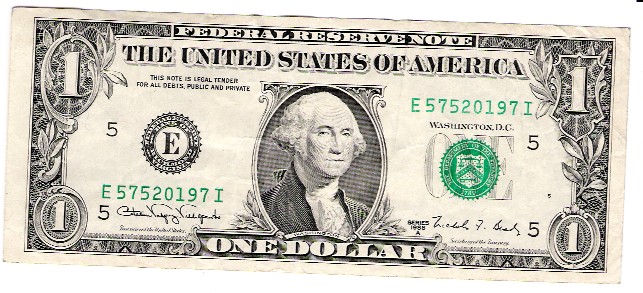
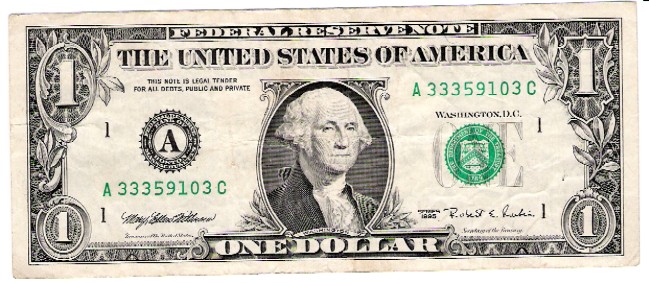
Keep your eyes open cause they can still be found very rarely in circulation. I personally have 2 web notes both of which have been found in circulation. The first a 1988A E..I block which was found in a strap of ones from the bank. The second is a more common 1995 A..C block which was handed to me by a customer where I work. Just one more thing to look for before you spend your money

.





 First Page


 Posted 09/21/2009 10:17 pm


 I didn't think about cut and pasting... I typed it out over 3 pages on Microsoft Word...





